MYANMAR
As a Blockade and a Global Hunger for Minerals devastated MYANMAR

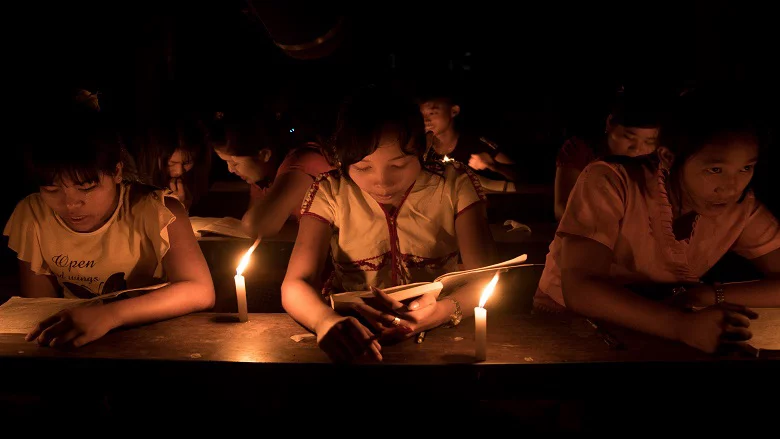
Young Students under candle lights at nights
© Tagu FilmsBy 2030, the EU must slash emissions by 55% while Germany targets 15 million EVs on its roads—up from just 2.3 million in 2023. That leap demands six times more rare earths and twelve times more lithium. But decades of processing those metals have left toxic, thorium‑laced waste seeping into soils and groundwater, poisoning farmlands, displacing herder communities, and threatening both ecosystems and human health. Is our climate solution sowing a poisoned harvest?
In April 2026, at the height of the fuel price crisis—just weeks after the Strait of Hormuz closed on 28 February—a 28-year-old father on the outskirts of Yangon made the most painful decision of his life. He gathered his two children and told them they could no longer go to school. The money that once paid for their uniforms and books now had to buy rice. (Asia News Network, 2026). For most of the world, the Hormuz closure meant higher oil prices; for Myanmar, which imports over 90 percent of its fuel oil, it was a catastrophe.
Where is Myanmar?
Since antiquity, Myanmar has served as the critical land‑bridge between China and the Indian Ocean along the Southern Silk Road. By the 1st and 2nd centuries CE, caravans moved from Chengdu through Yunnan into Myanmar and onward to India—a route so vital that Roman envoys to China in 97 and 121 CE deliberately chose it (Gyan, 2023). The passage still captivated Marco Polo in 1282, who described Bagan—which he called "Mien"—as a city of gilded towers and silver spires (English School, 1921).
Economic Collapse
Myanmar's economic collapse is most starkly visible at the petrol pump. Despite importing mineral fuels as its top category, the country lacks domestic refining capacity, leaving it exposed to global shocks—when the Hormuz blockade hit, the price of widely used 95 Octane petrol surged 115 percent above pre‑crisis levels. For a government clerk earning just €60 per month, filling an 80‑liter tank for a private vehicle now costs €80—more than a full month's salary. At peak shortages, queues for the next morning's fuel begin forming the night before, snaking through Yangon's streets long after the midnight curfew falls. Yet Yangon, the former capital and most developed city, has banned motorcycles since 2003 without justification, forcing residents into a public transport system so unsafe and inefficient that the German Embassy officially advises its INGO partners against using it. Inflation hit 24.6 percent in April 2026, fertilizer imports have been halved—slashing farm output by 15 percent—and garment factories are closing en masse. The regime's rationing measures, like alternating vehicle plate numbers, are cosmetic at best; the military's true priority is stockpiling fuel for jet airstrikes against revolutionary‑held regions, leaving commercial flights suspended indefinitely. Myanmar is not merely struggling—it is cannibalizing its own future to preserve a crumbling regime.
Human Security Deterioration
Human security in Myanmar is unraveling at an alarming pace. Food insecurity now grips 12.4 million people—nearly a quarter of the population—as the price of rice, the national staple, has surged 20 percent (WFP). Since the 2021 military coup, armed conflict has claimed over 100,114 lives as of July 2026, according to ACLED, while the UN has verified 702 civilian deaths from airstrikes between August 2025 and January 2026 alone, warning that dwindling international assistance only deepens civilian suffering. The healthcare system, already fragile, has collapsed under military blockades and funding cuts, leaving millions without access to even basic emergency care. Despite repeated international appeals, the ASEAN‑coordinated humanitarian corridor—designed to reach conflict‑affected regions regardless of political allegiances—has remained blocked by the ruling regime for over five years, a stark testament to the regime's indifference to civilian lives. The tragedy crystallized in a single, heartbreaking image: an airstrike on Oe Htein Kwin village that killed 20 children and two teachers—a wound that will haunt Myanmar for generations.
Geopolitical Realignments & Rare Earth Dependency
Myanmar now stands as China's single most important external source of rare earths, supplying a staggering 60 to 87 percent of its annual imports—a trade that generated over USD 4 billion between 2017 and 2024, with a staggering 84 percent flowing after the 2021 military coup (ISP Myanmar). In 2024 alone, China accounted for 70 percent of global rare earth production, cementing its stranglehold on the minerals essential for EVs, wind turbines, and advanced defence systems. Yet this dependency exposes a profound ethical paradox: Western governments publicly sanction Myanmar's ruling junta while quietly consuming the very minerals that fuel its war machine, as the New Indian Express has starkly observed. Nowhere is this contradiction more acute than in Kachin State, the global epicentre of heavy rare earth mining—dysprosium and terbium, the lifeblood of clean energy technologies. There, the Kachin Independence Army has seized control of mining operations and imposed its own taxes, a power shift that promptly sent terbium prices spiking 21 percent. The West's green future, it seems, is being forged in Myanmar's conflict zones, where the price of progress is measured not in euros or dollars, but in the blood of a nation tearing itself apart.
Resurrecting Ancient Corridors: China and India's Strategic Imperative
Today's infrastructure projects are, in effect, a resurrection of trade routes that are millennia old. These ancient corridors once carried Indianized culture and religion alongside Chinese statecraft and ideology, shaping what is now the Indo-China Peninsula and, by extension, Southeast Asia. What is unfolding now is not merely a contest for economic prosperity — it is a contingency strategy against a global order increasingly prone to disruption by political rivalry, arms competition, and historical fault lines that put millions of lives at stake.
China's Malacca Dilemma

China-Myanmar Economic Corridor links landlocked Yunnan in southern China to Kyaukphyu, a deep-sea port on Myanmar's western coast — a route designed to bypass the Strait of Malacca entirely. The "Malacca Dilemma" refers to China's structural dependence on this narrow chokepoint linking the Indian Ocean to the South China Sea: more than 60,000 vessels pass through it annually, carrying roughly a quarter of global maritime trade and some 80% of China's crude oil imports. Hu Jintao, then General Secretary of the Chinese Communist Party, coined the term in 2003 to capture Beijing's anxiety over piracy, maritime terrorism, and the risk of geopolitical disruption — particularly at the hands of the United States.
India's Answer: The Kaladan Project
India's Kaladan Multi-Modal Transit Transport Project connects Kolkata to Mizoram via the port of Sittwe, offering an alternative to the vulnerable Siliguri Corridor. Known as the "Chicken's Neck," this 17–22 km wide, 60 km long strip of land in West Bengal — hemmed in by Nepal, Bangladesh, and Bhutan — is India's only terrestrial link to its eight northeastern states, a lifeline for more than 40 million people.
Sittwe itself, formerly Akyab, is no newcomer to global trade. It hosted a US Consulate Agency under the American Consulate General in Kolkata as early as the 1860s, when Myanmar was still British Burma, and the British later developed it as a deep-water port. Historical photographs even show Mercedes-Benz showrooms displaying the latest models in early twentieth-century Sittwe — a level of commercial sophistication Yangon, Myanmar's most developed city today, still cannot match.

After Bangladesh's independence from Pakistan, it became strategically logical for India to pursue a direct, cost-efficient route to Myanmar that bypassed Bangladeshi customs control altogether. The India–Myanmar–Thailand Trilateral Highway, stretching 1,400 km, extends this ambition further east, linking India by land to the whole of mainland Southeast Asia.
The Armed Groups Holding the Keys
Yet both projects run through territory these two capitals do not fully control. The Arakan Army holds the ground along the Kaladan route, while the Kachin Independence Army controls the rare-earth-rich north. The long-term viability of these corridors depends less on Naypyidaw's central authority than on engagement with the armed ethnic organizations that now physically hold the trade routes — populations with distinct identities and interests from Myanmar's Bamar-majority heartland.

Without ethical engagement, Europe consumes conflict minerals.
EU-Germany Engagement Imperative
The European Union sanctions Myanmar, yet quietly relies on it for 60 to 87 percent of its heavy rare earths—a trade worth over USD 4 billion since 2017. That contradiction deepens as Germany, the EU's industrial engine, spent more than €24 million on Chinese rare earths in 2025—double the previous year—with China now the sole gatekeeper for minerals critical to EVs, wind turbines, and defence, raising palpable security concerns. European due diligence laws, including the Supply Chain Act, mandate risk tracking, but supply chains remain stubbornly tangled in Myanmar's conflict zones, where irresponsible mining has left a trail of poisoned water, respiratory diseases, devastated farmlands, and displaced communities. Yet a responsible path forward exists. Through ASEAN, with its non‑interference ethos and its SDG roadmap grounded in the 5 Ps—People, Prosperity, Planet, Peace, and Partnership—Europe can pursue de‑risked, ethical partnerships that tap into Myanmar's young workforce and strategic trade routes without perpetuating exploitation. Full traceability and genuine local consent are not bureaucratic niceties; they are the moral floor for any credible green transition. If Europe wants its EVs and defence without blood and poison, it must engage ASEAN not as a passive consumer, but as an accountable partner—lest its climate triumph be forever shadowed by a human‑rights failure.
A distant war and a global hunger for Myanmar’s minerals are rewriting Myanmar's future, demographics and sovereign landscapes. As the world cannot forgo EVs, fighters, or mobile handsets, establishing a responsible, fair-trade supply chain of critical minerals with Myanmar relevant actors through sustained ASEAN coordination is non-negotiable.
*Thiha published papers on topics of Ethnic Reconciliation, Peacemaking, Human Security Deterioration in Myanmar and Compliance of Social Contract Theory by the Rakhine State Government. His areas of expertise are Security, Trade and Peace.