International
New Studies on Cuba and Nicaragua:

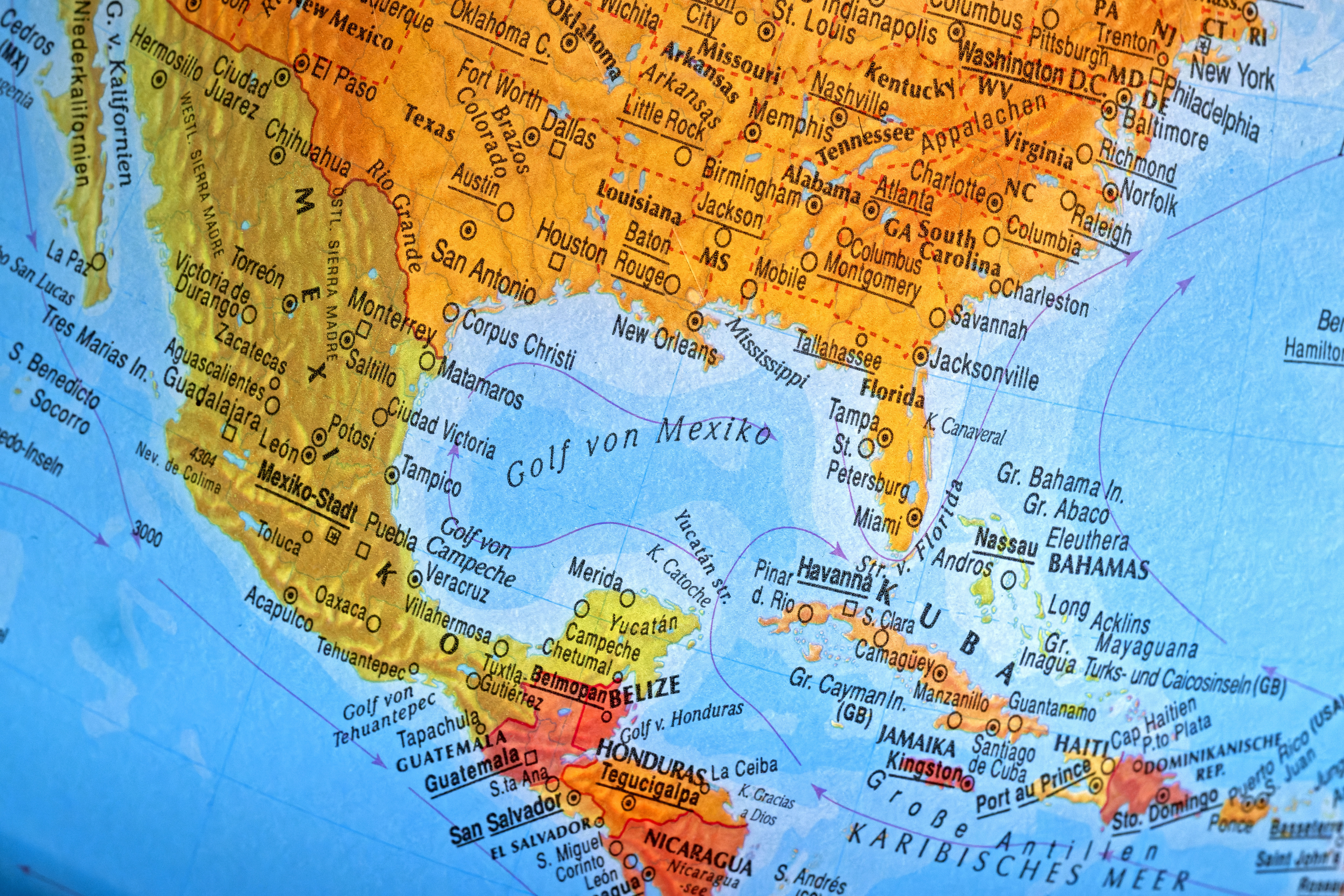
Karte des Golfs von Mexiko
© picture alliance / M.i.S. | Bernd FeilBerlin – Following the arrest of Venezuelan leader Nicolás Maduro, international pressure on the authoritarian regimes in Havana and Managua is mounting. Against the backdrop of ongoing political, economic, and humanitarian crises, the Friedrich Naumann Foundation for Freedom has published two new strategy papers on possible political transitions in Cuba and Nicaragua.
The analyses show that both regimes continue to respond to increasing instability with repression. For Cuba, the scenario analysis points to clear indications of a regime change, as three out of four scenarios suggest a political upheaval. In Nicaragua, however, the situation is less clear-cut: Only two out of three scenarios point to a regime change, which is why a stabilization of the authoritarian status quo is currently the more likely outcome there.
In Cuba, approximately 1,260 political prisoners have been documented—the highest number since records began. In Nicaragua, the Ortega-Murillo regime has driven more than 800,000 people into exile and stripped opposition figures of their citizenship since 2018. At the same time, the country’s economic stability does not rest on industry or innovation, but largely stands on remittances from abroad, which are projected to account for around 30 percent of gross domestic product by 2025.
Against this backdrop, Dr. Maren Jasper-Winter, member of the Executive Board of the Friedrich Naumann Foundation for Freedom, states:
“We liberals stand firmly alongside civil society in Cuba and Nicaragua. The people there should be able to decide freely about their future. Europe must take a clear stand: end oppression, release political prisoners, and enable freedom. Solidarity is with the people, not with dictatorships.”
Reflecting on Germany’s history, she adds:
“In Berlin, we made history and proved that no wall, no unjust state, and no authoritarian regime lasts forever. Those who live in freedom must not turn a blind eye to oppression elsewhere.”
Felix Maradiaga, president of RELIAL, a former political prisoner, and author of the Nicaragua strategy paper, warns:
“The greatest short-term danger is not that the dictatorship will fall tomorrow. It lies in its end being delayed: that Ortega leaves, but the structures of control remain in place.”
Carolina Barrero, founding director of Ciudadanía y Libertad, Sakharov Fellow, and author of the Cuba paper, emphasizes:
“A window of opportunity for change guarantees neither democracy nor stability. Without the participation of civil society, transitions risk reproducing authoritarian systems in new forms.”
Both authors call for targeted sanctions against those responsible, a clear linking of international cooperation to reforms, and stronger mechanisms for addressing human rights violations.
The studies conclude that sustainable democratic change is only possible with a strong civil society. Transitions driven solely by the elite carry the risk of authoritarian continuity.
Dr. Maren Jasper-Winter comments:
“True change can only succeed if civil society plays a leading role and is not marginalized. A pseudo-transition would not represent progress but would breathe new life into authoritarian structures. We must not allow that to happen.”
Both studies can be downloaded for free here: