LGBTQ
Why Same-Sex Co-Ownership Is About More Than Property

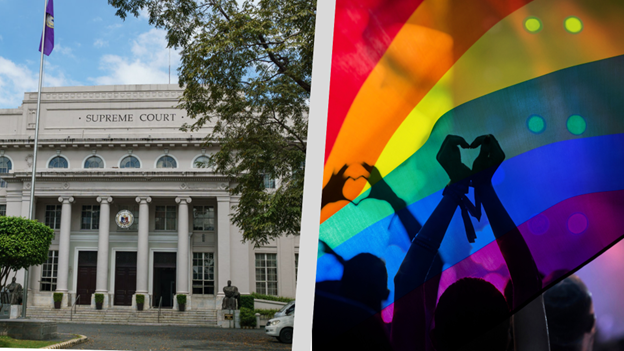
Philippine Supreme Court. © Flickr, LGBT flag. © Ibrar Hussain / Canva
In the 1800s, the French liberal political economist Louis Wolowski challenged the idea of property as mere possession, instead describing property as a “sacred” (sacrée) extension of the owner’s personhood. For Wolowski, this sacredness did not denote mysticism, but rather the externalization of one’s faculties, labor, sacrifice, and choices. When a person works on property, alters it, and builds a life around it, “a fragment of his person” is left in the property itself. The wealth produced by the owner through his property, he concludes, “is still himself.”
Despite the seeming distance between Wolowski and our time, the full realization of property rights and the recognition of the person in the property remains elusive for much of the Philippines’ LGBTQ+ community. However, a significant ruling marked a step forward when the country’s Supreme Court clarified in February 2026 that Filipino same-sex couples may be recognized as property co-owners under Article 148 of the Family Code, provided there is proof of actual contribution.
In a country embroiled in a decades-long march for gender equality, the ruling—which itself took a decade to reach resolution—this development carries far-reaching consequences for Filipino liberals’ broader pursuit of freedom and equality in the economic, social, and political spheres. Prior to the ruling, Filipino same-sex couples may have hesitated to pool resources for a house, rental property, small business space, farm lot, condominium, equipment, or other income-generating asset, because the legal protection for the contributing partner was uncertain. The ruling reduces that uncertainty by clarifying that each party’s actual contribution may be recognized even in the absence of marriage. In doing so, the Supreme Court made joint investment less legally risky for same-sex couples.
Socially, the concurring opinions of the justices indicate a growing legal recognition of same-sex relationships as part of Philippine social reality. Justice Leonen emphasized that Article 148 does not distinguish based on gender and warned that excluding same-sex couples would render some intimate relationships “legally invisible.”
This legal visibility matters because many same-sex partners remain economically vulnerable in moments of conflict, either after separation, during inheritance disputes, in confrontations with relatives, or in situations involving care, illness, or death. Same-sex partners are often treated as strangers because they are “not really family” under the law. While the ruling does not eradicate the larger legal inequalities that remain, it gives same-sex partners a property-based claim. It sends a bold message that no property title, romantic breakup, or family pressure can wipe off decades or a lifetime of joint hard work.
While such legal visibility grants immense practical benefit, it is also where Wolowski’s philosophical insight becomes particularly enriching. If property carries a fragment of the person who labored for it, then the Court’s ruling does more than settle a technical question of co-ownership. It recognizes the self whose labor, creativity, and personality gave shape to the property — this “fruit of human liberty” that is “an emanation from [their] being.” It is the same self through which LGBTQ+ people have long animated Philippine society with color, talent, labor, and life. For same-sex couples, this recognition affirms the personhood behind property formed within relationships that Filipino society has too often resisted, moralized against, or condemned as sinful.
Politically, the ruling also gives same-sex couples a stronger stake in public life. As more couples assert property rights, enter contracts, acquire homes, and defend their interests in court, they become more visible not only as members of a marginalized community, but as rights-bearing citizens with assets, obligations, and claims before the law. The positive feedback loop between property rights and wealth creation may, over time, give same-sex couples and the broader LGBTQ+ movement greater means to organize and advance their rights in public discourse and policymaking.
Across history, excluded groups have often claimed their place in society through the long struggle to secure property under the law. Commoners who became landholders gained a more visible stake in political affairs, especially where landownership was tied to civic participation. Meanwhile, women who fought for the right to own, inherit, and manage property helped lay the foundation for the suffrage movement. Later generations of property-owning women, now with separate legal identities and greater economic independence from their husbands, went further in challenging the idea that their social lives should be absorbed into the household.
They did not gain freedom all at once, but claimed it gradually through institutions that began to recognize their right to property. Seen this way, the ruling is a step in the long journey of same-sex couples to protect what they have built and demand greater equality and freedom to pursue their goals. Ultimately, property rights—and the wealth they generate—are tied to one of the most intimate human aspirations, including for same-sex couples: the ability to build a home and nurture a family.
This does not mean complacency, however. Even with this legal and philosophical visibility, the ruling still falls short of the rights that same-sex couples deserve. The justices themselves acknowledged the limitations of the ruling, as it remains a litigation-based protection. A partner may still need to go to court to enforce the right. Given the realities of the country’s judicial system, this can be costly, slow, and emotionally difficult. Couples with fewer resources remain vulnerable if they lack written proof or cannot afford litigation. The onus, then, is on Congress to address the broader questions of policy surrounding same-sex couples’ rights—and on us, to continue advocating with them for their rights and freedoms.
*Cesar Ilao III is Research and Communications Lead at the Foundation for Economic Freedom (FEF) in Quezon City. He is also a lecturer at the University of the Philippines Los Baños.