Romania/Moldova
Union between Romania and the Republic of Moldova: Common Memory and European Destiny (part II)
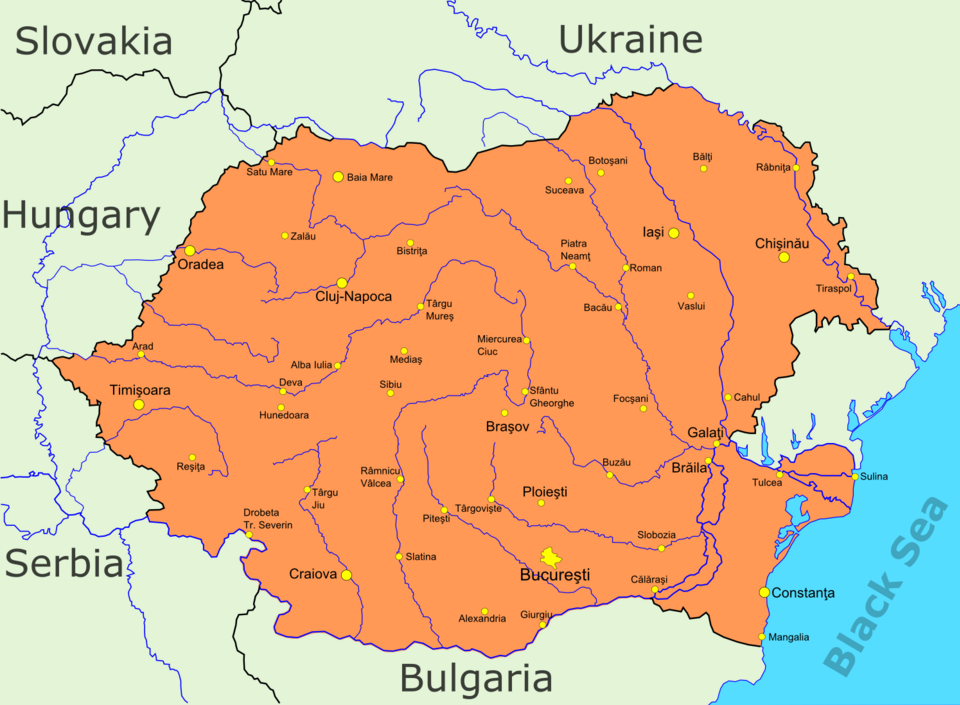
Map showing a potential union of Romania and Republic of Moldova, including Transnistria.
© WikipediaToday, the Republic of Moldova has many advantages: it has had an association agreement with the EU since 2014, visa liberalization for its citizens, and many of them already have a Romanian, therefore EU, citizenship. From a strictly political point of view, the government is aligned with Brussels' positions regarding the desire to pursue reforms within the country, but also on the geopolitical level. Chisinau and the main European capitals are converging on the issue of support for Ukraine. For the Republic of Moldova, the defense of Ukrainian sovereignty is an almost vital interest, as the direction taken by the current government would be greatly affected by a defeat of Ukraine and the installation of a pro-Kremlin regime in Kyiv. Beyond the European Commission, the Republic of Moldova maintains very good relations with EU Member States, especially Romania. Their own European integration is a model for pro-European Moldovans, who see how much Romania has benefited from the single market, structural reforms and European investments.
However, Chisinau faces many difficulties: first, the question of its own territorial integrity. Transnistria is still de facto independent, and even if the separatist administration in Tiraspol is considerably weakened the ties to Russia are still strong. The Kremlin recently said it would distribute Russian passports to many inhabitants of this region. But Russia's threats against Moldova are hybrid, and therefore diverse: disinformation during election campaigns, corruption of voters (notably during the referendum on EU membership), an end to energy deliveries, cyberattacks, infiltration of certain state services, etc. These threats significantly weaken political and economic stability in the Republic of Moldova, even if it enjoys European support. While Sandu and the PAS were re-elected, they also know that the situation is very fragile because of the both internal and external hostility.
Finally, Chisinau faces a dilemma regarding Ukraine's accession to the EU. Should they hope for joint membership (as Romania and Bulgaria did in 2007), and if so, wait to know more about the outcomes of the war? Or should they expect the Commission to "decouple" the Moldovan and Ukrainian candidacies, in order to be more independent in its accession process?
EU membership seen as a necessity in Chisinau
The challenges in terms of development, particularly agriculture, in the Republic of Moldova are still very significant. Even if the Commission seems willing to integrate Moldova into the EU in a few years, the process is still in its initial phase. However, Moldovans also know that their choice is quite limited: if the horizon of EU membership is receding, the danger of a return to Moscow's orbit is likely. The outcome of the war between Ukraine and Russia is still uncertain, so it is difficult for this neighboring country to adapt to every conceivable scenario.
In this perspective, the unionist movement is progressing. The Republic of Moldova has officially turned the page on "Moldovenism", in particular by accepting the official language as Romanian, and by celebrating it on August 31 as ‘Our Romanian Language Day”. The date refers to the moment the MSSR Assembly adopted Romanian as an official language and the Latin script instead of Cyrillic. During an interview on the British podcast The Rest is Politics on January 12, 2026, Maia Sandu stated that she supports a unification between the two countries. She acknowledged that this view is still largely rejected in her country and that the priority is joining the European Union. A growing number in the population supports this idea. The fact that so many Moldovan citizens also have Romanian citizenship makes this issue even more evident among the population. At the same time, a union with Romania is increasingly being discussed in practical terms as an alternative to EU accession—as a “Plan B,” as Deputy Prime Minister Eugen Osmochescu put it. He said Moldova would “consider” this option if the EU accession process stalls after 2028.
Moldova’s EU accession was established as a strategic national goal following the referendum on October 20, 2024. The constitutional amendment, which enshrines the country’s European future, was narrowly approved with 50.35% of the vote. However, the vote reveals a clear divide: 77% of the diaspora voted in favor, compared to only 45% within the country. The situation is similar in polls on unification with Romania: Overall, 47% support this move—44% within the country and 61% in the diaspora (ATES Research Group, March 2026).
The paradox of Romanian sovereigntism
The question of the union between Romania and the Republic of Moldova becomes very complex when we look at Romanian public opinion. The latter is much more supportive of the union (more than 71%), considered as the repair of a historical rupture. In general, opponents of this idea point to the economic difference between the two countries, which would cost the Romanian taxpayer dearly.
But in Romania, the question of the Republic of Moldova, also framed as Bessarabia, is associated less with the geopolitical evolution of the region and the EU-Russia rivalry than with nostalgia and nationalism. Thus, the main Romanian far-right party, the Alliance for the Unity of Romanians (AUR), uses this issue as the basis of their doctrine. The former anti-establishment presidential candidate Calin Georgescu was also a defender of Romania "from the Tisza to the Dniester", thus including the current Republic of Moldova.
However, both George Simion's AUR and Calin Georgescu adopt clearly pro-Russian positions, and a discourse hostile to the European Union. The last elections in Romania showed Russian interference in favor of this type of candidates. But then, how can we explain this convergence of interests between Romanian nationalists in Bucharest, who say they want to reintegrate Bessarabia into a restored Greater Romania, and Russians in Chisinau, who feed a discourse denying the Romanian identity of the Republic of Moldova and use the question of unification as a scarecrow?
First, the objective of this information war is to divide societies, Romanian as well as Moldovan, in order to weaken two governments that are openly pro-European and stand in solidarity with Ukraine. Secondly, the interest for the Russians in supporting sovereigntism in Romania is to fuel an anti-Ukrainian discourse among Romanians. This initial incoherence of the understanding between Moscow and the Romanian sovereigntists might be ignored because of the shared hostility towards Ukraine; but it remains a deep incoherence. Hence in a poll among the Romanian population concerning unification with the Republic of Moldova, the supporters of the Alliance for the Unity of Romanians are the ones who reject this project the most (26% clearly against unification, against 21% on national average), even though it is literally invoked in the party's name.
The outlook of unification
From a legal point of view, unification between Romania and the Republic of Moldova is theoretically possible. If we take the example of Germany in 1990, we notice that the former GDR has been integrated into the FRG, the EEC and NATO. But today, this project would inevitably require a referendum, at least among the Moldovan population. But this subject is still very divisive within the European Union, and therefore it is difficult to defend politically per se. That is why the most likely scenario for unification is one in which the Republic of Moldova would be slowed down in its accession procedure, while at the same time being increasingly exposed to the risk of open conflict, for example in Transnistria. Moreover, we should not exclude the possibility that the unionist hypothesis is a signal sent by Maia Sandu to the EU, in order to reaffirm the objective of Moldova's rapid accession, which would be decoupled from the negotiations for Ukrainian membership. At the same time, her pro-unification declaration in January 2026 is also analyzed as a point given to the unionists in the Republic of Moldova, who are a significant part of her electorate.
If this union seemed unfeasible a few years ago, it is now back in the midst of debates in both countries. Given the upheaval that this would be, it is safe to say that it will not happen in the short term. The "plan B" dimension in the case of an overly long accession process is undoubtedly the strongest argument for this project; massive support in both countries (from which we are still a long way from in the Republic of Moldova) for this project would not be the only key to the realization of the Union, but only the effective starting point.
About the author: Martin de La Garanderie is a specialist in European affairs and international relations. He is a graduate of the College of Europe in Natolin, Poland; the Faculty of Political Science at the University of Münster in Germany; and Sciences Po Lille in France. He has worked at the European External Action Service (EEAS) in Brussels and with several think tanks. He is currently an intern at the Friedrich Naumann Foundation for Freedom in Romania and the Republic of Moldova.