Summit in China
Europe Caught in the Crossfire

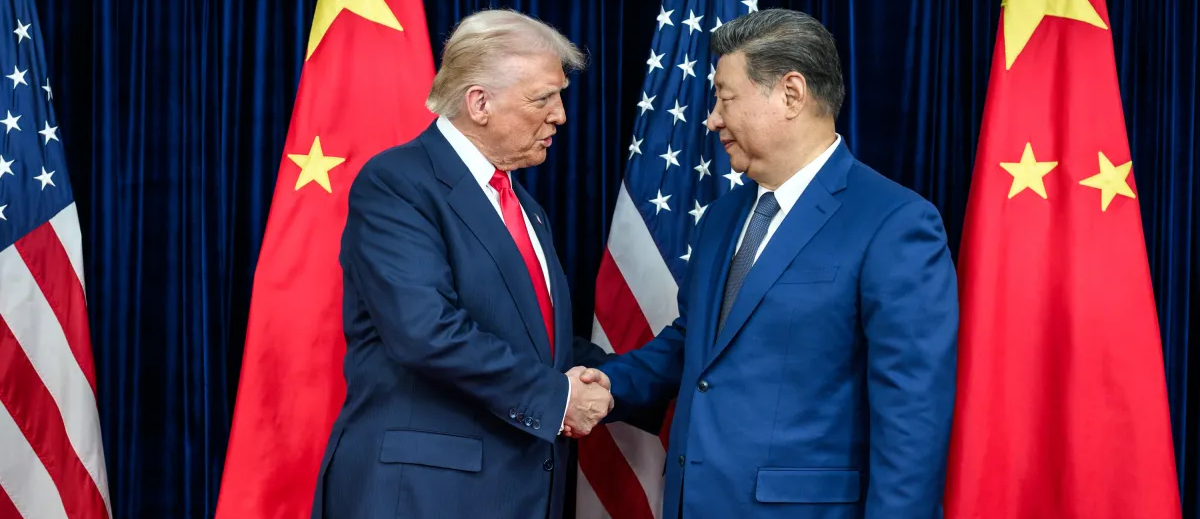
Trump und Xi in Busan/South-Korea im Oktober 2025.
© The White HouseWhen US President Donald Trump meets his Chinese counterpart Xi Jinping this week, Europe is not on the agenda. Nevertheless, the outcome of the meeting is likely to have consequences for the continent.
In their rhetoric, both superpowers are signalling a willingness to compromise. However, the latest regulations and legislative initiatives from both countries do not in any way point to a thaw in relations. Rhetorically, tensions are being defused, but legally, they are being escalated. Collateral damage to Europe’s economy is being accepted as a necessary evil, or is even being welcomed.
The US Congress is currently working on tightening export controls. Representatives from both parties are pushing ahead with the MATCH Act. MATCH stands for “Multilateral Alignment of Technology Controls on Hardware”. With this legislation, the US aims to further restrict China’s access to chip manufacturing equipment, thereby safeguarding US dominance in the semiconductor and AI sectors.
The MATCH Act stipulates that allied nations must demonstrate progress on comparable export controls within 150 days. If they fail to do so, the US could enforce its rules via the Foreign Direct Product Rule. This would mean that foreign products would also be covered if they rely on US software or US components. This is the case for almost all high-tech products.
Another key player is the Dutch group ASML, whose machines are indispensable for the manufacture of modern chips. The company is one of the most valuable in Europe and is also supplied by German technology firms.
China fights back
The US export controls are a continuation of the policy initiated under US President Joe Biden and are just one example of several initiatives. What is new is the determination with which China is resisting American pressure, whilst also putting European companies in a tight spot.
In April, the Chinese State Council issued two regulations that are causing concern among American and European companies operating in China. Decree No. 835 aims to block the effects of foreign laws and sanctions on Chinese soil. Anyone complying with these foreign rules may face sanctions in China in future. China is thus fighting back against precisely what the MATCH Act seeks to achieve: US control over foreign technology flows to China.
Decree No. 834 expands China’s powers to take action against foreign companies and executives if their conduct is deemed a threat to China’s industrial and supply chain security. This could also affect Western companies if they intervene in Chinese supply chains or relocate production for compliance or de-risking reasons.
For European companies, this means that if they comply with US export controls or attempt to reduce their dependence on the People’s Republic, they may face legal difficulties in China. If, on the other hand, they ignore these requirements, they will face sanctions from the US.
It is not yet clear how China will interpret its new rules. In the past, the People’s Republic has already exerted pressure on some Western companies and their management, for example through travel bans or sanctions. Such cases are becoming increasingly frequent. As recently as April, China placed seven European defence companies on a sanctions list for exports to Taiwan, including the German firm Hensoldt AG.
Trump, Xi and their close advisers will certainly discuss these issues. Following a preliminary meeting ahead of the summit, US Treasury Secretary Scott Bessent has already criticised the new Chinese regulations. However, it is unlikely that there will be any substantial breakthroughs on these issues. The interests of the two superpowers are simply too diametrically opposed. The US wants to contain China technologically and economically.
China, on the other hand, is seeking to further strengthen its state-supported export-oriented economy and reduce its technological dependence on the US.
The aim is to buy time
Trump and Xi are likely to announce a few deals following their summit. It is possible that China could order Boeing jets and promise to buy more American soya beans. In Europe, however, we should not be blinded by the ceremonial images that will be broadcast around the world from the summit in Beijing, but rather view the results for what they are: Trump and Xi are buying time to make their economies less dependent on one another and to prepare for potential more serious conflicts between the two countries.
Europe, too, should use this time to make its own economy more resilient to potential shocks that are bound to arise sooner or later as a result of the dispute between the superpowers. It has demonstrated, at least in part, that it can stand up for itself in times of crisis, as seen in the trade dispute with the US. The EU was able to negotiate significantly better deals with the US than, for example, South Korea or Japan. A united front towards Washington can be effective. As a large single market, the European Union has negotiating power if it uses it strategically.
Europe needs transatlantic cooperation, but must not allow itself to be subordinated. When it comes to relations with China, de-risking remains important, but it must be driven by a European strategy rather than under American pressure. Otherwise, Europe would not be helping to shape the new world order, but would instead be managed — by both Washington and Beijing.
*Frederic Spohr heads the offices of the Friedrich Naumann Foundation in Taipei and Seoul