Serbia
Aleksandar Vučić's resignation is merely a charade

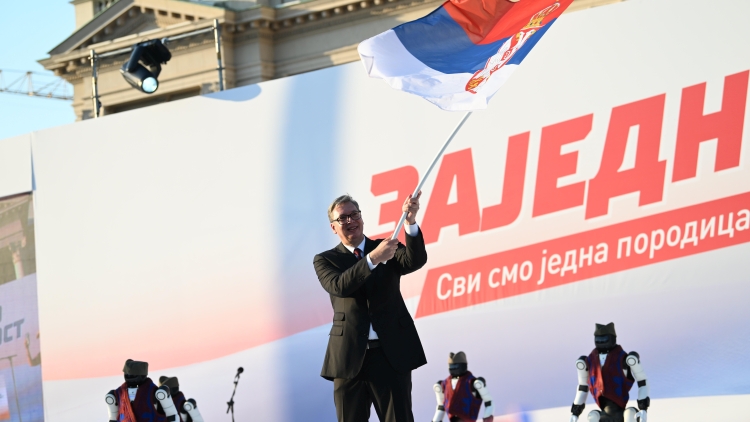
Aleksandar Vucic
© picture alliance / Anadolu | StringerOver the weekend, Aleksandar Vučić announced that he will be resigning as President of Serbia in the upcoming weeks. Anyone who thinks he is thereby bowing to pressure from the streets and stepping down simply does not know Aleksandar Vučić very well.
According to its constitution, Serbia is a parliamentary democracy. Apart from ceremonial duties, the President has few powers: he is authorised to appoint, promote and dismiss army officers, to dissolve Parliament and to call elections. The President’s role is essentially ceremonial.
This, however, bears no relation to the reality in Serbia: here, Aleksandar Vučić calls the shots on everything. As president, he attends cabinet meetings and tells the government which laws to pass. He determines foreign policy, oversees economic policy, opens sections of motorway and tells the citizens of Serbia what to think – and sometimes he even explains the weather. By the end of May, Vučić had already appeared live on television 167 times, with an average speaking time of around thirty minutes. All power is concentrated in the office of the President, whilst his Serbian Progressive Party (SNS) has made the state its prey.
Ever since the collapse of a railway station canopy in Serbia’s second-largest city Novi Sad, in November 2024, killing 16 people, large sections of the population have been protesting against the party’s takeover of the state and the corruption associated with it. They are demanding that the institutions fulfil their constitutional mandate. For the first time, Aleksandar Vučić finds himself facing a movement that could pose a threat to him and his hold on power.
Vučić is stepping down, but by no means leaving politics
Furthermore, Vučić faces another problem: as president, he is barred from standing for re-election after two terms in office. To remain in power, he would therefore have to return to the post of prime minister, a role he previously held from 2014 to 2017. His nine years as president were characterised by the party’s takeover of the state, links between members of the government and organised crime, an erosion of media freedom and setbacks in Serbia’s integration into the EU. It is hardly surprising that, as president, he maintained excellent relations with Viktor Orbán.
At a large party rally on Saturday, at which he appeared in his capacity as President, he therefore announced his resignation from the presidency “within the next few weeks”. This keeps all his options open: following his resignation as President, he could theoretically become Prime Minister even without a snap general election – the governing majority in parliament can appoint him to the post.
Another option would be for Vučić to call a general election and head the SNS list himself. As president, he can order this with 40 days’ notice. In the past, this has allowed his party to enter the election campaign in the best possible shape, whilst all his opponents were taken by surprise by the election date.
The risk remains incalculable
This time, however, the SNS and Aleksandar Vučić find themselves facing a new situation: the student movement, which has been organising the protests for the past year and a half, has announced its own technocratic electoral list. And for the first time in his reign, which has now lasted a decade and a half, Vučić is hesitating to call a snap election. Whilst in the past he has used elections to re-legitimise himself and the SNS, this time the party is not certain that it can actually win the largely unfree parliamentary elections, despite its influence.
But time is running out: the presidential term ends in April 2027. To avoid finding himself in an uncontrollable situation shortly before the deadline, Vučić must make the move to the office of Prime Minister beforehand. And for the first time, his nationalist movement is being challenged by an equally strong movement that wants to put an end to the unconstitutional behaviour of the past fifteen years. Virtually every Serbian man and woman is convinced that things are going to get dirty in the process.
Markus Kaiser is project director for the Western Balkans at the Friedrich Naumann Foundation for Freedom. He is based in Belgrade.