Malacca Strait
On the Malacca Strait: Pointing A Toy Gun at The World’s Busiest Chokepoint

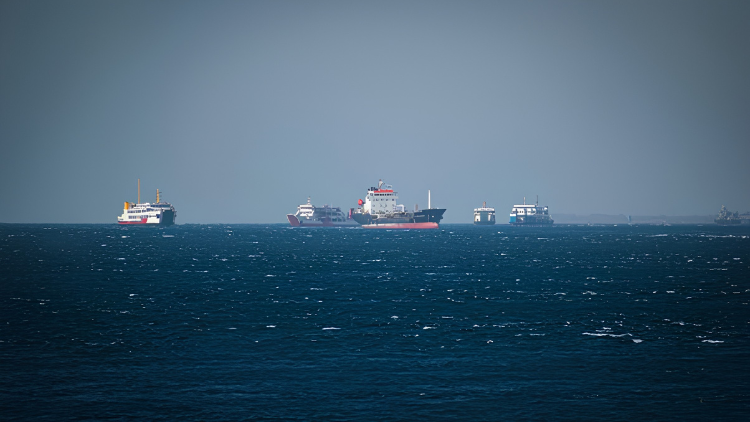
Schiffe in indonesischen Gewässern
© Fahrul Razi on UnsplashFrom afar, a toy gun will look like a real gun, and when Indonesia’s Finance Minister casually jokes about putting a toll tax on one of the world’s most critical maritime chokepoints, the Malacca Strait, the world does not wait to see whether the barrel is plastic or not.
Speaking at a financial symposium in Jakarta last April, Purbaya Yudhi Sadewa, Indonesia’s Finance Minister jokingly floated the idea of charging tolls on ships transiting the Malacca Strait, the same way Iran had begun to demand transit fees for ships crossing the Strait of Hormuz, he chimed,
“If we split it three ways between Indonesia, Malaysia, and Singapore, that could be something, right? We (Indonesia) hold the largest share of area, the longest.”

Purbaya himself is well known for his blunt, or what locals like to describe as having a ‘cowboy’ attitude when it comes to public communication. His well-known off-the-cuff style left the last half of his sentence to be largely ignored, “If only it could be like that, but that's not the case."
Within two days, both Singapore and Malaysia’s Foreign Affairs officials put out a statement that ships hold the right of passage and no bordering country could make unilateral decisions on the strait. Later, Indonesia’s own Foreign Minister Sugiono clarified that Jakarta was “in no position to impose such charges.” Pressured internally and publicly, Purbaya walked it back entirely, saying that he “wasn’t being serious at the time. The government never had such plans.”
In the end, it was just a toy gun—a really bad joke, made at a symposium where nobody expected the cameras to care. The problem is that, with the current situation happening at Hormuz, and when the country that was telling the joke about taxing the world’s third-busiest shipping lane is currently having its own fiscal problem, people tend not to laugh.
“The What Strait?”
The 900-kilometre waterway connects the Indian Ocean to the South China Sea, linking the markets of the Middle East and Europe to those of Asia. In the first half of 2025, it handled roughly 29% of total global maritime oil flows, with over 102,500 ships transiting.
It is so significant for trade in the Indo-Pacific region that nearly two-thirds of all Chinese maritime trade by value crosses through it, and in 2023, it is estimated that 53% of China's energy imports from the Middle East depended on it. Thus, calling it a chokepoint is not an exaggeration.
With its strategic position, there is no easy substitute for the strait. Rerouting through the Lombok-Makassar—which itself is technically controlled by Indonesia—passage would add roughly 7,500 nautical miles to a voyage and could cost the global shipping industry an estimated $84–250 billion in additional annual costs. Apart from that, almost all of the other alternatives will need to transit through Indonesian waters—directly or indirectly—controlled by Indonesia’s government, with respect to the right of transit passage.
What Has Kept the Strait UNCLOS(e)
Purbaya's quip ran directly into the 1982 United Nations Convention on the Law of the Sea (UNCLOS), which Indonesia has ratified. Under Articles 37, 38, and 39, straits used for international navigation are governed by the right of transit passage, which cannot be suspended, restricted, or made conditional on fees by the bordering state.
Historically, Indonesia's status as an archipelagic state is itself contingent on honouring this framework. At the early stage of its post-independence borders mapping, diplomats and experts have agreed to follow a straightforward compact with the international world, Indonesia gets recognised as an archipelagic nation with sovereign rights over vast ocean territory, and in return, it guarantees freedom of navigation through its international straits. Taxing the Malacca Strait would not just invite diplomatic protest; it would saw off decades of diplomatic talks, soft power building, and the very legal framework Indonesia sits on.
Purbaya, who once served as Deputy for Maritime Sovereignty Coordination, knows this well. As the current finance minister, with a myriad of tasks to solve Indonesia's burgeoning debt, high government spending, and President Prabowo Subianto's vision of Indonesia no longer positioning itself as a "peripheral nation." His joke was not born out of ignorance, but perhaps, of a casual moment to solve a rising fiscal frustration.
The Waters Indonesia Actually Controls
Even when the idea of taxing the Malacca waterway seems absurd. As stated before, Indonesia does sit at the centre of geopolitically strategic maritime geography.
As the world's largest archipelagic state, with over 17,000 islands straddling the Indian and Pacific Oceans. Beyond Malacca, it exercises sovereign or co-sovereign influence over several strategically vital passages.
The Lombok Strait, between Bali and Lombok, is wider and deeper than Malacca, making it the preferred alternative for supertankers exceeding 200,000 deadweight tonnes. Around 3,900 ships transit it annually, carrying goods worth $40 billion. The Makassar Strait, running between Kalimantan and Sulawesi, is inseparable from Lombok in practice; together, they form the only viable deep-water alternative if Malacca were ever closed. The Sunda Strait, between Sumatra and Java, handles roughly 3,500 ships a year and serves as a secondary route for Cape shipping and Australia-bound vessels. And lastly, the Ombai-Wetar Straits near Timor complete the archipelago's catalogue of strategic passages.
Taken together, UNCTAD estimates that roughly 40% of the world's commercial sea trade passes through Indonesian waters or the surrounding regional territory. On paper, this made Indonesia into a maritime power that holds the keys to the global economy.
Power Without the Noise
No, Indonesia cannot tax the Malacca Strait.
But what it can do—and in some capacity, already did—is to invest in its role as the guardian of these waters. This means developing its port infrastructure into competitive regional hubs and deepening environmental and safety management frameworks that give Indonesia regulatory authority without violating transit principles.
The real threat to these waters was never Purbaya's joke. It is the slow erosion of the norms that keeps them neutral. For the past few years, we have seen the creeping militarisation of the South China Sea and the weaponisation of trade routes as geopolitical leverage. Every time a country floats the idea of turning a waterway into a toll road, even as a joke, it chips away at the consensus that keeps global trade moving.
Since its independence, Indonesia has played its part as a reliable partner, not a gatekeeper. A stable, cooperative Indonesia, one that actively participates in multilateral maritime governance, that maintains safe passage through all of its straits, that invests in regional coast guard cooperation and environmental protection of these waters, is worth far more to global trade and its own development than any transit fee could ever generate.
Purbaya's remark was a toy gun—not even aimed at anyone, just waved around at the wrong moment. But toy guns still make people cautious. The better signal Indonesia can send is putting the gun down entirely and showing up instead as the country that keeps the sea lanes open, safe, and free. Not out of global pressure, but because it understands what that reliability is worth.
*Raffyanda Indrajaya is a program assistant and communication officer at the Indonesia Office of the Friedrich Naumann Foundation for Freedom.