Energetics
Online tour of the 100% energy-autonomous community of Feldheim in Germany

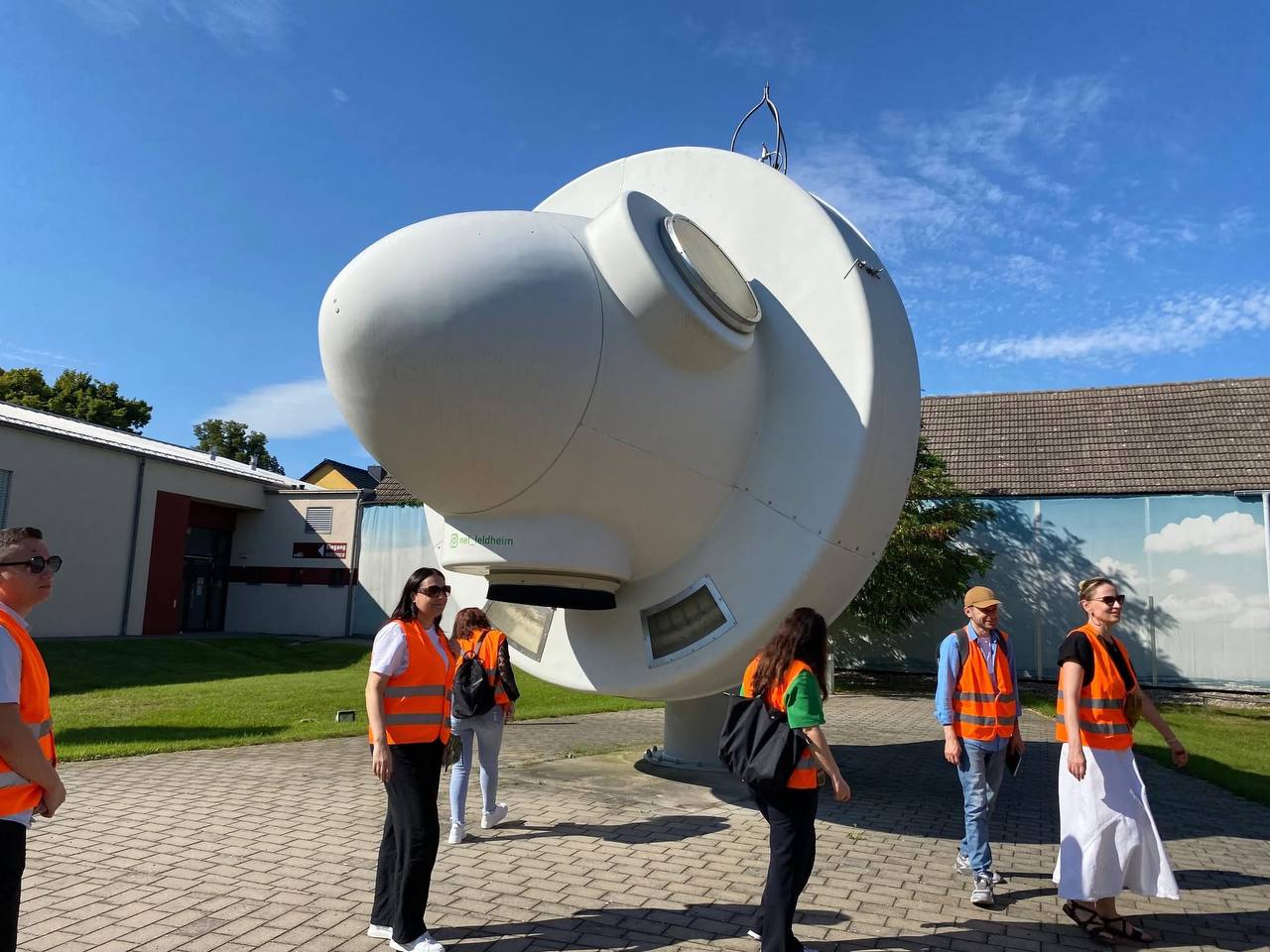
Громада Фельдгайм, Німеччина / © FNF
Can a small community become 100% autonomous and fully provide itself with electricity and heating? The experience of the German community of Feldheim proves that it is possible — when residents, local authorities, and businesses join forces.
On May 6, more than 300 participants from Ukraine — including representatives of local communities, businesses, and the education sector — joined an online tour of this unique village together with its representative, Kathleen Thompson.
The idea for such a tour emerged after last year the team of the Agency for Recovery and Development, along with representatives of other organizations and communities, had the opportunity to personally explore Feldheim’s energy-efficient model during a study visit organized by the Friedrich Naumann Foundation for Freedom.

Громада Фельдгайм, Німеччина / © FNF
The success story of Feldheim began back in 1993, when a local student — now the owner and managing director of the project development company Energiequelle — proposed building a wind power plant near the village. The local authorities supported the initiative, and over the past 30 years this small German community has become a globally recognized example of green energy, now known as a “bioenergy village.”
Today, Feldheim has its own closed energy ecosystem, which includes:
• A wind power plant with 52 turbines and a total capacity of 124 MW;
• Solar panels with a total capacity of 2.25 MW, installed on the site of a former Soviet military base;
• A biogas plant generating more than 500 kW of electricity and 534 kW of thermal energy, powered by agricultural waste, including livestock waste;
• A lithium-ion energy storage system with a capacity of 10 MW and 10.7 MWh (built in 2015 and, at that time, the largest in Europe);
• Local energy networks — 4.6 km of electricity grids and 3 km of heating networks.

Онлайн-екскурсія громадою Фельдгайм, Німеччина / © FNF
The key to Feldheim’s success was cooperation: residents established a non-profit cooperative and a separate private company in which 49 villagers became co-owners, while also attracting an investor. Each resident invested from €3,000. The community’s heating network is managed by the company, while an elected committee of five residents represents the interests of all co-owner households.
The project budget amounted to approximately €1.725 million:
• €138,000 was invested by the 49 co-owners of the company;
• €830,000 came from European Union funding and public budget resources at the federal state and local levels;
• Around €757,000 was provided through a loan.

Онлайн-екскурсія громадою Фельдгайм, Німеччина / © FNF
Energiequelle invested €12.5 million in the 10 MW energy storage system. This made it possible to balance the system, which receives energy generation from multiple sources, and ensure its stability.
Today, the small German community of Feldheim is 100% independent from external energy sources, while the training center established there helps other communities around the world begin their own path toward energy independence.

Громада Фельдгайм, Німеччина / © FNF
This is an invaluable experience for Ukrainian communities, as the example of Feldheim shows that energy independence is not only about technology, but also about effective governance and trust. Even during wartime, Ukrainian communities can lay the foundation for building such energy autonomy by using renewable energy sources and cooperative models.
The online tour was organized by the Agency for Recovery and Development together with the Friedrich Naumann Foundation for Freedom Ukraine.