Romania
Bucharest at Europe’s Eastern Flank: The Ukraine-Romania New Strategic Partnership
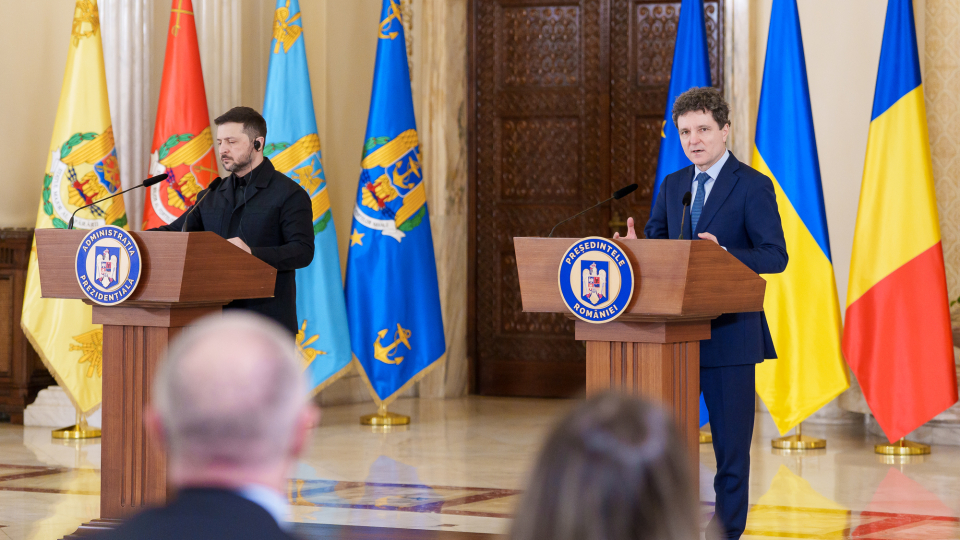
Romanian President Nicușor Dan, March 12, 2026, at Cotroceni Palace, in a joint press conference with Ukrainian President Volodymyr Zelenskyy.
© Presidential Administration of Romania, https://www.presidency.roOn March 12, 2026, Presidents Nicușor Dan and Volodymyr Zelenskyy signed a strategic partnership agreement between Ukraine and Romania, aimed at deepening trade relations as well as enhancing regional and military cooperation. Romania officially supports Ukraine’s accession to NATO and the EU. Ukraine says it has relied on Romania as a key partner, on par with Poland and the Baltic states, since Russia’s invasion of its territory in 2022. While Romanian-Ukrainian relations were once complicated by territorial disputes and linguistic, cultural and juridic questions regarding the Romanian community in Ukraine, today the relationship between the two heads of state is at its highest level. Ukraine certainly remains a sensitive topic among the Romanian population, particularly in sovereigntist circles, but in fact, relations between the two countries have never been better. In this brief analysis, we will detail the aspects of this partnership that will strengthen the relationship between Kyiv and Bucharest: logistics, infrastructure, the defense industry, and minority rights. First, let us review what already existed before the partnership was signed.
Since the start of the war in 2022, Romania has not only affirmed its support for Ukraine but has also become a key hub within the European and NATO ecosystem in this conflict. The Mihail Kogălniceanu Air Base is expanding to become the largest NATO base in Europe by 2030–2040, capable of accommodating up to 10,000 troops. Romania hosts a NATO multinational battlegroup, Mission Aigle, under French command, to deter any Russian aggression. Furthermore, in the Black Sea, Romania plays a vital role in the region’s maritime security, particularly since Russia annexed Crimea and a large portion of the Ukrainian coastline. Politically, Romania has taken a similar stance as Poland and the Baltic states toward Moscow. And Romania has also played a decisive role in welcoming Ukrainian refugees since 2022, with more than one million of them having crossed the border.
Because of its special relationship with the Republic of Moldova - and the threats facing the latter - Romania has also drawn closer to Ukraine economically. The three countries now have a trilateral chamber of commerce and form the Odessa Triangle, essential for the economic integration of the entire region. In terms of energy, Romania is also instrumental in connecting the Ukrainian and Moldovan networks with the EU. The three countries have, in various ways, been targeted by the Kremlin’s hybrid war in the energy sector as well as in the information sphere.
Romania has also played a key role in providing economic support to Ukraine, particularly through the facilities offered by the port of Constanța, which served as an alternative port for Ukrainian goods, including grain. From 2022 to 2025, Constanța replaced Odessa as the main export port for Ukrainian grain, as the Ukrainian coastline was targeted by Russia. Goods such as steel, iron ore, wheat, corn, and sunflower oil were transported to Constanța by truck, rail or by barge along the Danube, and then shipped by boat from Romania’s largest port city. In 2023, 14 million tons of Ukrainian grain exports passed through Constanța. In 2025, after Ukraine regained control of some of its shipping lanes out of Odessa, grain exports fell to just 226,000 tons.
Finally, Romania is a major logistical player in European support for Ukraine, having delivered a Patriot long-range air defense system and serving as a rear base for the maintenance of armored vehicles, the hospitalization of Ukrainian soldiers, and the delivery of fuel. Romania, while not a belligerent, is affected by this conflict, notably by the incursion of Russian drones into its airspace near the border with Ukraine. As in other European countries facing this issue, Romania has decided not to systematically shoot down these relatively non-threatening flying objects, as the cost of air defense would be disproportionate. However, this issue has prompted Bucharest to adopt a clearer strategy regarding drone production and has incorporated this aspect into its partnership with Kyiv. Romania is actively involved in the European SAFE (Security Action for Europe) program, which provides a total of 150 billion euros in loans for “joint defense procurement” on a European level.
Romania and Ukraine formalized an even closer partnership on March 12. Under the SAFE program, Romania is receiving €200 million to fund its defense systems, which include drones. For now, Romania imports its drones. Today, it is seeking to train its youth—particularly in military high schools, though not exclusively—to improve drone proficiency and repair expertise. Several Romanian lawmakers, including USR MP Corina Atanasiu, are working on this issue and have taken the initiative to establish pilot programs in certain schools, similar to those already in place in Estonia, Finland, and Ukraine.
Beyond the issue of drone training, Romania and Ukraine have also signed an agreement for cooperation over the next ten years in the areas of cybersecurity and intelligence, as well as a confirmation of political and logistical support. And this cooperation will be more than just Romanian support for Kyiv, as evidenced by the Romanian military’s upcoming use of Ukrainian defense technologies. Furthermore, energy interconnectivity will be strengthened, particularly to facilitate the transport of LNG through Romanian gas pipelines. Romanian gas will be able to be stored in Ukraine, which will be essential for improving the “Vertical Gas Corridor.” This corridor is the main route for U.S. LNG to Central and Eastern Europe, running from the Aegean Sea in Greece to Ukraine via Bulgaria, Romania, the Republic of Moldova, Hungary, and Slovakia.
The border between the two countries, although it remains heavily controlled in times of war, will see the construction of additional crossing points and cross-border rail lines, as well as a relaxation of customs controls. A mine-clearing plan in the Black Sea will also be pursued by both countries. River safety on the Danube will also be strengthened as part of the plan adopted by the Odessa Triangle.
Finally, Ukraine and Romania have decided to resolve their disputes regarding the Ukrainian ethnic minority in Romania and the Romanian ethnic minority in Ukraine. Thus, the two countries have committed to respecting the cultural and political rights of minorities. In Ukraine, the term used to refer to the language has shifted from “Moldovan” to “Romanian,” as the Republic of Moldova had done, putting an end to the highly political distinction between these two names. President Zelenskyy even signed a decree designating August 31 as the official Day of the Romanian Language in Ukraine (as in Romania and the Republic of Moldova). This cultural and linguistic rapprochement aims to ease tensions between the two countries, which are often exploited by Russian disinformation.
Romania is now facing the consequences of the Russian invasion of Ukraine on its own soil. Drones entering Romanian airspace in the east of the country are one example. Despite nationalist rhetoric rejecting any form of aid to Ukraine, Romanian support has never been more crucial for the Ukrainians. The possibility of this cooperation is also the result of a political alignment between Kyiv and Bucharest, as well as with Chisinau, and perhaps Budapest in the future. Both countries know how fragile this opportunity is, and that their bilateral relations are specifically targeted by Russia.
About the author: Martin de La Garanderie is a specialist in European affairs and international relations. He is a graduate of the College of Europe in Natolin, Poland; the Faculty of Political Science at the University of Münster in Germany; and Sciences Po Lille in France. He has worked at the European External Action Service (EEAS) in Brussels and with several think tanks. He is currently an intern at the Friedrich Naumann Foundation for Freedom in Romania and the Republic of Moldova.