Argentina
Public and private leaders debated infrastructure, investment, and federal development in Argentina

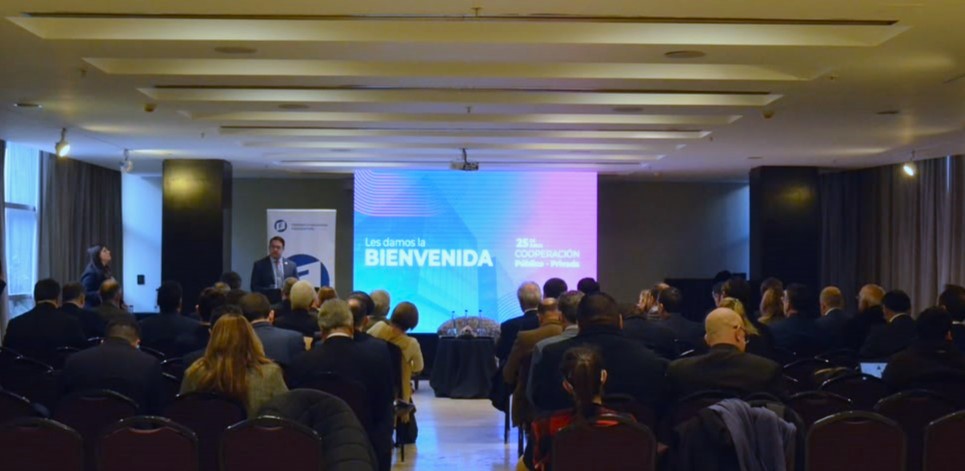
Opening of the forum "Public-Private Cooperation: Investment in Infrastructure, Mining, Energy, and Financing"
The Friedrich Naumann Foundation for Freedom in South America, alongside the Catholic University of Cuyo and allied organizations, hosted the forum "Public-Private Cooperation: Investment in Infrastructure, Mining, Energy, and Financing".
The forum "Public-Private Cooperation: Investment in Infrastructure, Mining, Energy, and Financing" was a day of dialogue that brought together representatives from the public, private, academic, and civil society sectors, along with speakers and participants from Argentina, Chile, and Uruguay, consolidating itself as a regional space to strengthen public-private cooperation and promote a favorable climate for investment.
The event was organized by the Friedrich Naumann Foundation for Freedom in South America, alongside the Catholic University of Cuyo and allied organizations. Its objective was to analyze the challenges and opportunities Argentina faces in attracting investment, strengthening strategic infrastructure, improving legal certainty, and promoting public-private cooperation mechanisms geared toward federal development.
Throughout the day, participants agreed that infrastructure must be understood as an indispensable condition for expanding opportunities, connecting territories, reducing inequalities, and improving competitiveness. In that sense, one of the main conclusions was that infrastructure is not an expense, but a policy of freedom. Routes, ports, energy, digital connectivity, and logistics allow for the integration of regions, boosting production, facilitating exports, and expanding opportunities for individuals.
The panels and working groups agreed on the need to move toward a more predictable institutional framework, with clear rules, regulatory stability, and greater coordination between the National Government, provinces, and municipalities. They also highlighted the importance of reducing bureaucratic hurdles, strengthening human capital, facilitating access to financing, and restoring trust between the public and private sectors.

Tomás Villalba and Eugenio Marí at the panel discussion "Argentina's Current Conditions to Attract Investment in Infrastructure"
Another central pillar was the need to consolidate a productive federalism that allows for the leveraging of each region's potential through sustained agreements and a shared agendas that transcends political cycles.
During the working groups, the development of local suppliers was also analyzed as part of a regional growth strategy. It was emphasized that these policies are more effective when they promote competitiveness, innovation, and productivity, so that producing locally is a choice based on quality and not an obligation derived from restrictions.
The meeting concluded that Argentina has strategic resources, human talent, and concrete opportunities to insert itself into the new global competition for investment. However, transforming that potential into sustainable development requires building trust, strengthening institutions, and promoting public policies with a long-term vision.
Argentina needs fewer discussions about who is right and more agreements on what country we want to build today to be a stable country twenty years from now.
Because infrastructure is not built solely with investment. It is also built with trust. And trust is born where there are solid institutions, clear rules, and the determination to engage in dialogue to build a shared future.
This will continue to be the commitment of the Friedrich Naumann Foundation for Freedom: to promote consensus, cooperation, and the conditions that allow for the building of an Argentina that is more open, more competitive, more federal, and, above all, freer.