ALUMNI
Dialogue as the Starting Point for International Security
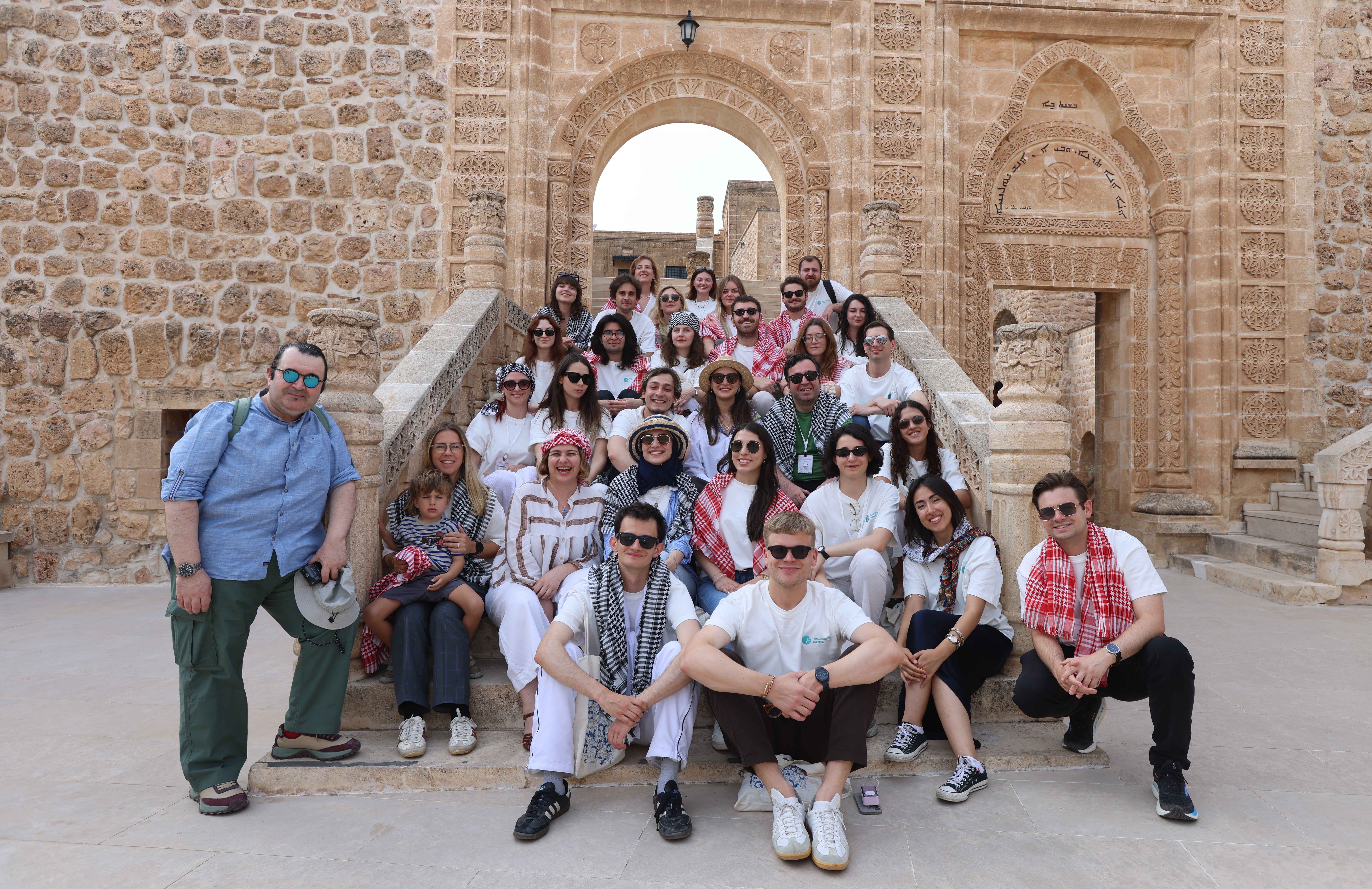
Participants of the 6th edition of the international summer school "Security and/or Human Rights: Navigating Freedom in a World of Polycrisis".
Between June 8 and 12, the city of Mardin (Turkey) hosted the sixth edition of the international summer school “Security and/or Human Rights: Navigating Freedom in a World of Polycrisis.” This event, organized by the Human Rights Academy and the Friedrich Naumann Foundation For Freedom Turkiye, brought together young people from different parts of the world.
The educational program took as its starting point the recognition that we live in a world shaped by multiple crises, the scope of which demands global debate. In this regard, the panels were composed of professionals from diverse fields who addressed contemporary security challenges from multiple angles.
First, the need to analyze certain conflicts from a regional perspective was considered. Accordingly, lectures were held on the strategic landscape of the Euro-Atlantic region, the Middle East, and the role of China and the Indo-Pacific in the new geopolitical order. The specificity of these theoretical blocks highlighted the importance of understanding the different actors and dynamics of the international arena through the lens of their own histories and perspectives.
Following this same logic, group workshops were structured as a complementary dynamic where each team represented a region of the world. This format provided an ideal environment for attendees to exchange views and devise solutions to realities that, based on their personal experiences, could feel more or less familiar. Therein lay the fundamental challenge: to approach the lived experiences of each territory without losing sight of the global implications of these phenomena.

In addition, training sessions focused on specific areas of the international agenda were conducted, such as economic security and interdependence, emerging trends and strategy, states of emergency, and terrorism. The relevance of these core topics stems from two essential reasons: on one hand, their diverse nature, as they have different origins but directly impact citizens; on the other, the fact that they are phenomena that, to a greater or lesser extent, affect the entire global order regardless of geographic location.
Panels were also developed to analyze security from an international relations perspective, ranging from regional cooperation and international law to the role of multilateral organizations and leadership in diplomacy. In line with this, the final session was designed as an interactive reflection space driven by questions addressed to the attendees. This not only involved a recapitulation of the previous content but also opened a vital channel for debate.
This last aspect is probably the core of any gathering of this nature: debate. Beyond the necessary theoretical approach to the topics, the summer school succeeded in bringing together young people of different nationalities, ages, and disciplines to discuss an issue as complex as security in the current context.
After all, championing global and multidisciplinary exchange in a world of recurring crises is, now more than ever, the path to transforming strategic knowledge into concrete solutions.

When dealing with global agendas, encountering the other establishes itself as an opportunity for mutual learning. It is there where the understanding of different realities lies, realities that, at the same time, shape our common reality. It allows us to make visible what sometimes feels foreign to us and to pay attention to transversal factors that condition the entire system.
However, this empathy and understanding must also serve as a driving force for action. Today, youth no longer limit themselves to mere theoretical discussion; they seek to influence governance. The new generations question, reflect, and assume an active role within the international landscape. They challenge it because they take on the responsibility of building an efficient security architecture, where order and stability stem from the absolute respect for the rights to life, liberty, and private property.
In this way, this international summer school succeeded in establishing itself as a comprehensive learning environment. After all, championing global and multidisciplinary exchange in a world of recurring crises is, now more than ever, the path to transforming strategic knowledge into concrete solutions.