Serbia
Culture war in its final stages

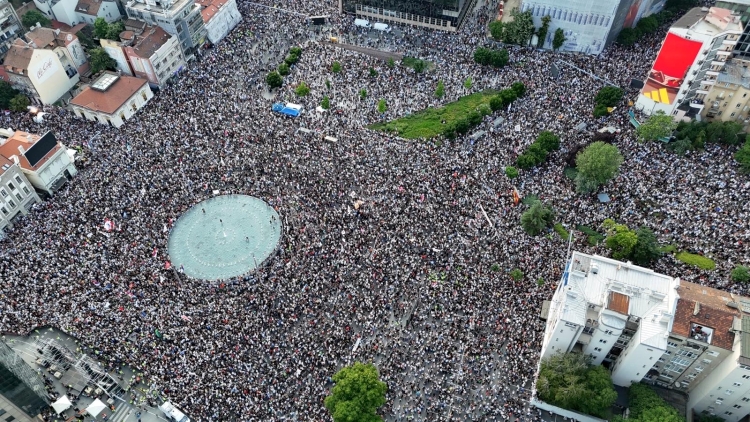
Since the collapse of a railway station canopy in November 2024, which left 16 people dead, large sections of Serbian society have been demonstrating for a different Serbia – for a country in which institutions do what they are supposed to do, rather than what the president tells them to do. It is a struggle that requires perseverance. Fortunately, the driving force behind this movement is young and resilient.
Although the Serbian media are almost completely ignoring the mass protests led by students, over a hundred thousand people gathered again in Belgrade at the weekend to protest for “a different Serbia”. This is the lowest common denominator on which all demonstrators can agree. They have had enough of President Aleksandar Vučić and his “Serbian Progressive Party” (SNS), which has been in power for a decade and a half and has seized control of the state.
State and party are one and the same in Serbia. This was already the case in Yugoslavia, yet at least some of the former republics managed to free themselves from this yoke. In Serbia, however, the ruling SNS has established dual structures that have effectively replaced state authorities: 98% of all municipalities are governed by the SNS, and dissent is not tolerated at any level. If you want anything from the state, even if it is just a building permit for a garage, you have to curry favour with the party. Corruption is rife.
In a country with just under seven million inhabitants, there are said to be 700,000 party members: ten per cent of the population benefits from this system, whilst the rest are left to fend for themselves. As the public sector accounts for a large proportion of the economy, far more people are dependent on the system. And anyone holding a public office is compelled to vote for the party. Reports of this are aplenty.
New elections: Way out or dead end?
Whilst 100,000 people are protesting in Belgrade to put an end to this nightmare, the all-powerful president is in China to strengthen the ‘iron friendship’ – critical voices speak of an ‘iron stranglehold’ – with the People’s Republic. China is investing heavily in Vučić’s Serbia. Infrastructure is being built by the Chinese themselves or with the help of Chinese loans. The exhibition grounds for ‘Expo27’ on the outskirts of Belgrade are also being developed by China under a state contract, which in turn employs Serbian subcontractors close to the regime. Independent observers estimate that up to 30 billion euros of taxpayers’ money will flow into the pockets of SNS supporters through this completely oversized project. Furthermore, China supports Serbia’s claim to Kosovo, just as Serbia regards Taiwan as part of China.
Many Serbian citizens are no longer willing to tolerate the SNS party’s stranglehold on the state and are calling for new elections. Whilst Vučić has in the past regularly called for new elections to renew his and his party’s legitimacy, he is hesitating this time. For the first time, there are doubts as to whether the party will be able to win the upcoming election, despite electoral fraud. And this poses a significant challenge for Aleksandar Vučić: after two terms as president, he must stand as prime minister until April 2027 if he wishes to continue leading the country. According to the constitution, Serbia is a parliamentary democracy, but in practice Vučić, as president, holds all the power. That is why the next parliamentary election is of crucial importance not only for his loyalists, but for him personally as well.
The public is pinning its hopes on an electoral list to be drawn up by the students. Although the student movement is extremely diverse – encompassing everything from nationalist to pro-European ideas – many still see it as the only hope for change. The Serbian regime media denigrate the protest movement as “anti-Serbian” and accuse it of “treason”. Aleksandar Vučić, too, mocked the protesters from China, whose numbers were estimated by the Ministry of the Interior at 34,000 and by an opposition-aligned think tank at 180,000: “As far as I’m concerned, they can claim there were three million people,” the president remarked. “The next elections will prove it, as always. I’m just surprised they aren’t ashamed to spread such lies.”
The fight against free media
Eighty per cent of Serbia’s population receives nothing but regime propaganda. All five of the country’s free-to-air channels are strictly aligned with the government’s agenda. This year alone, Vučić has already appeared live on television 167 times; last year, he appeared a total of 411 times, with an average speaking time of around thirty minutes. Only around twenty per cent receive two news channels partnered with CNN, which report objectively on events in the country and put them into context.
But even that may soon come to an end: under unclear circumstances, the private cable network operator, which has the two news channels in its portfolio, was sold to a regime-aligned consortium chaired by a confidant of Viktor Orbán. The opposition fears that this will silence what little remains of the free media in time for the next election. The European Parliament is aware of the implications of this restriction on media freedom, but can do little about it.
The President decides when parliamentary election takes place, as he can call elections with 40 days’ notice. In this way, the SNS party has so far ensured that it could enter the election campaign perfectly positioned, whilst opposition parties first had to draw up electoral lists and forge alliances. The problem from the regime’s perspective, however, is that the student movement appears just as well positioned as the ruling party. For the past year and a half, it has been mobilising hundreds of thousands of Serbs and shows no sign of tiring in its creative displays of civil disobedience. Supporters of the regime respond with graffiti insulting the ‘blockaders’ and proclaiming ‘Serbia’s victory’. The whole country is full of it.
A country at the end of its tether
Serbian society appears worn down by a year and a half of fierce cultural conflict. In a survey conducted at the end of May by the opposition-aligned “Institute for Social Research”, more than two-thirds of respondents stated that it is unclear nowadays who is telling the truth. Worse still: only 13.5 per cent of respondents believe that people in Serbia can look to the future with optimism.
The student movement must keep the public’s interest alive. All too often, society has lapsed into lethargy when the regime has flooded the public with information, half-truths and rubbish. Until now, it has felt as though there was no way out. The students are tireless in their efforts to convince Serbian society otherwise.
Markus Kaiser is project director for the Western Balkans at the Friedrich Naumann Foundation for Freedom. He is based in Belgrade.