Beyond the ballot
Are Zambia’s election reforms built for the people?

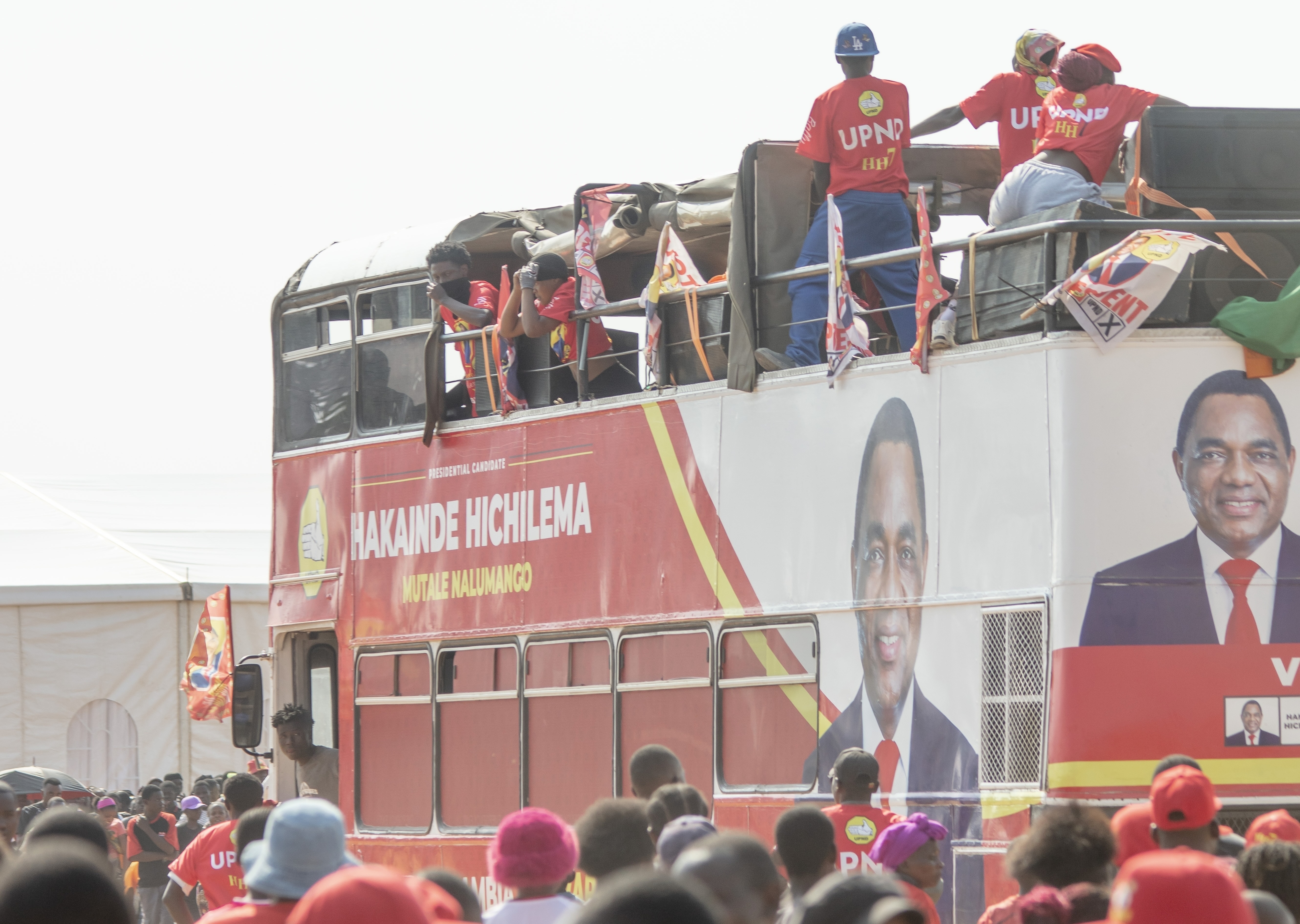
Chongwe, Zambia - July 11th, 2026: A red UPND (United Party for National Development) election campaign double decker bus featuring portraits of Hakainde Hichilema surrounded by a crowd of supporters in Zambia.
© ShutterstockDoes Zambia’s electoral legal framework merely regulate elections, or does it effectively protect the constitutional and democratic rights of citizens? Zambia is a constitutional democracy in which elections are governed by a constitutional and legislative framework intended to protect political participation, representation, electoral integrity, and the rights of citizens. However, the existence of a comprehensive legal framework does not, in itself, guarantee democratic outcomes. The effectiveness of Zambia’s electoral framework ultimately depends on how these laws are implemented and experienced by citizens.
Taken together, these instruments provide a substantial legal and institutional architecture for constitutional democracy. They establish rules for political participation, electoral competition, representation, electoral administration, and the protection of electoral rights. Key democratic tests therefore include whether voters have equal and meaningful opportunities to participate; whether electoral institutions operate independently and transparently; whether citizens understand the rules governing elections; whether political actors are subject to the same rules; whether voters can effectively challenge violations; and whether electoral reforms improve representation without creating new barriers to participation.
The central question is therefore not simply whether Zambia has laws governing elections, but whether the electoral framework translates constitutional rights into meaningful democratic participation for ordinary citizens.
Heading into Zambia’s August 13, 2026 general elections, major legislative and constitutional reforms have sparked intense friction between the government and civic groups. According to the CIVICUS Global Alliance, while President Hakainde Hichilema’s administration initially campaigned on democratic reform and the widening of civic freedoms, civil society organisations (CSOs), legal bodies such as the Law Association of Zambia (LAZ), opposition groups, and human rights defenders have raised major concerns that recent legal amendments serve political expediency and shrink democratic space.
For example, the proposed Non-Governmental Organisations Bill, 2025 raises important concerns regarding the constitutional protection of freedom of association in Zambia. The concern is not simply that NGOs would be regulated, as reasonable regulation can be legitimate, but whether the regulatory framework gives the executive disproportionate discretion to determine which organisations may exist, operate, and continue their activities.
The Bill proposes to replace the existing framework and provides for the registration, licensing, and coordination of NGOs, while establishing the Department of Non-Governmental Organisations and continuing the Council and Congress of NGOs.
A primary grievance among Zambian civil society organisations has been the manner in which constitutional changes were pushed through. An earlier attempt to pass constitutional amendments was declared unconstitutional by the Constitutional Court due to a lack of genuine public consultation. When the government revived the bill in late 2025, CSOs noted that public consultation remained superficial, relying heavily on virtual platforms and brief sessions in provincial capitals and effectively excluding rural communities, trade unions, and grassroots groups.
Passing major electoral amendments less than eight months before a national election was also seen as inconsistent with broad consensus-building norms. Civic actors and opposition parties argued that restructuring constituency boundaries and expanding parliamentary seats so close to the poll was designed to alter the political balance in favour of the ruling party, the United Party for National Development (UPND). While reserved seats for youth and women were welcomed in principle, CSOs argued that token quotas were being used as a “Trojan horse” to justify an unmanageable expansion of Parliament.
While traditional media face varying degrees of pressure, the digital space, previously a vital refuge for Zambian civic voices, has increasingly come under police scrutiny. Cybercrime legislation has been leveraged to arrest critics, commentators, and politicians for “cyberbullying” or spreading “false information”, creating a chilling effect ahead of the campaign period.
The lesson from Zambia is that electoral reform cannot be measured by the sophistication of the law alone. It must be measured by the power it gives citizens. Germany’s mixed electoral system demonstrates how constituency representation can be combined with proportional representation, but its experience also shows that complex rules require clear institutional safeguards and sustained voter education.
For Zambia and other African democracies, the challenge is therefore not simply to design better electoral systems, but to build electoral institutions in which citizens understand how their votes translate into representation, can scrutinise the rules governing elections, and have meaningful avenues through which to hold political and electoral institutions accountable.
Conversely, Germany and other established democracies can learn from Zambia’s experience that even well-designed reforms can weaken public confidence if they are introduced without sufficient consultation, transparency, and time for citizens to understand their consequences. Germany’s 2023 reform is a good example because the government had a legitimate institutional objective, preventing the Bundestag from becoming excessively large, but the reform nevertheless had to withstand constitutional scrutiny concerning party equality and the effective representation of voters.
By way of comparison, Germany shows that electoral reform can legitimately pursue institutional efficiency, but such efficiency cannot be separated from constitutional safeguards protecting political equality, representation, and democratic participation. The German Constitutional Court’s 2024 decision illustrates how an independent constitutional institution can act as a safeguard when electoral rules potentially disadvantage particular parties or groups of voters.
The common lesson is simple: electoral reform strengthens constitutional democracy only when the citizen, not the political institution, is placed at the centre of the system.