Exchange
Learning from liberal practice

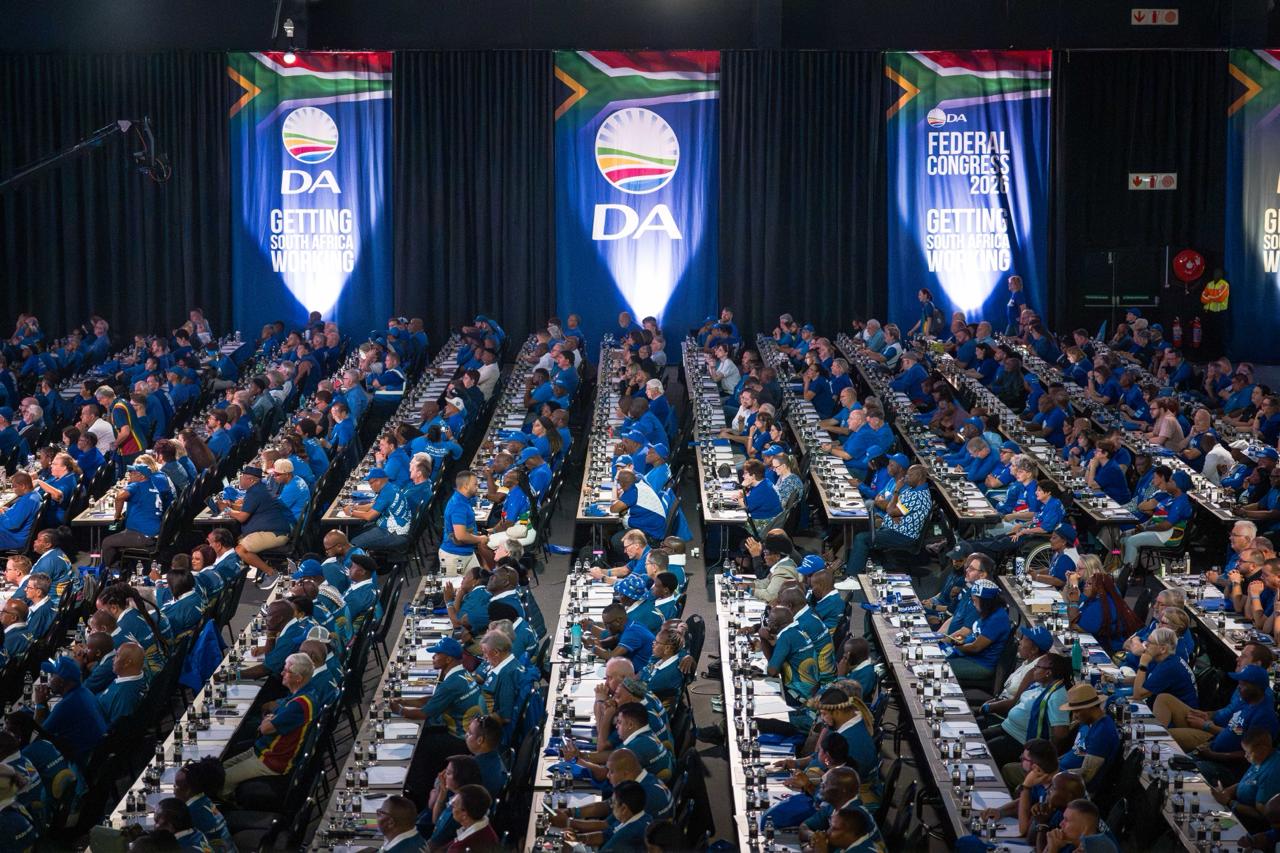
Members of the Democratic Alliance gather for their 2026 elective congress in Johannesburg on 11-12 April 2026
© Democratic Alliance / FacebookDemocracy depends on exchange, on listening, observing and learning from one another across borders. With this in mind, a delegation of the Young Liberals (JuLis – Germany), including members of the federal executive board and the head of the JuLis Africa Team, travelled to South Africa to attend the federal congress of the Democratic Alliance. What we encountered there went far beyond a party conference. It was a practical lesson in how liberal politics can be organized, communicated and sustained under challenging conditions.
From the outset, the professionalism of the Democratic Alliance was striking. The congress was meticulously organized, messaging was disciplined and the overall presentation conveyed a clear sense of purpose. This was not politics driven by short term impulses, but by a long term strategic vision. The party understands how to position itself, firmly anchored in liberal values while focusing on tangible solutions to everyday challenges.
One of the key takeaways from our visit was precisely this combination of clarity and pragmatism. The Democratic Alliance does not treat liberalism as an abstract ideal, but as a framework for governance. Issues such as the rule of law, administrative efficiency and economic opportunity are not merely referenced, they are operationalized. In a political environment often marked by deep structural challenges, this consistency builds trust and reinforces the party’s profile.
Liberalism thrives where we learn from one another.

Equally instructive was the party’s approach to coalition building. In a fragmented political system, governing requires the ability to cooperate across party lines without losing one’s own identity. The Democratic Alliance has developed this capacity with notable success. For liberal parties in Europe, this offers a valuable perspective. Political influence increasingly depends not only on electoral strength, but on the ability to form stable, values based alliances.
What made this visit particularly meaningful, however, extended beyond the congress itself. The Friedrich Naumann Foundation organized a highly engaging and impactful accompanying programme for our delegation. In both Johannesburg and Cape Town, we were given the opportunity to gain deeper insights into the day to day work, internal structures and strategic approach of the Democratic Alliance.
Through a series of discussions, site visits and background briefings, we were able to move beyond surface level impressions and engage directly with those shaping liberal politics in South Africa. This level of access was invaluable. It allowed us to better understand not only how the party organizes itself, but also how it navigates the broader political landscape while balancing principle with pragmatism in a complex environment. We are sincerely grateful to the Friedrich Naumann Foundation for enabling these experiences with such depth and care.
Another aspect that stood out was the role of younger members and the importance of international exchange. Conversations with liberal actors from across the African continent made clear that many challenges are shared, just as many solutions can be developed collaboratively. The openness of these exchanges created a sense of genuine partnership.
At the same time, the visit offered a sober reminder that democracy cannot be taken for granted. South Africa faces significant economic and institutional challenges, and the pressure on democratic structures is tangible. It was precisely in this context that the determination of liberal actors became most visible. The Democratic Alliance’s work is driven by a clear commitment to improving governance and expanding opportunities, often under demanding conditions.
For us as Young Liberals, the implications are clear. International exchange is not an optional addition to political work, but an essential part of it. The insights gained in South Africa will inform our own approach, whether in strengthening organizational structures, refining political communication or approaching coalition building with greater strategic awareness.
Ultimately, this visit reaffirmed a simple but important point. Liberalism is a global project. Its success depends on the willingness to learn from one another, to adapt ideas across contexts and to remain committed to the principles that underpin open and free societies.