GEOPOLITICS, TRADE & SECURITY
Navigating India’s Role: Security, Geopolitics and Trade

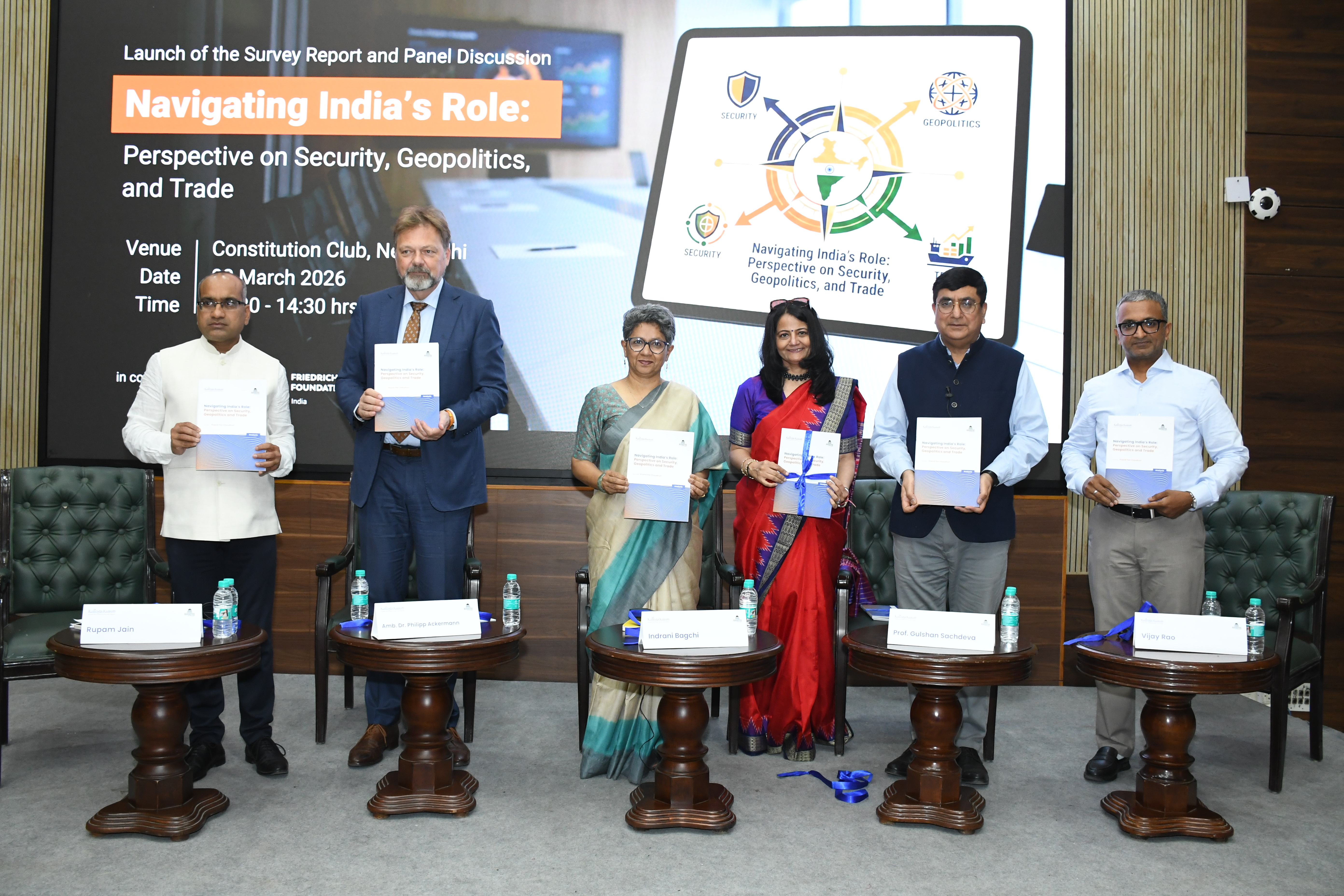
Survey Report Launch in New Delhi
© FNF IndiaA new survey conducted by Kalinga Kusum Foundation in New Delhi in cooperation with the Friedrich Naumann Foundation for Freedom shows that economic growth is seen as the most important objective of foreign policy. For India to rise in next 20 years, those questioned in the survey believe its diplomacy must serve development at home.
The findings are based on a structured quantitative survey conducted between November 17, 2025 and December 22, 2025. Participants comprising business leaders, academics, students, defense experts, civil servants, journalists, and informed citizenry shared a common perspective. For them, diplomacy should be a tool to advance the economy.
Interest in global partnership
Respondents recognize that their country is still a low-middle income nation with development issues, particularly in jobs, pollution, poverty and education. Of these concerns, employment anxiety stands out, perhaps reflecting the pressures felt most sharply in urban centers. Many want political leaders to use India’s growing influence in the world to help domestic prosperity. Foreign policy shall first and foremost be about supporting the economy at home. This lens explains why a policy of multi-alignment is welcomed - one where India retains strategic autonomy but develops close relations with great powers in a non-exclusive manner. In a fragmented world, rather than choosing sides, India maximizes opportunities.
How India sees great powers
Indians consider the US an economically strong military power. 90 percent of respondents agree with the statement that the US’s significant military capabilities shape its global influence. Many acknowledge shared democratic values and recognize American unmatched soft power. Yet doubts linger as the US is coming to be unpredictable in the eyes of many respondents.
China is seen as globally influential militarily and an economic powerhouse, especially in most forward-looking sectors like technology. At the same time, distrust and dilemma against China run deep due to misalignment in values and Beijing’s relationship with Pakistan. Even so, many Indians still see China’s development model worth studying.
Russia on the other hand ranks lower than the US and China in terms of economic opportunities. But it stands apart in one aspect: trust. Many respondents see Russia as a reliable and trustworthy partner, a legacy of ties drawing back to the Soviet era. Many respondents are confident that the government in Moscow would provide military support in the event of an armed conflict. Therefore, an overwhelming a three quarter of respondents consider it acceptable for India to continue buying Russian oil and not participate in Western sanctions.
The European Union is considered a relevant economic power aligned with India in values on democracy and rule of law. Trade, advanced technology and manufacturing expertise, climate protection and sustainability issues are seen as promising areas for engagement. The strategic importance of deeper trade relations with Europe becomes particularly clear for India in the context of global trade tensions.
Within Europe, Germany draws particular interest, especially in cooperation in education and skilled labor. However, many Indians want Germany to act more independently from the US’s influence and urge for improvement in digital technology, most specifically artificial intelligence.
Beyond the major powers, respondents see Southeast Asia as the most important regional partner given the sheer volume of tourist, business and cultural ties. Again, partnerships are evaluated through a pragmatic lens focused on economic development of India.
India’s ambition
If India’s foreign policy is anchored in development, its economic vision is clear. A large majority of survey-respondents favor deeper integration into the global economy, particularly forming regional free trade zones and greater openness to foreign investment. Manufacturing is central to this ambition. Many respondents believe India can, within a decade, replace China and Vietnam as a preferred destination for global manufacturing investment. Institutional reform and educational transformation are deemed essential for this acceleration to take place.
Please read the full analysis of our survey report here.
* Hnin Wint Naing is a regional communication officer of the Asia Office of the Friedrich Naumann Foundation for Freedom.