Freedom Prize
Acceptance Remarks Reza Pahlavi

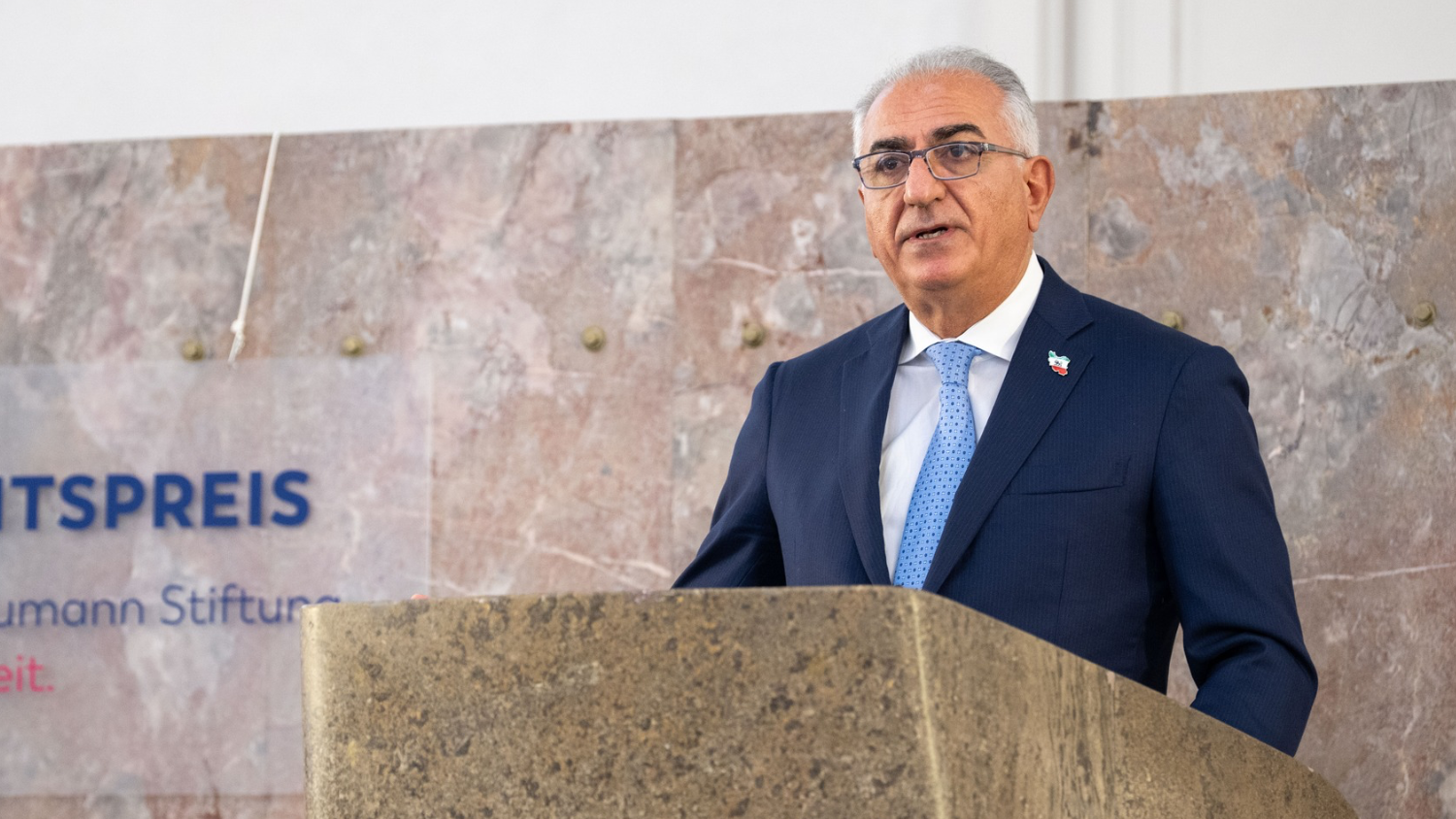
Ladies and gentlemen, members of the board of trustees of the Friedrich Naumann Foundation, members of parliament, members of the Frankfurt city council, distinguished guests, German friends, and my fellow Iranians.
And to my compatriots: those of you in this hall, and those watching in Iran, from whatever corner of our beautiful homeland you have bypassed the regime’s censorship to be here today.
It is indeed a humbling moment, and a great honor for me to have been asked to receive this prestigious Freedom Prize on behalf of my brave compatriots.
When the Friedrich Naumann Foundation asked me to receive it, they chose their words with care. I was asked to hold it in trust on behalf of millions. It was on exactly those terms that I agreed to accept it, because they describe more than my role this morning. They describe my role in this chapter of Iran's history.
A trustee holds something of great value that belongs to someone else. He guards it. He protects it. He does not spend it. And when the time comes, he hands it back, whole.
That is what I will do with this prize. I hold it only temporarily. And indeed, not for long. One day, and I believe that day is closer than the dying clerical regime wants to admit, I will place it in the hands of its rightful owners, the Iranian people. Not on foreign soil, but our capital Tehran.
This prize also belongs to some of the people, here in this room today: the families of those who gave their lives for freedom.
For 47 years, Iran has been held like a house whose occupants, its owners, were locked out of their own home or were held captive inside it. The keys were taken from the people in 1979. My task is to help recover them, and to return them to the only rightful owner: the Iranian nation.
I have often said that I see my role as a bridge. A bridge carries people from one shore to another.
One does not build a home on a bridge. You cross it, and then it has done its most important job. My role is to help Iranian democracy arrive safely, healthily, and to be long lasting. If I can do that, I will have done my duty.
So today, I am the custodian of a promise. And I intend to keep it.
Indeed, there is no better place to accept a prize for freedom than this hall.
In 1848, Germans elected their first national parliament and sent it here, to the Paulskirche [POWLS-keer-sheh]. The delegates were professors and lawyers, merchants and clergymen. They wrote a catalogue of fundamental rights: equality before the law, freedom of the press, freedom of belief.
They believed that power must be bound by law and answerable to citizens.
Despite their lofty, even noble ideals, their constitution never took effect. By every measure of the moment, they had failed.
Eastward, a little more than half a century later. In 1906, in Tehran, merchants, intellectuals and other patriots organizing in secret forced the creation of Iran's first parliament, the Majles. They wrote one of the first constitutions in Asia. They believed exactly what the men in this church in 1848 believed: that the nation is not the property of potentates, but of the people.
Two peoples, four thousand kilometers apart, reached for the same idea within the same lifetime.
A vision of a democratic future. But if we are honest, neither path ran straight.
Germany's road from this hall passed through Weimar, and then into the abyss of Nazism. Iran's constitutional promise was buried under an Islamist theocracy that declared that sovereignty belongs not to the people, but to an unelected cleric who answers to no one. These perverse regimes waged war on their people and on the principles of liberty, democracy, and freedom.
But this building teaches a lesson that tyrants never learn. The ideas of 1848 were not defeated. They held in the minds of free people. And after the darkest chapter in this nation's history, they returned in the Basic Law of 1949, which opens with the declaration that human dignity shall be inviolable.
That return seemed improbable, even impossible at times. This very church was reduced to ruins by bombs in 1944. Yet in 1948, Germans rebuilt it from the rubble, among the first buildings to rise again in this city, to mark the hundredth anniversary of that first parliament. It is a testament to the thirst for liberty that, among all things, a people standing in ruins chose to rebuild their house of freedom first.
You did not forget liberty.
Well, neither have we. The Iranian people have not forgotten 1906. The Islamic Republic has spent 47 years trying to make them forget, and it has failed.
The constitutional idea, the idea that political power must be exercised within the limits of the constitution and governed by laws derived from it and people’s will, is alive in Iran today: It is alive in every young woman who walks uncovered past a checkpoint; it is alive in every worker who strikes; it is alive in every student who refuses to be silent, and it is alive in every young person who takes to the street.
I want to stay with this history for a moment, because it answers a question that hangs over every conversation about Iran's future. We, too, have been told that freedom and democracy, that reclaiming our nation from the forces of evil and rebuilding it from the rubble is improbable or even impossible, ironically by some in the West.
No one needs to bring democracy to Iran. Human rights do not need to be imported. Freedom is not a foreign concept. We Iranians are heirs to a civilization that helped pioneer the very ideals of human rights, individual liberty, and human dignity.
But that civilization, our nation, our people have been taken hostage by an illegitimate occupier that is not only opposed but hates those very ideals. The Islamic Republic is not the legitimate government of Iran, it is the antithesis to everything Iran and Iranians stand for.
What was the world to do with such a regime? For years, I argued against two paths. Against appeasement, which handed the regime money and legitimacy, while it imprisoned and killed our people.
And against war, because no Iranian wants to see bombs fall on his own country. Instead, I argued for a third path: maximum pressure on the regime, and maximum support for the Iranian people.
Year after year, the world chose to appease. And year after year, Iranians rose up, in 2009, in 2017, in 2019, in 2022, and each time the regime answered with more prisons and more bullets.
Then came January 8 and 9. Millions took to the streets. The regime nearly lost control. And so it killed. It slaughtered. A regime that can kill tens of thousands of its own citizens in a matter of days has told us exactly how it intends to survive. An unarmed people cannot be asked to defeat, with bare hands, a state prepared to kill without limit. It was, thus, with great pain and a heavy heart that we came to accept that military pressure on the regime's machinery of repression was perhaps the only way left to weaken it, and to give the Iranian people a fair chance. The people of Iran had the right to be protected, and the world had a responsibility to protect them in the face of a massacre of unspeakable scales.
Why? Because we had no other choice. Because people went to the streets prepared for a crackdown, but what they got was a slaughter. A massacre.
They filmed themselves putting on swimming goggles, scarves, and masks.They were prepared for tear gas. They were prepared to resist and to fight for their freedom. They were not just prepared, but they were proud of their preparations. They recorded videos sending them to their friends to inspire them, too, to take ot the streets and to the media to be their voice. But their preparations were no match for AK-47s. They were no match for shots to the head and genitals. They were no match for an Internet blackout. They were no match for an all-out military-style assault on innocent protesters that slaughtered 40,000 of them in 48 hours. And so, yes, we needed this humanitarian intervention and we do not apologize for it.
Just as you celebrate May 8 as liberation day, so Iranians celebrated the prospects that they too might be liberated. No one celebrates bombs. What they celebrated was the hope that their jailers, their occupiers might be weakened.
Iranians called for the regime to be targeted: its Revolutionary Guards, its instruments of repression, the apparatus that turns its guns on our people. We call for Iran's people and its civilian infrastructure to be spared. Every innocent Iranian lost in this war is a grief I carry, and the responsibility for it lies with the regime that brought this war upon our country.
While our tactics were forced to change, our principles did not. In 1980, when Saddam Hussein invaded Iran, I was a young fighter pilot. I asked to return and fly for my country, under the Islamic Republic, against a foreign invader. I was ready to fight for Iran under the very regime that had driven my family into exile, because Iran came first. It still does. It always will.
That principle guided me then, and it guides me now: Iran's national interest and Iran's sovereignty.
Neither can be secured while this regime survives. A regime that massacres its own people, squanders the nation's wealth on wars abroad, and makes Iran a pariah is not the guardian of our sovereignty. It is the greatest threat to it.
So let me say it clearly. Pressure from outside can weaken this regime. It is necessary. But it cannot replace it, and it must not try to choose what comes next. That belongs to the Iranian people alone.
The line runs unbroken. The constitutionalists of 1906. The students of 1999. The youth who asked "Where is my vote?" in 2009. The people of all faiths, languages, and backgrounds gathered at the tomb of Cyrus the Great in 2016 and years after to recall our national unity and beloved inheritance of human rights. The workers, teachers and truck drivers who went on strike and led the country in nationwide protests in 2017 and 2019. The women who led the uprising of 2022. And the millions of men and women who filled the streets in January.
Five generations, one demand: that Iranians govern themselves.
The foundations of a free society are already in place. Iran's universities produce engineers, doctors and scientists by the hundreds of thousands, many of them women. Its lawyers, labor organizers, writers, filmmakers and entrepreneurs have built networks of trust under the nose of a police state.
This is not a country waiting to be taught democracy.
It is a country being prevented from practicing it.
Earlier this year, a member of the Bundestag asked me: "Do you really think Iranians are ready for democracy?"
I will admit the question stung. But it is not a new question, and I do not hold it against her. Perhaps she was only bold enough to say aloud what many in many capitals quietly think.
So let me answer it here, in the house where Germans first asked that question of themselves.
The answer is clear in every town square in every city of my country. Iranians are proving they are ready for democracy. They prove it every time they march unarmed toward men with machine guns.
They prove it when they organize strikes in a country with no free unions, and spread the truth in a country with no free press. And on January 8 and 9, they paid for their answer with their lives.
A people willing to die for the right to vote is ready to exercise the right to vote. A people who can stand together in front of bullets, can stand together at the ballot box!
Your foundation’s namesake, Friedrich Naumann, believed that a democracy cannot be handed down from above. It needs responsible citizens who stand up for it, and he founded a school to educate them.
Iran's citizens have had no such school. Their books are censored, their teachers imprisoned, their internet cut. And still they have become citizens, in the most demanding classroom there is. They learned their rights by being denied them. They learned the meaning of law by living under lawlessness.
Naumann would have recognized them at once.
The people of Iran, these brave citizens, like the men and women who built this church and the men and women who fought in the resistance against fascism across Europe, the people of Iran’s fight against this religious fascism did not stop on January 8 and 9. It continues today, as we speak.
What the world rarely hears is what that continuing fight looks like: the extraordinary courage, resilience, and defiance of ordinary Iranians, especially the families whose loved ones were murdered by the Islamic Republic. The regime tried to break them through massacre and isolation, cutting Iran off during the January killings and later imposing an 88-day blackout, the longest Internet blackout in world history. But they did not break. At gravesides, in homes, workplaces, universities, and prisons, Iranians are rebuilding their strength and finding new ways to keep the struggle alive. Their resistance has not disappeared. It has evolved.
The totalitarian regime wants to bury the names and memories of the victims in the dust of oblivion. Just as the Jewish people recorded and immortalized the names and memories of the Holocaust victims, Iranians are doing the same.
This prize honors their courage and sacrifice in the fight for freedom and the right to determine Iran’s future. While the world speaks mainly of war and negotiations, I stand here to speak of their courage, their unshaken faith in this cause, and their determination to overcome every obstacle until victory.
The foundation chose to honor the many whose names are unknown. Their legacies will forever live on in the annals of our history.
At the end of December last year, Iranians poured into the streets of cities and towns across the country. They were not armed. They carried flags, phones, and their voices.
On January 8, the regime switched off the internet.
In some cities, it switched off the electricity too. And in the darkness, over two days, its forces did what they had prepared to do. Snipers on rooftops. Live ammunition aimed at heads and chests. Wounded protesters, instead of being treated and given oxygen were shot in the eyes, murdered in their hospital beds. Medical staff, instead of being able to heal the injured, had to try to barricade hospital doors and were sexually assaulted for aiding the dying. Families were made to pay before they could bury their children.
More than 40,000 Iranians were killed. It was the deadliest crackdown in the history of the Islamic Republic. It was a massacre.
Daughters shielded by their dying fathers. Sons killed holding their mothers’ hands. That is the Islamic Republic.
Today, we have the family members of some of the brave who took to the streets on January 8th and 9th and never came home. Today, ladies and gentlemen, we are standing in the presence of the families of heroes. Please, rise in their honor.
Few nations understand better than this one that some dates divide a people's history into before and after. Germany has built its democracy on the duty to remember, and on the conviction that remembrance is not a burden but a foundation.
For Iranians, January 8 and 9 is that dividing line. It is the wound at the center of our national memory.
When Iranians say "never again" to January 8 and 9, they mean what you mean: never again a state that treats its own citizens as enemies to be exterminated. Never again silence from the world while it happens. And never again impunity for those who gave the orders.
There is a chant you hear in Iran's streets, at funerals that turn into protests, from rooftops at night, from university campuses and bazaar alleys:
Azadi. Azadi. Azadi.
Freedom. Freedom. Freedom.
You are the Foundation for Freedom, and this is the Freedom Prize. You could not have chosen a people who understand the word better than perhaps any in the world.
But freedom is not only a chant. It must become an order: laws, institutions, a constitution. That is why, as the struggle grew, I proposed four principles on which every Iranian who wants a free country can stand together. I want to describe them today as what they truly are: four freedoms.
The first is the freedom of Iran itself: Iran's territorial integrity. It is only in a single, secure, stable unified nation state that our freedoms can flourish.
The second is the freedom of the individual.
Individual liberties and equality before the law. The same rights for women as for men. The same rights for every citizen, whatever their language, their origin or their beliefs. Iran is one nation, rich in languages, cultures and traditions and Iran belongs to them equally, and in a free Iran no citizen will have to choose between who they are and the country they love.
The third is the freedom of conscience. A secular democracy, with religion separated from the state.
This is not hostility to faith. It is its protection. Shia and Sunni, Bahá'í, Christian, Jewish, Zoroastrian, and those of no faith at all: in a free Iran, the state will belong to all of them because it belongs to none of them, exclusively.
The fourth is the freedom to choose. The right of the Iranian people to decide, freely and at the ballot box, the form of their future government.
Please notice what is not on this list. No name, no party, no system of government is on it, because all of those choices belong to the people. I will not take it from them. Nor will I allow others to. These four freedoms are not a program for one political movement. They are the platform for democratic cooperation on which an entire nation can stand.
And a free Iran will extend an open hand beyond its borders too. It will end the conflicts this regime has fueled across our region, and make peace with all its neighbors, including Israel. The Iranian people have never been the enemy of any nation.
Iran is home to varying, often combative political families. Some have written that I should not be the one to hold this prize.
I want to answer them directly, and with respect.
First: thank you. You were able to make your objections freely, in German newspapers and on German streets, without fear of arrest or a bullet.
That is exactly the freedom I am fighting for in Tehran.
Second: this prize is yours, too. The foundation did not give it to me, or to any faction. It gave it to the Iranian people, and you are the Iranian people as much as anyone in this hall.
Third: my hand is open. To monarchists and republicans. To the left and the right. To believers and secularists. To those who marched for me and those who marched against me. If you accept these four freedoms, these four principles, then we are on the same side, and there is a place for you in this struggle and in the Iran that comes after it.
We do not have to agree about the past to agree about the future.
So let me say a word to my compatriots abroad, many of you in this hall today, and those watching around the world.
Look to Iran. Inside the country, people who disagree about a great deal march side by side. For them this is not a partisan debate. It is a matter of life and death. The Islamic Republic must go, to save their lives and to save the life of our very country. They do not let differences of ideology divide them in front of the bullets. So we, abroad, certainly should not, with far less on the line.
Our differences are real, and they matter. We will settle them the way free people do: at the ballot box.
But that day comes only after this regime is gone.
Until then, every Iranian who calls themselves a patriot must recognize the priority. Our fight is with the regime, not with one another.
To our German friends, and those in elected or appointed office, I did not come only to give thanks. I came to ask for three things.
First, justice. German courts have shown, in Koblenz, that those who torture their own people can be tried far from home. Treat the crimes of January 8 and 9 the same way. Name those responsible, and make clear to every commander still deciding whether to fire on his own people that the world is keeping a record.
Second, connection. The regime's most important weapon on January 8 was not a rifle. It was the off switch. Help Iranians stay connected to the Internet, and thus to each other and to the world.
Third, no agreement over the heads of the Iranian people. Any arrangement that keeps this regime in power buys a short calm and pays for it with Iranian lives, and with your lives– the live of free people here in Germany, in Europe, and around the world.
The Islamic Republic’s support of Putin in the war in Ukraine and Tehran’s ongoing terrorist activities in Europe, including the orchestration of the foiled RAF Fairford attack, prove that the regime is an imminent danger to European stability. Standing alongside the Iranian people in their fight to overthrow the Islamic Republic is no longer a remote act of charity or a distant human rights stance, but an absolute security necessity for the defense and preservation of the free world.
And protect the Iranians who live among you. Too many are watched and threatened by the regime's agents here in Germany. This country learned that at great cost in a Berlin restaurant in 1992, and again when the regime executed Jamshid Sharmahd, a German citizen. Transnational repression must have a price.
In two days, Germany will remember the night the Berlin Wall fell. Thirty-seven years ago, a wall that had seemed permanent was opened by ordinary people who decided they would no longer be afraid.
No one in this hall in 1988 would have dared to predict it. That is how dictatorships end: slowly, and then all at once. That day is coming to Iran.
When it does, I will be ready to hand over this prize to the Iranian people. When I do so, I will tell them that a foundation in Germany believed in them before the world did, perhaps even before they did.
Until that day, I will keep it safe. I will keep it as I keep the memory of the thousands of heroes who died so that others might live free.
The people who rebuilt this church from rubble in 1948 did not know what Germany would become.
They built it anyway, because they believed that freedom deserves a home before it has one.
The Iranian people are building that home now. With their courage, with their sacrifice, and with a single word that the regime has never managed to silence:
freedom.
Thank you. Vielen Dank.