Economy
The Polish Economic Miracle: Lessons to be Learnt


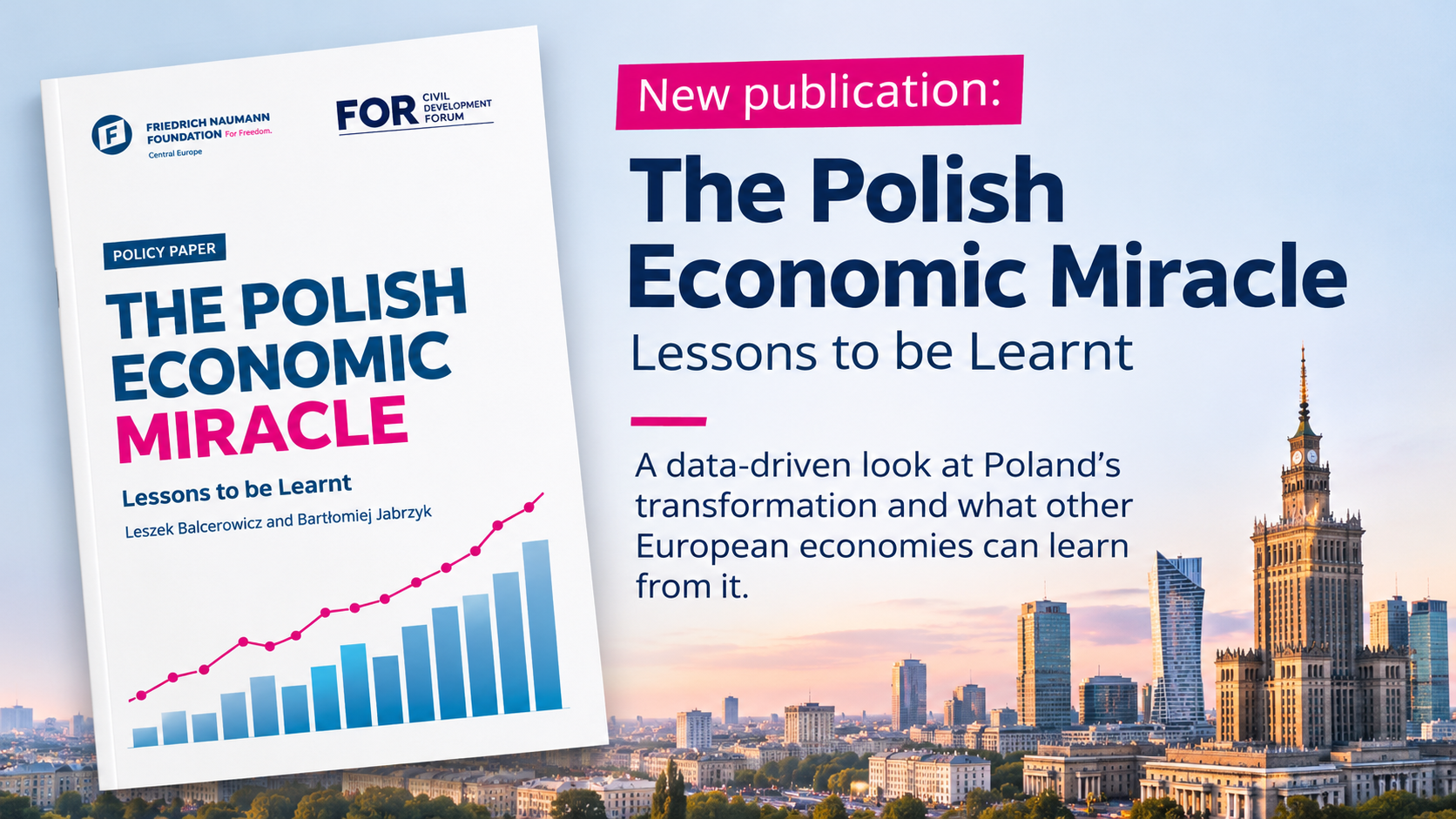
More than three decades after the fall of communism, Poland’s economic transformation remains one of the most striking examples of successful transition in Central Europe. But what exactly drove this development, which common narratives about the transformation hold up against the data, and what lessons can other European economies draw from Poland’s experience?
Our new policy paper, “The Polish Economic Miracle: Lessons to be Learnt,” by Prof. Leszek Balcerowicz and Bartłomiej Jabrzyk, takes a closer look at these questions.
Poland entered the transition in 1990 facing inflation of 585.5%, external debt equivalent to almost 70% of GDP and GDP per capita at only 37% of the OECD average. By 2025, its real GDP had reached 350% of its 1990 level. The paper argues that Poland’s success was not an inexplicable “miracle”, but the result of abandoning a dysfunctional socialist system, introducing market mechanisms, opening the economy and strengthening the rule of law.
At the same time, the authors challenge several persistent myths surrounding Poland’s transformation, including claims that privatisation led to industrial collapse or that foreign investment turned Poland into little more than an “assembly plant”. Drawing on data on industrial production, exports, foreign investment and domestic value added, the publication offers a data-driven assessment of how the Polish economy has changed since 1989.
The paper does not argue that Poland’s experience can simply be copied elsewhere. Instead, it identifies broader lessons: the importance of competition and openness, private ownership, sound public finances, strong institutions and the rule of law. Above all, it stresses the need to address economic problems before a crisis removes the freedom to choose how to respond.
Read the full policy paper “The Polish Economic Miracle: Lessons to be Learnt”
-
Explore what Poland’s experience can teach us about reform, openness and long-term economic growth.
Debate in Berlin
These questions were also at the centre of our discussion in Berlin on 7 September, where Prof. Leszek Balcerowicz joined Svenja Hahn MEP for a conversation on what Germany might learn from Poland’s economic reform experience.
The discussion explored the role of competition, entrepreneurship, economic freedom and sound public finances in restoring stronger economic growth. Balcerowicz also reflected on the political challenge behind reform: even when change is economically necessary, implementing it requires persistence, public support and the ability to communicate why reform is needed.
The new publication now takes this debate further, looking beyond individual policy recommendations to examine the data behind more than three decades of Poland’s economic transformation.
