Brazil
Elections in Brazil – Flávio Bolsonaro in Pole Position for the Second Round


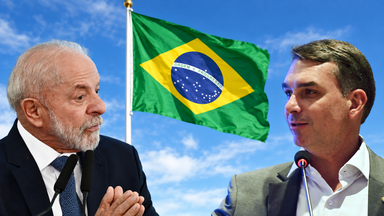
In the end, the first round of the Brazilian presidential election on Sunday turned out to be somewhat more decisive than expected. Instead of the neck-and-neck race still predicted by the polls, right-wing conservative candidate Flávio Bolsonaro—who seeks to continue the political legacy of his father, Jair Bolsonaro— , was leading by approximately 2% with 47.0% of the vote, according to the preliminary official final results, ahead of incumbent President Lula, who is seeking his fourth term in office and received 45.2%.
This means a runoff election between Bolsonaro and Lula will be held on October 25. According to initial tallies in the evening, Bolsonaro was even above 50%, which would have been enough for a victory in the first round. As the evening progressed, however, his lead continued to shrink. A total of 159 million Brazilians were eligible to vote. Since the elections were conducted electronically, the preliminary official final results were available after just four hours.
Several of the candidates eliminated in the first round are generally considered to be on the right of the political spectrum, so Bolsonaro enters the runoff in three weeks as the favorite. However, as an experienced campaigner, Lula will do everything in his power to close the gap before the decisive vote.
Polarization Leaves No Chance for Alternative Candidates
The elections took place against a backdrop of deep polarization between Lula and Bolsonaro and their supporters. As expected, third-party candidates who focused on substantive solutions to the country’s challenges—particularly in the areas of combating corruption, strengthening institutional independence, security, and economic and fiscal policy—struggled to gain traction with voters. None of the alternative candidates managed to secure more than 3% of the vote. This also applies to Romeu Zema, the former governor of the state of Minas Gerais, who ran for president as the candidate of the liberal Partido NOVO. The actual results for the alternative candidates were thus even significantly lower than the pre-election polls had indicated. Ultimately, Sunday’s election boiled down to the question: “Lula or Bolsonaro?
Bolsonaro’s Partido Liberal Party Strengthened in Congress; Liberal Partido NOVO Also Gains Ground
As part of Sunday’s “super elections,” voters also elected the 513 members of the Chamber of Deputies, a majority of the Federal Senate, and the governments of the 26 states and the Federal District of Brasília.
In the Chamber of Deputies elections, Bolsonaro’s “Partido Liberal” (PL) performed best and is projected to win 121 seats. The “FE Brasil” coalition, which supports Lula, is projected to win 88 seats.
In the Senate, which plays a key role in the crucial institutional reforms, the “Partido Liberal” gained 19 seats and now holds 28 of the 81 seats. Lula’s party, the “Partido dos Trabalhadores” (PT), gained 6 seats and now holds 9 seats. As a result, the PL under Bolsonaro has strengthened its position in both chambers but remains dependent on pragmatically organizing political majorities. Traditionally, this is done in Brazil through the “Centrão” (“Big Center”), an influential, informal bloc comprising various conservative and opportunistic parties.
Although Zema had no chance of making it to the runoff as a presidential candidate, his liberal party, the Partido NOVO, succeeded in significantly increasing its number of seats in both chambers. In the Chamber of Deputies, it garnered 2.6% of the vote and is expected to win 10 seats. In the Senate, it managed to secure 5.3% of the vote and win 3 seats.

Will Bolsonaro be able to govern unchallenged after October 25?
The election results show that, when it comes to who should lead the country as president in the future, Brazilians are seeking a highly polarized choice between Lula and Bolsonaro. In Congress, however, they are relying even more heavily than before on political majorities for pragmatic solutions between Bolsonaro’s party and the Centrão—including with strengthened representation from the liberal Partido NOVO.
Should Bolsonaro win the runoff election on October 25, he will have—with skillful negotiation—a good chance of securing Congress’s support for implementing his political agenda. His key goals include securing amnesty for his father, who is currently under house arrest; restoring order to the national finances; improving public safety; and fostering international cooperation with other right-wing conservative governments across the Americas, from the United States to Argentina. Should Lula win the runoff election, however, the already strained relationship with Congress is likely to deteriorate even further, thereby making it even more difficult to make progress on the country’s most pressing problems (to the extent that Lula even seeks to do so).
“Super Elections” in Brazil in 2026 – Where is Latin America’s largest democracy headed?

On October 4, Brazil will hold its next “super elections.” All eyes – both within the country and internationally – are focused in particular on the presidential election, where a neck-and-neck race is expected between the left-leaning incumbent Lula and the right-wing conservative Flávio Bolsonaro, who aims to continue his father’s political legacy. Where is Latin America’s largest democracy headed? A high-level expert event organized by the Friedrich Naumann Foundation for Freedom on September 10, 2026, in Berlin addressed this question and its implications for Germany and Europe.
Elections in Brazil: Causes, Consequences and What Is at Stake
Brazil is defining its future amid polarization, institutional crisis, and demands for renewal. What is at stake on October 4, and why this election will shape the country’s direction. An article by Rafael Mendonça.