Brazil
“Super Elections” in Brazil in 2026 – Where is Latin America’s largest democracy headed?

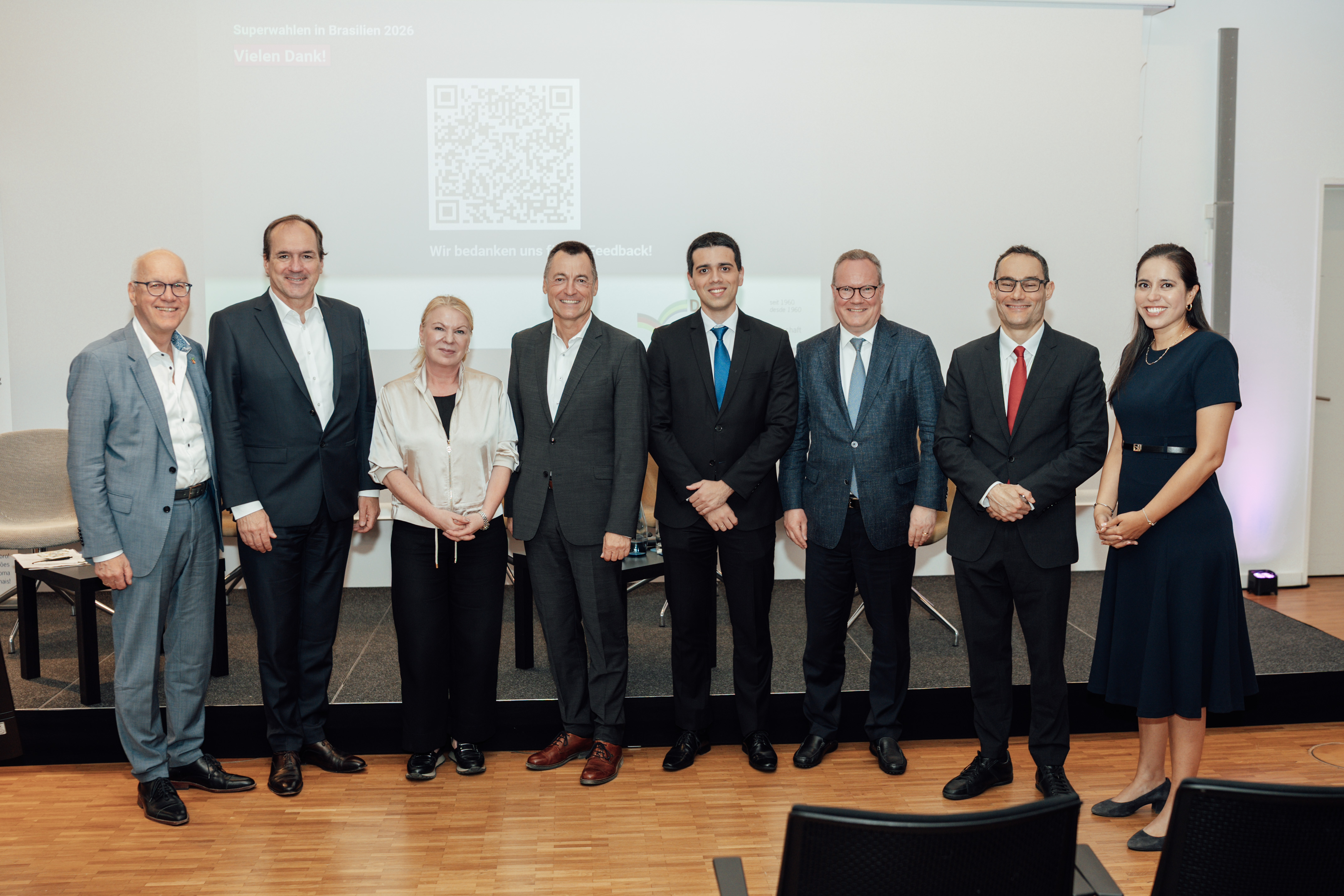
On October 4, Brazil will hold its next “super elections.” All eyes – both within the country and internationally – are focused in particular on the presidential election, where a neck-and-neck race is expected between the left-leaning incumbent Lula and the right-wing conservative Flávio Bolsonaro, who aims to continue his father’s political legacy. Where is Latin America’s largest democracy headed? A high-level expert event organized by the Friedrich Naumann Foundation for Freedom on September 09, 2026, in Berlin addressed this question and its implications for Germany and Europe.
Brazil’s “super elections” on October 4 are just a few weeks away. The approximately 156 million eligible voters will elect the president, vice president, the 513 members of the Chamber of Deputies, a majority of the Federal Senate, as well as the governments of the 26 states and the Federal District of Brasília. All of this takes place on a single day, providing clarity for the next four years regarding the country’s political balance of power—unlike in Germany, which, due to staggered election dates, often feels as though it is in a perpetual election campaign. Should none of the presidential candidates secure a sufficient majority in the first round, a runoff election will be held on October 25 between the two candidates with the best results.
Polls suggest a close race in the decisive second round between incumbent Lula and his right-wing conservative challenger Flávio Bolsonaro, the son of former President Jair Bolsonaro, who is serving a sentence of house arrest on charges of plotting a coup attempt following his 2022 election defeat. Regardless of who ultimately becomes president, one thing is already clear: Lacking a majority in Congress, the election winner will once again have to work pragmatically with the Centrão (“Big Center”), an influential, informal bloc comprising various conservative and opportunistic parties.
“Super Elections” in Brazil 2026 – Where Is Latin America’s Largest Democracy Headed?” was the title of a high-level expert event organized by the Friedrich Naumann Foundation for Freedom (FNF) on September 09, 2026, in cooperation with the German-Brazilian Society (DBG).
In his opening remarks, the Brazilian Ambassador to Germany, H.E. Rodrigo de Lima Baena Soares, highlighted the close political and economic ties between the two countries, which were particularly evident this year. For instance, Brazil was the partner country at this year’s Hannover Messe in April, and on the sidelines of the event, the 3rd German-Brazilian Government Consultations took place under the leadership of Chancellor Merz and President Lula. Referring to the EU-Mercosur Agreement, which was implemented—at least provisionally—on May 1, the ambassador noted that Brazil is always open to partnerships that benefit both sides.

H.E. Rodrigo de Lima Baena Soares, Brazilian Ambassador to Germany
In his welcoming remarks as host for the FNF, board member and treasurer Roland Werner provided concrete examples of Brazil’s international competitiveness, which extend far beyond the well-known examples of the agricultural sector and natural resources. For instance, aircraft manufacturer Embraer is a major global player in the regional jet market. In the digital economy, Brazil has developed into an important international hub for fintech companies and startups, as demonstrated, for example, by the success of Nubank, the country’s largest digital bank with over 140 million customers.
The ensuing discussion was expertly moderated by Dr. Georg Witschel, former German ambassador to Brazil and current vice president of the DBG.
Dr. Hans-Dieter Holtzmann, FNF’s project director for South America, pointed out that Brazil has all the ingredients to be a superpower: it is the fifth-largest country in the world with enormous natural resources, making it nearly self-sufficient, and it has a traditionally open and neutral foreign policy. By comparison, however, Brazil’s economic growth of 2% is below its potential. Of particular concern is the sharp rise in public debt, which is leading to higher interest rates and placing a burden on consumers and businesses.

Dr. Hans-Dieter Holtzmann, FNF’s project director for South America
Susann Kreutzmann, the NZZ’s correspondent in Berlin, turned her attention to the continuing deep polarization in Brazil. Due to the sharp political divide between President Lula and the Bolsonaro family and their respective supporters, a rift has run through the country—even down to individual families—that is felt everywhere and is paralyzing the nation. There is a high level of perceived dissatisfaction among the population, for example regarding high food prices. In this polarized environment, presidential candidates running as alternatives to Lula and Bolsonaro are finding it difficult to attract voters’ attention.
Rafael Pereira Mendonça, a public policy analyst at Instituto Libertas—an organization affiliated with the liberal Partido NOVO—who had traveled from São Paulo specifically for the event, presented the perspective of younger Brazilians. He noted that polarization is causing a great deal of dissatisfaction among young people, who expect political solutions to their everyday concerns rather than ideological debates. These concerns include, in particular, the difficult economic prospects for finding a good job, high crime rates—especially in city centers—and a loss of trust in institutions due to corruption scandals and a decline in moral values. Instituto Libertas has worked with experts to develop over 800 policy recommendations on the country’s key issues.

Rafael Pereira Mendonça, a public policy analyst at Instituto Libertas—an organization affiliated with the liberal Partido NOVO
Torsten Herbst, a consultant and former member of the German Bundestag, emphasized—just a few days after the state elections in Saxony-Anhalt—the general challenge of winning over voters with pragmatic politics in times of increasing polarization. Germany needs access to new markets for its export-oriented economy, especially in light of the geopolitical challenges posed by the U.S. and China. That is why the final ratification of the EU-Mercosur Agreement next year – after more than 25 years of negotiations – is so important.
During the discussion with the audience, a key focus was on Brazilian foreign policy and the impact of the election on German-Brazilian relations. The panel agreed that under President Bolsonaro, relations with the U.S. and Argentina—which are currently under significant strain—would improve. Furthermore, the victory of several center-right governments in recent elections in South America (Argentina, Bolivia, Chile, Peru, Colombia) presents an opportunity for closer regional political and economic cooperation to promote trade and investment and to collaborate across borders in the fight against organized crime. The importance of BRICS for Brazil and cooperation with China, however, is likely to decline under Bolsonaro.
As for German-Brazilian relations, there was a consensus that Germany would have to accept any election outcome and work with the respective Brazilian government, precisely because of the enormous opportunities for closer cooperation between the two countries. This must take place on an equal footing and without German arrogance. On the Brazilian side—regardless of the election outcome—there is hope stemming from the fact that the Brazilian Congress approved the EU-Mercosur Agreement by an overwhelming majority—despite the otherwise strong polarization, particularly in the run-up to the elections—and even unanimously in the Federal Senate.
Special thanks go to the FNF’s Berlin office for organizing the event and to Diana Luna, the Americas Program Officer, for its conceptual design.