Tunisian–German Green Hydrogen Dialogue
From Research to Partnership: Carbon Hub and the Tunisian–German Green Hydrogen Dialogue

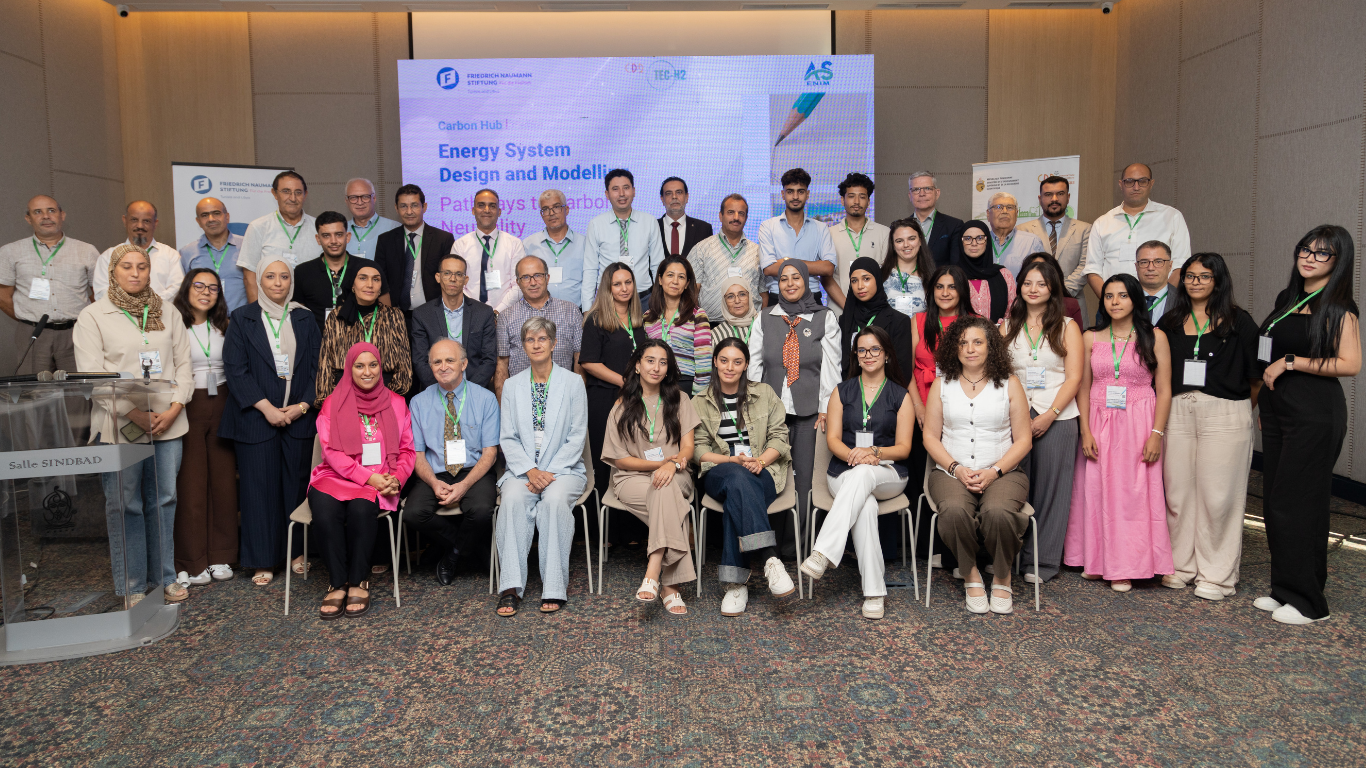
Through its support for ENIM and the development of a green hydrogen consortium, the Friedrich Naumann Foundation for Freedom is helping connect scientific expertise, institutional cooperation and economic opportunity.
How can scientific cooperation translate into opportunities for Tunisia’s energy transition and a stronger partnership with Germany?
The third Annual Meeting of Carbon Hub, held in October 2026 under the theme “Energy System Design and Modelling: Pathways to Carbon Neutrality,” provided a platform to explore this question.Bringing together Tunisian researchers and contributions from Germany and Morocco, the program connected energy modelling, hydrogen technologies and industrial applications with the decisions needed to advance a competitive low-carbon economy.
For the Friedrich Naumann Foundation for Freedom (FNF), supporting this exchange reflects a commitment to innovation, informed policymaking and international cooperation. It also builds on a broader institutional effort: supporting the National Engineering School of Monastir (ENIM) in developing a green hydrogen consortium capable of sustaining collaboration beyond individual events.
A consortium that gives cooperation continuity
FNF’s support for ENIM has helped establish a framework for bringing expertise together around green hydrogen. The consortium provides a basis for connecting research teams, sharing knowledge and identifying complementary capabilities across institutions.Its value lies in giving cooperation continuity. Developing a hydrogen economy requires expertise in electricity generation, production technologies, storage, infrastructure, industrial demand and economic modelling. A consortium can connect these fields and help researchers approach shared challenges through coordinated work.
For ENIM, this framework strengthens its role as a convening institution within Tunisia’s emerging hydrogen research ecosystem. For its partners, it creates opportunities to develop research relationships, exchange methods and identify questions that require joint investigation. FNF’s contribution therefore extends beyond support for a scientific meeting. By backing ENIM’s efforts to structure this network, the Foundation has helped create conditions for sustained cooperation, with Tunisian expertise and institutional ownership at its centre.
Building the evidence for investment
The Carbon Hub program demonstrated the relevance of this collaborative approach. Presentations examined Tunisia’s long-term hydrogen ambitions, electricity transition scenarios, carbon pricing and the additional renewable electricity required for green hydrogen production.
Other contributions addressed the geographical screening of potential production sites, hydrogen storage technologies and the operational monitoring of electrolysers.
These questions matter for investment. Reliable models can help compare technological options, assess infrastructure needs and identify potential constraints before resources are committed. Sharing methods across a research network can also improve the basis for discussion between scientists, public institutions and businesses.The consortium offers a framework through which such exchanges can continue, helping connect individual research contributions to a broader understanding of Tunisia’s energy choices.
German expertise and reciprocal partnership
German academic contributions added practical experience to this dialogue. Professor Walter Théodore Czanetzki of Esslingen University of Applied Sciences contributed a plenary lecture on building a hydrogen economy through selected projects and lessons learned. Professor Ertan Akgün of Technische Hochschule Ingolstadt contributed an online lecture on hydrogen and the circular economy.These contributions complemented Tunisian research on energy systems, local resources and technological applications. Together, they illustrated the value of reciprocal cooperation: German project experience can inform discussions in Tunisia, while Tunisian researchers contribute their own solutions, analytical capabilities and knowledge of national priorities.
The consortium strengthens the institutional basis for developing these relationships over time. In doing so, FNF’s support can help deepen Germany’s role as a knowledge and innovation partner in Tunisia, while creating a platform with potential for wider exchange across North Africa.
Connecting shared economic interests
The programme also highlighted areas where scientific collaboration could support mutual economic interests.
For Tunisia, hydrogen research can contribute to specialised skills, industrial innovation and the assessment of new opportunities for local value creation. For Germany, stronger relationships with Tunisian research institutions can provide a foundation for future technological and commercial cooperation.Presentations explored hydrogen-rich syngas production from Tunisian date palm waste, industrial waste heat recovery and synthetic sustainable aviation fuels. These topics connect the energy transition to specific resources, industrial processes and potential markets.
Turning this potential into viable activity requires careful attention to costs, infrastructure, domestic needs and demand. It also requires clear rules that allow entrepreneurs and investors to assess opportunities with confidence. By supporting a forum for examining these questions, FNF brings a liberal perspective to the discussion: innovation supported by open exchange, competition and predictable institutions.
From a scientific network to practical cooperation
The meeting’s roundtable placed the central challenge clearly on the agenda: translating energy scenarios into concrete actions, investments and policies.
The green hydrogen consortium supported through ENIM provides an institutional foundation for continuing that work. Its future value will depend on how effectively partners develop joint research, maintain exchanges and connect scientific findings with practical needs.
Through this support, the Friedrich Naumann Foundation for Freedom is helping strengthen the relationships that make cooperation possible. Carbon Hub gives these relationships a forum; the consortium gives them continuity. Together, they offer a basis for a Tunisian–German partnership built on expertise, local initiative and shared economic opportunity.


