Opening of the Goethe-Institut in Dakar
Value transmission under the baobab

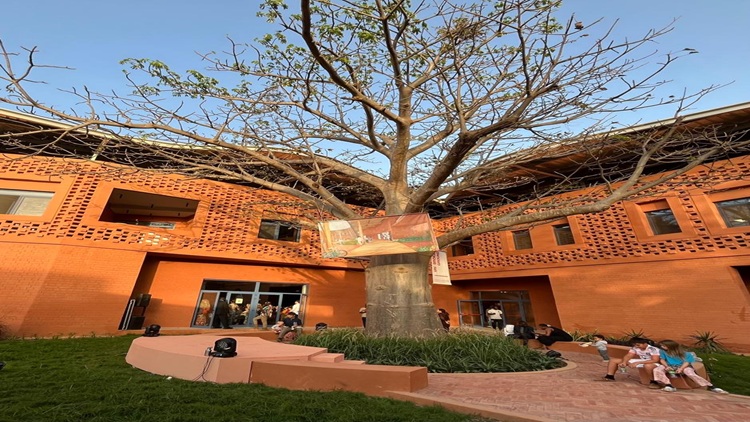
The light-filled, brick-red new building, which embraces the ancient tree at its center, appears both inviting and permeable. Most of the numerous guests pause at the entrance in admiration and respectfully take in what Pritzker Prize (2022) laureate Féré and his team have designed and realized on behalf of the German government: a new German cultural institute in Senegal, West Africa.
In the style of African Futurism—in which visions of tomorrow emerge in Africa—the building combines construction techniques and materials historically inspired by Mali and Burkina Faso with the latest insights in bio-ecological architecture, true to the motto: as little concrete as necessary, as much clay as possible. No air conditioning; instead, cleverly designed airflow, ample space for encounters and mobile work, and an inviting agora at the foot of the baobab, known as an arbre à palabres (palaver tree). This approach is key to an alternative and sustainable mode of construction in which less concrete, less sand, and lower energy consumption offer solutions to the urban planning challenges of the future.
With this project, the German state has achieved a real coup. Culturally vibrant Senegal gains an inspiring enrichment of its cultural scene, and Germany gains an attractive calling card.
Goethe-Institutes, much like German political foundations, act as intermediaries between worlds. Through multidimensional programs, they convey the democratic and liberal values that Germany stands for, fostering a culture of dialogue and exchange based on education, creation, and the promotion of innovation. Their initiatives stand for democracy and liberal values grounded in a humanistic worldview. They strengthen political and civic engagement among the population, introduce young people to local entrepreneurship, and help establish a shared language, a shared voice, and a shared visibility between the two continents.
In a world where established partnerships and traditional instruments of diplomacy and cooperation are increasingly reaching their limits, actors in foreign cultural, development, and economic cooperation are taking on an ever more strategic role. Accessible, welcoming, and affordable—bypassing war, extremism, and populism—they serve as important door openers and make a significant contribution to the positive image of the “Made in Germany -brand” worldwide.