Espionage
China’s War of Spies: What Europe Must Learn from Taiwan

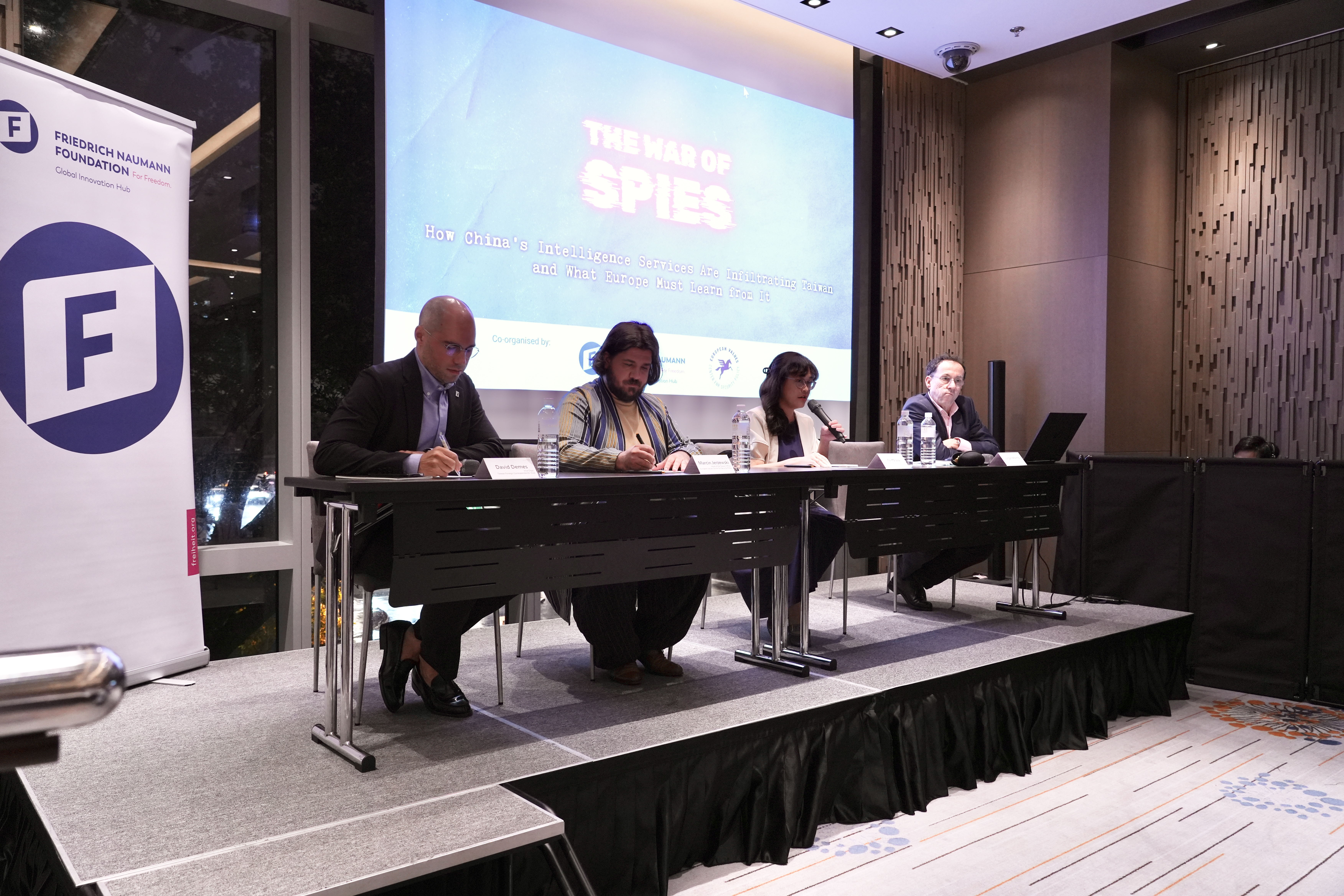
Panelist from “The War of Spies: How China’s Intelligence Services Are Infiltrating Taiwan—and What Europe Must Learn from It” launch event.
China’s pressure on Taiwan begins long before any potential military invasion. Espionage, disinformation, and the targeted infiltration of democratic institutions aim to weaken society from within. How these methods interact—and what they mean for Europe—is the subject of the FNF report “The War of Spies: How China’s Intelligence Services Are Infiltrating Taiwan—and What Europe Must Learn from It.”
Beyond Traditional Espionage
The author, Jürgen Kremb, a journalist, sinologist, and former long-serving SPIEGEL correspondent, draws on academic literature, reports from Taiwanese security agencies, and confidential background interviews. His central argument: Taiwan is a testing ground for influence operations whose methods also threaten European democracies.
The report describes an interconnected system of intelligence services, military cyber units, and so-called United Front networks. A central pillar of this strategy is United Front work, a long-standing CCP approach to cultivating individuals and organizations outside the Party in order to advance Beijing’s political interests.
In Taiwan, Kremb argues, business associations, cultural and religious groups, and other legal or semi-open networks can be used to build influence among political, economic, and social elites—what the report calls the “instrumentalization of friendship.”
At the launch event, jointly organised by the Taipei Office of the Friedrich Naumann Foundation for Freedom and the European Values Center for Security Policy, Kremb warned: “If you give your enemy too much leverage in a democratic society, he will fight you down until the last day of democracy is here.” He called for stronger legal instruments against infiltration and better preparation for crises.
The report and its launch attracted considerable media attention, including the German BILD. A particular focus was Kremb’s own account of being approached and followed by a Chinese woman in Taiwan.
Speaking to BILD, Marie-Agnes Strack-Zimmermann, Chair of the European Parliament’s Committee on Security and Defence, warned: “The case of German journalist Jürgen Kremb is a warning that we in Germany and Europe must not ignore.” It demonstrates that “transnational repression by the People’s Republic of China is not an abstract phenomenon on the other side of the world—it affects us too.”

Intimidation Across Borders
Lutz Güllner, Head of the European Economic and Trade Office in Taiwan, also focused on transnational repression: efforts by states or their proxies to threaten and intimidate individuals beyond their own borders. Cyber harassment and the exposure of personal information can push journalists, researchers, and diaspora communities towards self-censorship.
“This is much more than just foreign interference—it is an issue of human rights, freedom of expression, and sovereignty,” Güllner stressed during the launch.
Defending Democracy, Preserving Openness
The discussion revealed differing views on how democracies should respond. While Kremb advocated closer scrutiny and tougher measures, Marcin Jerzewski, Head of the Taiwan Office of the European Values Center for Security Policy, warned against countermeasures that undermine democratic freedoms themselves.
“Once the state starts deciding which political narratives are permissible, you start resembling your adversary,” Jerzewski said. If countering espionage restricts legitimate academic exchange or encourages self-censorship, authoritarian systems will already have achieved part of their objective.

Launch event of "The War of Spies: How China’s Intelligence Services Are Infiltrating Taiwan—and What Europe Must Learn from It."
Ultimate Danger is Distrust
Expanding on this warning, Professor Liu Yu-hsi, Member of Whole-of-Society Defense Resilience Committee, Taiwan’s Presidential Office, shifted the focus toward the deeper strategic psychological mechanisms that transcend regional borders. She observed that modern interference operations are designed to weaponise domestic grievances, explaining: “The goal of infiltration is to try to bring more distrust to our society. Try to stop our society from cooperating with each other, trusting each other.” The ultimate danger is not a sudden shift in political ideology, but the collapse of mutual civic trust.
For Europe, the report sets out a concrete agenda: draw more systematically on Taiwan’s experience, deepen exchanges on Chinese influence operations, and strengthen cooperation on protecting critical infrastructure. Alongside capable security institutions, this requires an informed society, independent media, and the ability to recognise manipulation early.