Serbia
David Beats Goliath!

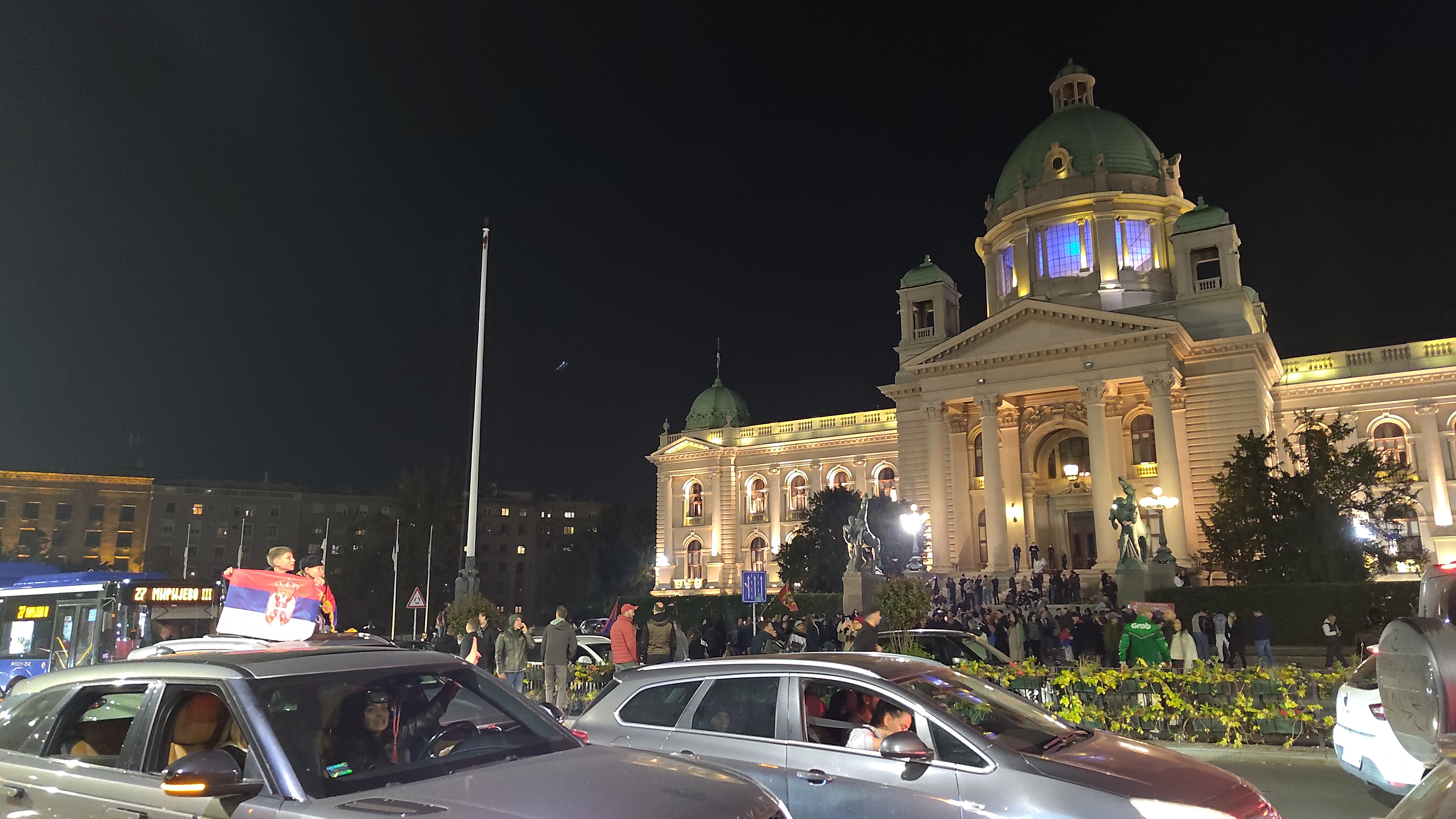
National Assembly of Serbia
© FNFThe student list has made the seemingly impossible possible in Serbia: the former Prime Minister and President Aleksandar Vučić, who had sought to return to the office of Prime Minister through this election, has been voted out of power. It was an impressive testament to democratic participation, in a clarity that hardly anyone had expected.
When Aleksandar Vučić concedes defeat at 9.30 pm, jubilation breaks out across the whole city. Even whilst he is delivering his brief press statement, the first fireworks shoot into the sky, cars honk their horns and people cheer. Within half an hour, Belgrade city centre grounds to a standstill. Once again, hundreds of thousands of citizens pour into the streets, embrace one another, and some weep with joy. The violence-prone supporters of the governing Serbian Progressive Party (SNS), who had been omnipresent throughout election day, had already fled the city’s key locations.
People are celebrating their victory over a system that had exploited the state for a decade and a half and rendered its institutions meaningless. While party officials enriched themselves shamelessly, the rule of law was hollowed out and the common good was subordinated to holding on to power. The students, who had protested against this system for almost two years, first succeeded in bringing large parts of the Serbian population onto the streets and then to the ballot boxes. Their student list, made up of politically inexperienced professors, artists and ordinary citizens, had brought to its knees a party that had previously dominated every area of public life.
Hope and Mistrust
The day had begun full of hope. While the nationwide free-to-air TV channels have been under government control for years, the government had removed the two remaining independent news channels from cable programming just a few weeks before the election. Yet videos of queues hundreds of meters long in front of polling stations in Vienna, Stuttgart and Chicago spread rapidly across social media. In Serbia, by 10 a.m., already twenty percent of eligible voters had cast their ballots; some had even queued for hours in bathrobes.
Too often, however, the hopes of the Serbian people had been disappointed before. And when, around midday, it became clear that turnout would be extremely high and that the SNS would hardly be able to win, even with the election fraud it had regularly practiced, uncertainty spread across the country. The mood in front of the polling stations turned as gangs of thugs appeared; in the city center, countless armored vehicles of the special police were deployed. Hardly anyone believed that the party, which had made the state its own for a decade and a half, would simply hand it over.
An Outcome Against All Expectations
But things turned out differently. The desire for change was simply too overwhelming. And Vučić, who had for years denounced opponents as “traitors to the fatherland” or “haters of Serbia”, showed at least a modicum of decency in conceding defeat and thereby prevented open violence on the streets. Election observers from the Council of Europe and the OSCE had earlier reported massive attempts at electoral fraud during the final hours. Before their eyes, desperate SNS members had stuffed pre-filled ballots into the ballot boxes. But it was clear that even massive fraud could no longer reverse the result.
According to the preliminary final result, the student list wins 52.9 percent of the vote, the SNS 38.8 percent. The “Studentska Lista” benefits from a huge turnout, which, including votes from the diaspora, will be above seventy percent. Apart from four small minority parties, for which the three-percent threshold does not apply, no other party will be represented in the future parliament. Many parties had chosen not to stand in favour of the Students’ List.
The students and their parliamentary representatives have resolved to “reclaim” the state structures captured by the SNS: state broadcasting and the government-friendly media are to be freed, the public prosecutor’s office depoliticized, and the authoritarian system, in which party officials could do as they pleased, dismantled. Ultimately, the list wants to create the conditions for free and fair elections, in which pro-European, nationalist and other parties can compete on equal terms. Therefore, Serbia’s political direction will be decided only at a later date. That such a decision can be made at all, however, is something the Serbian people owe to their young generation.
Markus Kaiser is Project Director for the Western Balkans at the Friedrich Naumann Foundation for Freedom, based in Belgrade.
Election night in Belgrade