Strategic Partnership
South Africa as Germany’s anchor in Africa

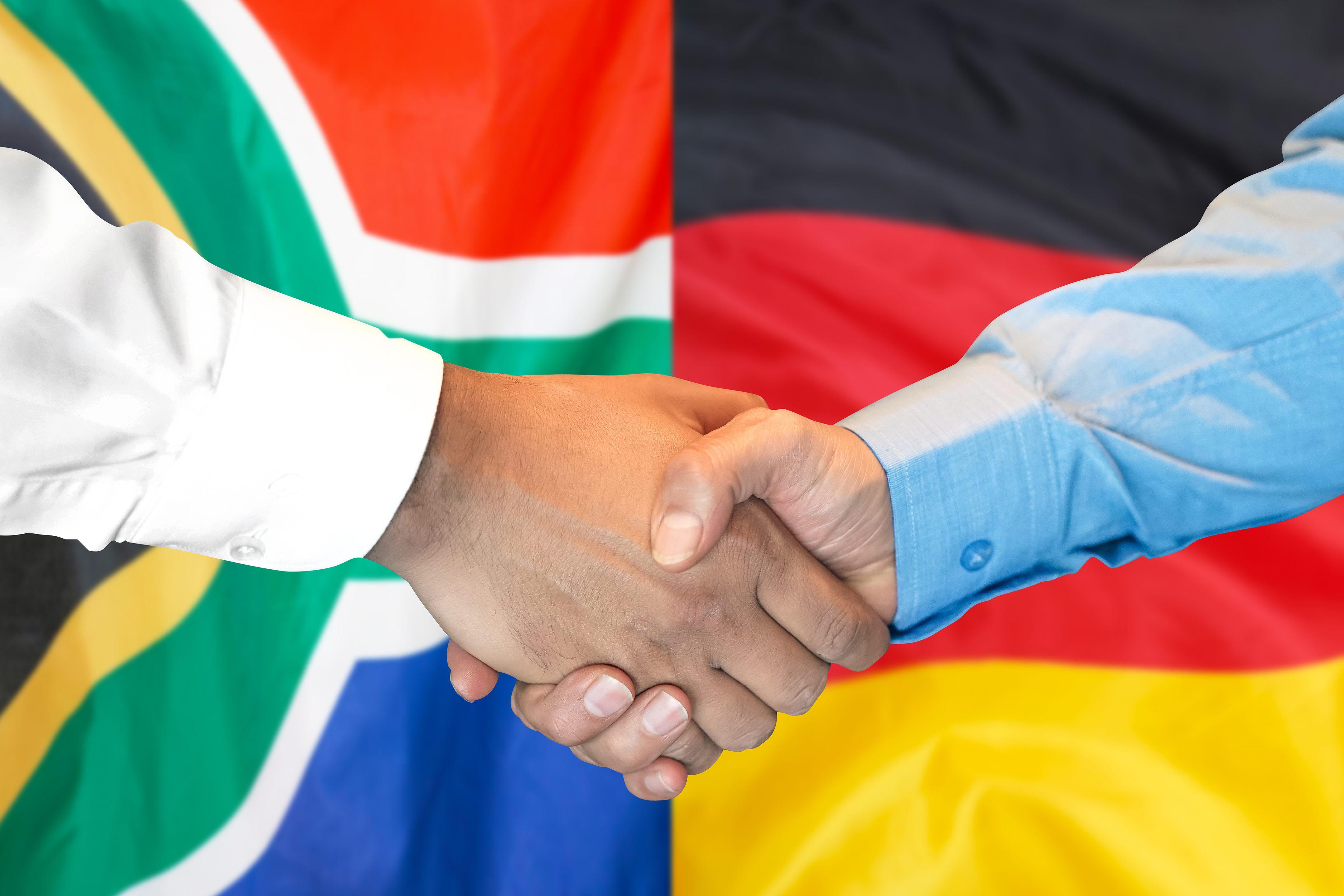
Business handshake on the background of two flags. Men handshake on the background of the South Africa and Germany flag. Support concept
© ShutterstockWhen German Foreign Minister Johann Wadephul visited South Africa, and other African countries in July this year, it was easy to read the trip as just another stop on a diplomatic tour. But that would miss the larger picture. The visit highlighted something more important: South Africa has become Germany’s most important point of reference on the African continent.
That is not only because of trade, although the trade relationship is significant between the two nations. Bilateral trade, for example, reached about €15 billion in 2025, and more than 600 German companies operate in South Africa, employing around 100,000 people. His visit also highlights that South Africa sits at the intersection of many of the issues that now shape German foreign policy. Energy transition, critical raw materials, industrial cooperation, multilateralism, and democratic resilience all come together here. If Germany wants to think seriously about its role in Africa, South Africa is where that thinking must become visible.
For a long time, German engagement with Africa was often discussed in broad and somewhat vague terms – a conversation about Africa, without Africa. The continent was presented as a future market, a development priority, or a geopolitical space in need of attention. South Africa changes that conversation. It is not an abstract case. It is a country with real economic weight, a functioning diplomatic infrastructure, and a political profile that makes it relevant far beyond its own borders. Germany, hence, does not engage with South Africa out of mere charity or symbolism. It engages because the relationship matters, for Germany, for South Africa and the broader continent. The recent upgrade of ties to a Strategic Partnership makes that even clearer. The two countries already have a Bi-National Commission that has existed since 1996, and in 2026 the relationship was explicitly elevated to a Strategic Partnership with a Joint Action Plan.
These partnerships and ongoing collaboration matter because it shows that both governments see the relationship as something that needs to be managed with more structure, more regular dialogue, and more ambition. Strategic partnerships should not remain high-level labels. They have to produce something concrete in the lives of people and institutions. In South Africa’s case, that means cooperation in areas that are already familiar but still unfinished. Energy reform remains one of the most obvious examples. Germany has committed substantial support to South Africa’s just energy transition, including a €200 million concessional climate loan and broader cooperation on energy, climate, and related reform efforts.
South Africa’s transition will only succeed if it is supported by investment, technology, planning and political patience. Germany can contribute here in ways that go beyond short-term projects. It can bring technical expertise, industrial know-how, and a long tradition of institutional cooperation. This is pivotal because South Africa needs partners who understand that transformation takes time. The same is true for skills development. South Africa’s future will depend not only on new policies, but on the people who can implement them. That is where German cooperation can have lasting value. It can help connect universities, companies, training institutions, and public actors in a way that strengthens the country’s economic base instead of just creating isolated initiatives.
There is also a broader political dimension. South Africa remains one of the few African countries with enough diplomatic weight to shape debates on the global stage. As the only African member of the G20 and a country that Germany describes as its most important partner in sub-Saharan Africa, it is a natural partner when questions of multilateralism, climate diplomacy, and international order are on the table. At a time when global politics is becoming more fragmented, that kind of partnership is not a luxury. It is necessary. Still, the relationship should not be understood in one direction only.
South Africa is not merely a place where Germany can project its interests. It is also a partner that can help Germany understand the future of global politics more clearly. South Africa knows what it means to govern under constraint, to balance ideals with reality, and to keep democratic institutions functioning under pressure. Those are not minor lessons. They are increasingly central to the question of how open societies remain stable. That is why the idea of South Africa as Germany’s key anchor in Africa works so well. An anchor is not the whole ship, and it is not the destination – it gives direction, stability and depth.
South Africa plays that role for Germany on the African continent. It is where economic interests, political values and strategic questions meet in a particularly concentrated way. If Germany wants a serious Africa policy, it will need more than goodwill and selective attention. It will need partners that are strong enough, complex enough and credible enough to matter over time. South Africa is such a partner. The challenge now is to treat that fact with the seriousness it deserves.