Lapsset Corridor
A bet gone wrong, the odds have shifted


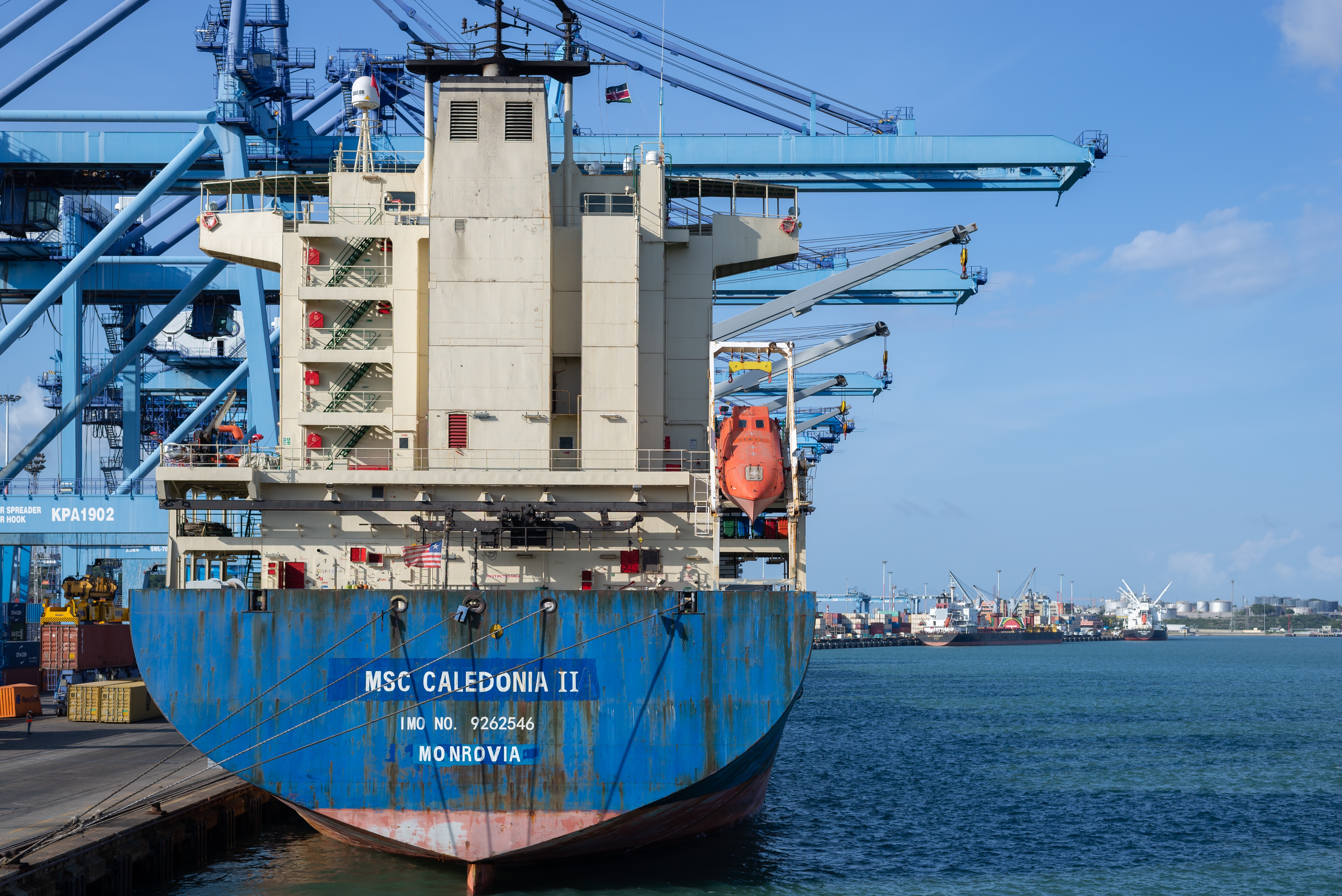
Vessel at container terminal in port.
© ShutterstockFor years, the Kenyan Lamu Port seemed an ambitious bet gone wrong. Three deep-water berths carved into Manda Bay at a cost of $480 million were meant to open up landlocked Ethiopia and South Sudan to the Indian Ocean. But since their opening in 2021, they have been left to gather barnacles, while the road, railway and pipeline that were supposed to reach them never made it further than the drawing board. In all of 2024, less than 75,000 tonnes moved through Lamu, a mere rounding error for a facility of that size. On most days, the loudest sound on the quay was the tide.
Then, in May 2026, the Baltimore Express berthed at the port. Operated by Hapag-Lloyd, a German shipping company, the 369-metre ship is the largest vessel ever to call at any port in East or Central Africa. More than that, it underlines a remarkable change. In 2025, Lamu's cargo volumes jumped from around to almost 800,000 tonnes, and since January the port authority has logged more than 120 calls. Abdulaziz Mzee, who runs the port, is already comparing Lamu to Singapore, Rotterdam and Hamburg. But none of this is down to Lamu itself. It is the blockade of the Strait of Hormuz. Shipping lines have to reroute, and Lamu is far from the conflict zone.
Yet the port is only one piece of a much bigger plan. The Lamu Port-South Sudan-Ethiopia Transport Corridor, or LAPSSET, is one of the most ambitious infrastructure projects in East Africa. Kenya, Ethiopia and South Sudan launched it in 2012, with Uganda joining later. It envisages 32 berths at Lamu, railways and roads running from there into Ethiopia and South Sudan, pipelines for crude oil from both countries, as well as industrial parks, airports and special economic zones along the route. The corridor is meant to give the landlocked states a second route to the coast, to reduce Kenya's dependence on its main port at Mombasa, and to open up the neglected north of the country, where oil and gas deposits are still barely tapped.
Little of it exists yet. Still only three berths at Lamu are in operation. Key stretches of the roughly 1,730-kilometre road between Lamu and northern Kenya are still missing, and railway construction towards Ethiopia has not begun. Without proper roads and rails, almost no cargo can move. Despite its potential, Lamu is still a port with no land behind it.
The bottleneck is finance. The corridor authority puts the total cost at more than $24.5bn. The European Union is not involved: its Global Gateway funding for African corridors is going elsewhere, for example to the Lobito corridor in the South of the continent. The contract for the first three berths went to the China Communications Construction Company. That places LAPSSET within the Belt and Road Initiative, China's vehicle for extending its links into East Africa. How the missing sections are to be financed remains unclear.
But for the neighbouring countries, the stakes are high. Ethiopia handles almost all of its foreign trade through Djibouti, where China has maintained a military base since 2017; LAPSSET would be the first alternative. South Sudan draws most of its revenue from oil exports, which have to travel by pipeline to the Red Sea through Sudan - a country in civil war that charges steep transit fees. Through LAPSSET, that oil could be shipped out of Lamu instead.
This is where the economics have shifted. The corridor's profitability was in doubt from the outset, yet recent months have changed the picture. Following the blockade of Hormuz, a key sea route in the global oil trade, crude prices surged. At those prices, an alternative route through Kenya becomes more attractive, and it would align with South Sudan’s political interests. Oil discoveries in north-western Kenya and western Uganda add a further argument, if on a smaller scale.
For Germany, this is not about replacement. South Sudan produces around 150,000 barrels a day, a fraction of German demand. It is about options. As recently as 2020, almost a third of Germany's imported crude oil came from Russia; today the share is zero. Diversifying supply chains has been a priority of German foreign policy ever since. Foreign Minister Johann Wadephul just made his third trip to Africa in a matter of months, emphasising the value of reliable African partners in unsettled times. Whoever controls ports, roads and pipelines decides who gets access to global markets and raw materials. Infrastructure policy has become security policy.
The gaps in the corridor match the strengths of German suppliers: rail technology, port logistics, energy infrastructure and vocational training. The shortage of skilled workers and reliable local suppliers is one reason construction is moving so slowly. This opens up opportunities for German companies. Investing here secures market access, and the transfer of technology and expertise benefits both sides. Yet the value does not lie in the pipeline alone, but in what grows around it: every installation creates jobs, wages circulate locally, and other industries follow.
But the gains are not evenly shared. In Kenya, the corridor cuts through a region rich in wildlife and cultures. Most communities along the route are pastoralists, moving with their herds in search of water and pasture. Lamu already knows the price: in 2018, a Kenyan court awarded compensation to around 4,700 fishermen who lost their fishing grounds to port construction. The corridor creates jobs and business opportunities, but it also disrupts land use and livelihoods.
Lamu's rise is the product of another region’s crisis. The Baltimore Express berthed at Lamu because Hormuz is closed. Whether it returns will not be decided at the quay but along the 1,730 kilometres behind it. Whoever builds that stretch decides who the corridor belongs to. So far, only Beijing has an answer.