Poll Dancing
Laughing our way through South Africa’s politics

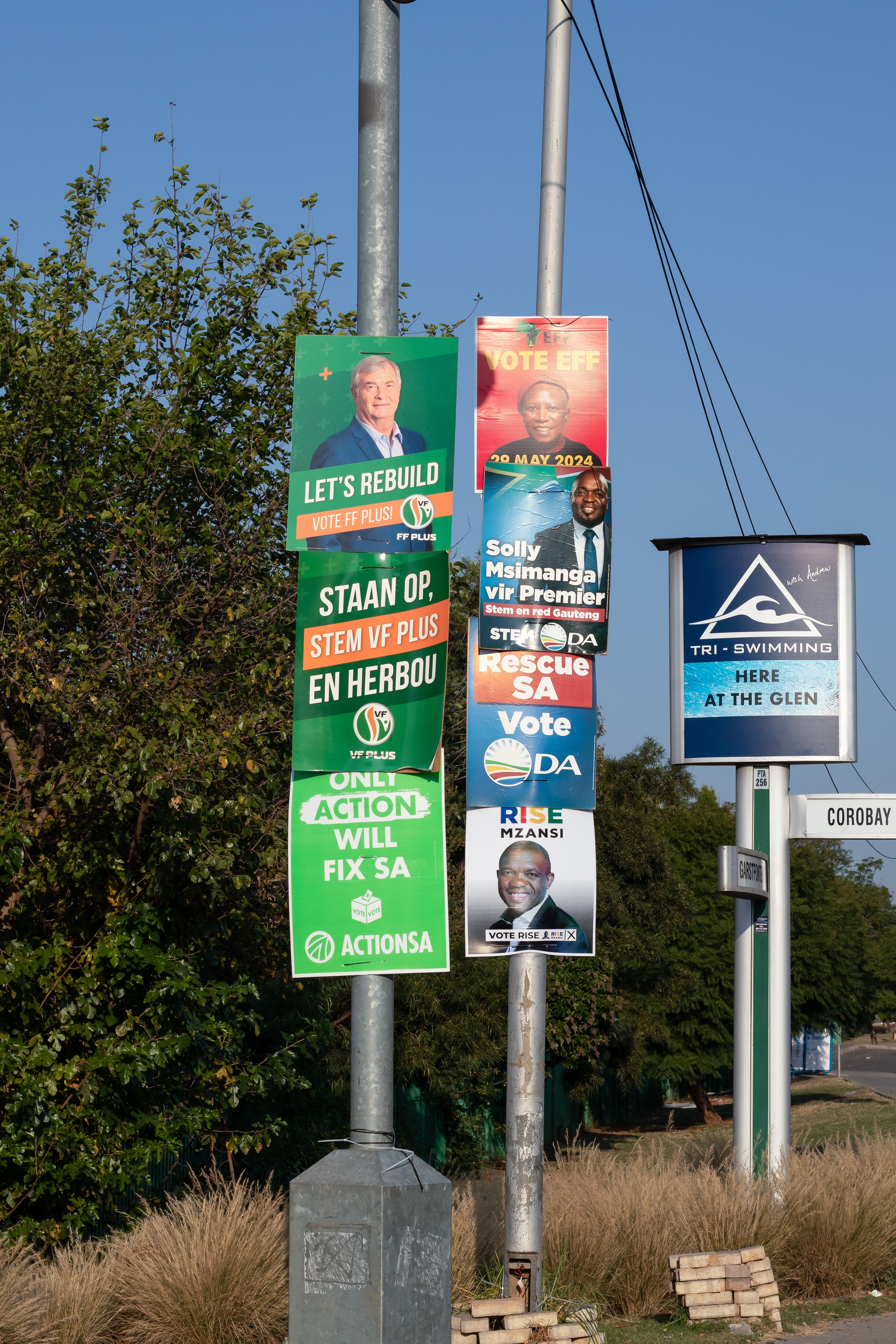
A collection of election posters on a street pole.Julius Malema, ActionSA, Rise Mzansi, DA, FF+, EFF. South Africa 2024 Elections.
© ShutterstockPoll dancing?
The words could mean a few different things. First, they could refer to the political party posters currently hanging on light poles across South Africa as we gear up for the 2026 local government elections. Or, of course, could mean exactly what you think it means.
Either way, South Africa’s politicians are certainly dancing, doing their best to persuade voters to give them another chance at the ballot box.
But politics can be daunting, complicated and, for many young South Africans, downright boring. So, when I received an invitation to attend Poll Dancing, a political comedy show presented by Politically Aweh and supported by the Friedrich Naumann Foundation for Freedom (FNF) South Africa, I expected nothing more than an ordinary evening of comedy.
I was wrong. And pleasantly so.
Hosted at the Homecoming Centre in District Six, Cape Town, the show created space for meaningful conversations about South African politics without losing sight of the humour that so often helps us make sense of our country's realities.
Perhaps that is one of the ways South Africans cope. We laugh. We make jokes about the things that frustrate us, the things that disappoint us and, sometimes, the things that frighten us. It is not that we do not take our problems seriously. Rather, humour offers us a way to confront the weight of our circumstances without being completely consumed by them.
And there we were, laughing our way through some rather serious political conversations.
With a panel of informed comedians and local journalists, including voices from the Daily Maverick, the show explored the realities of local government, municipal governance and the political choices facing South Africans.
Cape Town, for instance, finds itself in an interesting election year, with the possibility of coalition politics adding another layer of uncertainty. Beneath the campaign slogans and political promises lies a more important question: why do voters feel the way they do, and what might persuade them to change their minds?
Then there is Johannesburg, where Helen Zille, at 75, has taken the Democratic Alliance's (DA) mayoral campaign to a different level, using humour to attract attention and connect with voters. Recent polling has suggested that the DA could emerge with the largest share of the vote in the city, although not necessarily an outright majority. Whether this translates into the party leading a new coalition government remains to be seen.
For a city as important as Johannesburg, the stakes are considerable. Years of governance failures and municipal decline have left residents demanding better. The question is whether the DA can convince enough voters that it has what it takes to turn things around.
And perhaps humour is not such a bad place to start.
As a young South African myself, I found the show particularly refreshing. With my 25th birthday just around the corner, I have attended a handful of comedy shows and scrolled past countless clips on social media. But Poll Dancing offered something different. There was plenty of laughter, but beneath the jokes were some serious conversations about our country's political future.
The conversations extended beyond Cape Town and Johannesburg to eThekwini, where the uMkhonto weSizwe (MK) party, led by former president Jacob Zuma, could emerge as a major force in local politics. These developments reflect a broader political reality: South Africa's political landscape is changing, but the ideological currents that have shaped it for decades have not necessarily disappeared.
As comedian and presenter Dan Corder, who recently published his own book, pointed out during the discussion, the African National Congress's (ANC) loss of its national majority in the 2024 elections does not necessarily mean the political traditions associated with it have disappeared.
Consider the ANC's historical political family. The Economic Freedom Fighters (EFF), led by Julius Malema, emerged from a break with the ANC, while Zuma's MK party has also drawn support from former ANC voters. Although these parties differ in important ways, their electoral strength raises questions about how we understand the changing balance of power in South Africa.
In other words, the ANC may have lost its majority, but the broader political currents associated with its former support base remain significant. Meanwhile, parties seeking to offer an alternative face the challenge of building support across a diverse electorate.
These are not insignificant observations. They remind us that elections are about more than individual parties, personalities or campaign posters. They are also about the ideas, identities and expectations that shape how people vote.
And that brings us back to young voter apathy.
As the local government elections approach, it is easy to become cynical about politics. Many South Africans have good reasons to be frustrated. Poor service delivery, corruption, unemployment and the failures of local government have left many questioning whether their votes make any real difference.
But if there was one thing I took away from Poll Dancing, it was that political engagement does not always have to begin with a lecture, a policy document or a heated debate.
Sometimes, it can begin with laughter.
By making politics accessible, entertaining and relevant, Politically Aweh demonstrated that humour can be a powerful entry point into conversations about democracy. It can challenge politicians, expose contradictions and encourage people to look beyond the slogans.
Ultimately, though, the responsibility rests with us.
South Africa's democracy is in the hands of its ordinary citizens. In the coming local government elections, voters will once again have the opportunity to decide who governs their communities and, by extension, the cities and towns they call home.
The posters are going up. The politicians are dancing. The polls are telling their own stories. But when the music stops, it is the voters who will decide who gets to lead. And that is perhaps, the most important performance of all.