Trade
The EU-Mexico Modernized Global Agreement: Trade, Strategy, and Geopolitics

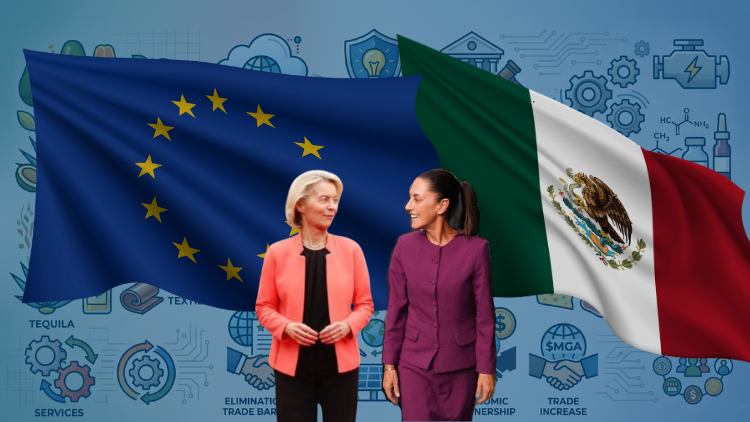
Edited image for ilustration purposes only. European Commission President Ursula von der Leyen and Mexican President Claudia Sheinbaum walking side to side
© FNF LatamThe Modernized Global Agreement (MGA) between the European Union and Mexico represents a significant update to the original EU-Mexico Free Trade Agreement, which had been in force since 2000. During the lifespan of the original accord, bilateral trade in goods increased by more than 300%, with combined trade surpassing US$94.5 billion in 2025. The modernization of the agreement reflects not only the evolution of global trade but also the profound geopolitical shifts reshaping the international order. The agreement is set to be formally signed on May 22 in Mexico City by European Commission President Ursula von der Leyen and Mexican President Claudia Sheinbaum, underscoring the political importance both parties attach to the partnership at a moment of growing global economic uncertainty.
A Changing Global Context
Since Donald Trump’s return to power in 2024, the Western political and economic landscape has entered a period of uncertainty. The post-Second World War order, built upon the assumption that the United States would remain a reliable partner for Europe and Latin America, has increasingly come into question. Trump’s “Make America Great Again” (MAGA) movement has become the guiding principle of both domestic and foreign policy.
Domestically, the aggressive use of Immigration and Customs Enforcement (ICE) operations has generated fear among immigrant communities, particularly those of Latin American descent. These actions have served not only as enforcement mechanisms but also as political messaging intended to discourage future migration to the United States.
In the economic sphere, tariffs have become one of Trump’s preferred instruments of negotiation. His administration views the purchasing power of American consumers as leverage capable of compelling foreign governments to accommodate U.S. demands. Consequently, tariff threats, and their sudden reversals, have become recurring features of Washington’s trade policy.
The Mexican Perspective
Mexico has become one of the clearest examples of this new dynamic. According to the Mexican news outlet La Silla Rota, Mexico faced tariff threats or tariff impositions from the United States eight times in 2025 alone. Trump has repeatedly pressured Mexico over issues ranging from water-sharing treaties to fentanyl trafficking, turning bilateral relations into an increasingly unpredictable affair.
The days when Mexico and the United States viewed one another primarily as complementary economic partners now appear distant. Yet Mexico remains deeply dependent on its northern neighbor. According to Mexico’s Ministry of Economy, approximately 83% of Mexican exports are destined for the United States, leaving the country in an extremely vulnerable position when negotiating with Washington.
This dependency is particularly significant because Mexico and the United States are currently approaching the scheduled review of the United States-Mexico-Canada Agreement (USMCA). According to BBVA, the review process could result in three possible outcomes:
- The agreement is terminated.
- The agreement is extended unchanged for another 16 years.
- The agreement remains in force but becomes subject to annual reviews.
While BBVA considers the third scenario manageable, it would nonetheless institutionalize uncertainty by allowing future U.S. administrations to repeatedly threaten withdrawal or demand concessions.
Against this backdrop, the modernization of the EU-Mexico agreement acquires strategic importance. For Mexico, securing stronger trade ties with Europe offers an opportunity to partially rebalance its economic dependence on the United States and diversify its export markets. In many ways, the MGA arrives at a critical moment for Mexican economic diplomacy.
The European Perspective
Europe, too, has found itself reassessing its relationship with the United States. Since his first presidency, Trump has consistently challenged traditional transatlantic arrangements. He has repeatedly pressured NATO members to increase defense spending, shifting the benchmark from 2% to as high as 5% of GDP depending on political circumstances.
His administration has also revived controversial geopolitical ambitions. In late 2024, Trump reiterated his interest in acquiring Greenland, arguing that “for purposes of National Security and Freedom throughout the World, the ownership and control of Greenland is an absolute necessity.” Simultaneously, Washington’s wavering support for Ukraine has alarmed European leaders, many of whom regard the conflict as an existential security challenge for the continent.
Trade tensions have further strained relations. In April 2025, during what the White House termed “Liberation Day,” the United States announced a flat 20% tariff on European Union imports. Although Brussels subsequently negotiated a partial agreement to cap tariffs, the episode reinforced perceptions of American unpredictability.
European Commission President Ursula von der Leyen announced on May 20 that the EU and the United States had reached an understanding to stabilize tariffs. In a post on X, she emphasized that “together, we can ensure stable, predictable, balanced, and mutually beneficial transatlantic trade.” Yet the language itself underscored Europe’s growing concern with restoring stability to a relationship increasingly characterized by volatility.
As a result, the European Union has intensified efforts to diversify its own strategic partnerships. The negotiations launched in 2016 to modernize the EU-Mexico Global Agreement have therefore become central to Europe’s broader economic and geopolitical strategy, opening new opportunities for sectors such as agri-food exports while strengthening ties with Latin America’s second largest economy.
The Economic Opportunities
The original Global Agreement already produced significant economic results. According to the Mexican Institute for Competitiveness (IMCO), trade between Mexico and the European Union increased fivefold after the 2000 agreement entered into force. Trade between Mexico and Germany alone reached US$24 billion in 2024.
The MGA is expected to deepen this relationship even further, with some estimates projecting an increase in bilateral trade of up to 35%.
Germany has emerged as one of Mexico’s most important strategic economic partners. Between 2015 and 2024, German investment in Mexico totaled approximately US$24.4 billion, representing 7.1% of total foreign direct investment during that period. Much of this investment has concentrated on high-value-added industries such as automotive manufacturing and chemicals.
Major German companies operating in Mexico include Volkswagen, BMW, Mercedes-Benz, Bayer, Bosch, Continental AG, KHS GmbH, and INEOS Styrolution. Notable projects include Audi’s US$1.3 billion plant in Puebla, which began operations in 2016, and BMW’s US$1.5 billion facility in San Luis Potosí, inaugurated in 2019. In 2024 alone, German firms invested approximately US$3.8 billion in Mexico.
The European Commission has also highlighted the benefits the MGA could bring to European agricultural exporters. The agreement would remove approximately 95% of Mexican tariffs on agri-food products and protect 568 European geographical indications, including products such as Champagne and Gouda cheese.
Key Benefits of the MGA
The modernized agreement offers a broad range of benefits for both parties:
1. Elimination of Trade Barriers
The MGA seeks to significantly reduce or eliminate customs duties and non-tariff barriers on goods and services. It also simplifies customs procedures, reducing administrative costs and accelerating the movement of goods.
2. Liberalization of Services and Investment
The agreement expands market access for services and establishes a more transparent and predictable legal framework for investment. It also introduces mechanisms for resolving investor-state disputes in a more impartial manner.
3. Support for Small and Medium-sized Enterprises (SMEs)
Dedicated SME contact points and publicly accessible information platforms will help smaller businesses navigate tariffs, taxes, and customs procedures more effectively.
4. Advancement of Digital Trade
The MGA prohibits customs duties on electronic transmissions and recognizes the legal validity of electronic contracts and authentication systems. It also strengthens consumer protections in digital commerce.
5. Open Government Procurement
Both parties commit to opening public procurement markets on a reciprocal basis, ensuring equal treatment for suppliers and service providers.
6. Sustainable Development and Climate Action
The agreement includes commitments to implement the Paris Climate Agreement and promote environmentally sustainable economic growth.
7. Gender Equality
The MGA explicitly recognizes the importance of inclusive trade policies and seeks to enhance women’s economic participation through international trade.
8. Intellectual Property and Innovation
Enhanced protections for intellectual property rights aim to promote innovation while balancing public interest considerations.
9. Animal Welfare and Public Health
The agreement establishes frameworks for cooperation on animal welfare standards and efforts to combat antimicrobial resistance.
Ratification and Political Outlook
Despite the lengthy process that such ratifications often entail, there are reasons for optimism. Óscar Ocampo, Director of Economic Development at IMCO, has argued that the complementary nature of the Mexican and European economies reduces many of the fears associated with other trade agreement, such as the EU-Mercosur negotiations.
As Ocampo noted in comments to Deutsche Welle, “There isn’t fear of competition like with Mercosur, because Mexico does not export meat or grains in direct competition with Europe, but rather fruits and vegetables.”
Conclusion
The Modernized Global Agreement between Mexico and the European Union is more than a trade accord. It is a strategic response to an increasingly fragmented and uncertain international environment. For Mexico, it offers an opportunity to diversify economic partnerships and reduce excessive dependence on the United States. For Europe, it represents a chance to strengthen ties with a reliable partner at a moment when transatlantic relations have become less predictable.
At a time when protectionism and geopolitical rivalry are reshaping global commerce, the MGA signals that both Mexico and the European Union continue to view openness, cooperation, and economic integration as essential pillars of long-term stability and growth.
*If you would like to explore the opportunities presented by the MGA in greater detail, our partner IMCO has published an in-depth analysis available here.