International Politics
Upcoming Israeli Elections

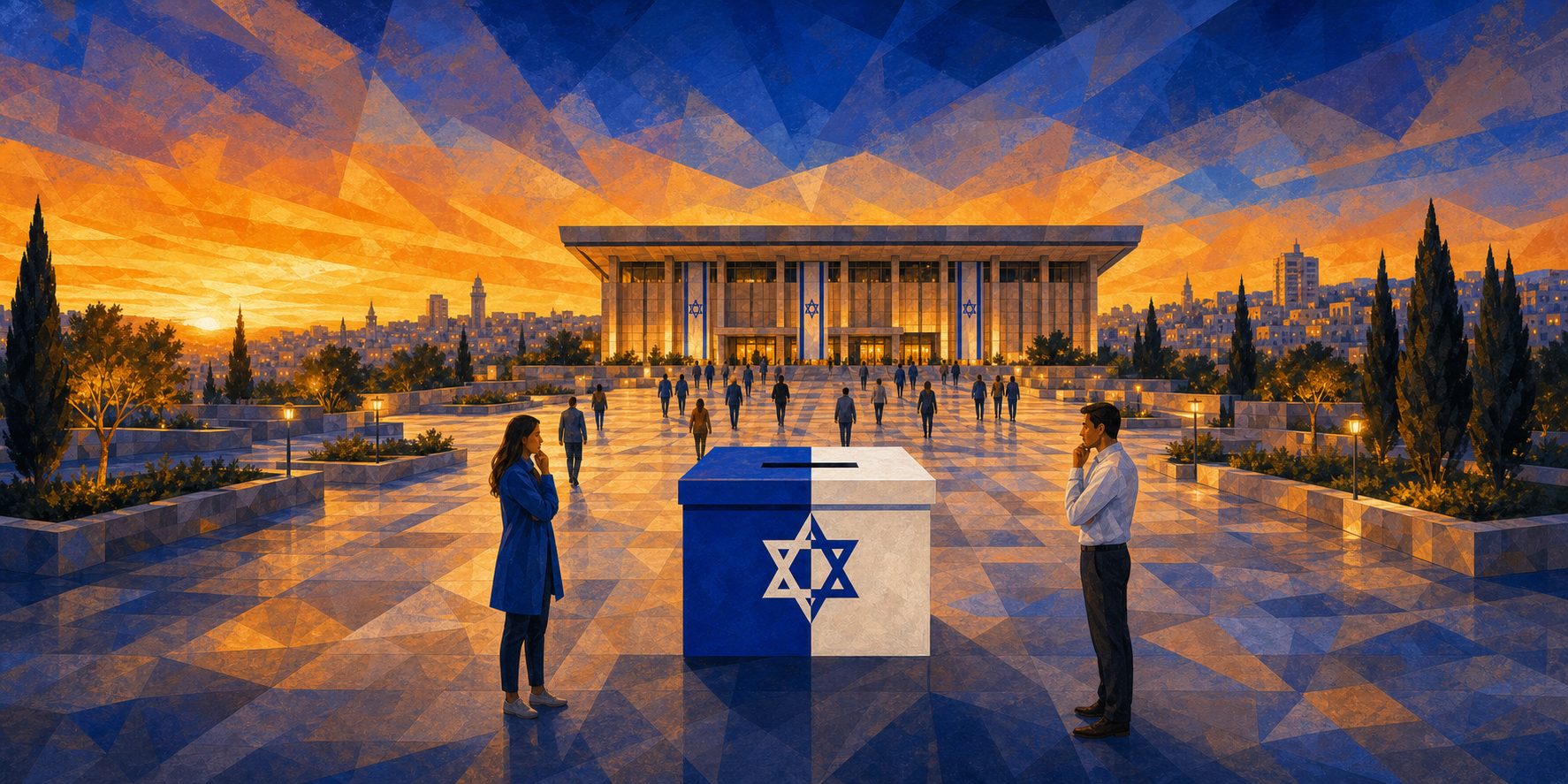
Israel goes to the polls on October 27, and it is still unclear whether the opposition will manage to replace Netanyahu. This uncertainty is difficult to explain, as Netanyahu’s bloc is expected to receive only around 50 seats out of a 120, far from the needed majority. This has been the case for quite a long time, ever since Netanyahu’s attempted judicial overhaul, long before the 7th of October. So why might Netanyahu still win?
Well, technically speaking, he probably won’t win. But he doesn’t have to win, he just needs to not lose. In order to form a government in Israel, one needs the support of at least 61 out of 120 members of Knesset, the Israeli parliament. It is not enough for this majority to decide that Netanyahu’s government needs to go, they also need to agree on the composition of the government that will replace it. If they cannot, it would lead to another round of elections, with Netanyahu staying as interim prime minister. This distinction between winning and not losing is what defines these elections. As it has the power to allow Netanyahu to stay in power despite not having a majority in parliament.
Understanding Israel’s Polarized “Two Bloc” Political System
In order to reach a parliamentary majority, many parties form into blocs. The two competing blocs in these elections are Netanyahu’s bloc, and the “Bloc of Change”, committed to replacing him. Netanyahu’s bloc is an alliance of Netanyahu’s Likud party with two Ultra-Orthodox parties, and Smotrich & Ben Gvir’s religious nationalist parties. The bloc of change is much less ideologically coherent. Led by former IDF chief of Staff Gadi Eisenkot, it also includes former prime ministers Bennett and Lapid’s liberal party, a secular nationalist party and a social democrat party.
Outside of these two blocs there are two Israeli Arab parties, Mansour Abbas’s “United Arab List” party and “The Joint List”, a union of the three other Arab parties. There are a few more smaller lists, including the “Reservists–Economic Alliance” and Ofer Winter’s “Your People Israel”, might also pass the 3.25% threshold and affect the balance between the blocs. While Winter is aligned with Netanyahu, the REA are committed to bridging between the two blocs, vowing to form a government without the extremists on both sides.
In 2019, Netanyahu’s bloc did not manage to get a majority in the national elections, but neither did the ideologically diverse opposition. How was this possible? Well, the Israeli Arab parties, that make up around 10% of the Knesset, have historically refused to join any coalition, out of solidarity with the Palestinian cause. This missing piece of the puzzle, created a political stalemate in which both blocs can lose simultaneously, and allowed Netanyahu to stay in power as prime minister until June 2021. That year, the Islamist United Arab List party broke away from the Arab boycott and joined the opposition to form what was called in Israel “The Government of Change”. This government consisted of eight parties, had a narrow majority, and broke down after a year, allowing Netanyahu to return to power in December 2022 stronger than before.
Two Competing Visions for Israel and a Solid Majority for Change
Over the last four years, Netanyahu’s coalition gradually lost public support. This might be due to the fact that they do not represent the majority of Israelis in key political issues. In many ways, these elections are a test. Will the Israeli public allow attempts to weaken Israel’s democratic institutions to continue? Will we let Netanyahu thwart an independent inquiry to establish responsibility for October 7? Will the ultra-Orthodox manage to avoid the burden of mandatory military-service and participation in the Israeli workforce? Ultimately, all of these questions relate to what kind of Israel we want to live in: a country where those in power can do as they please, with no accountability or oversight, as long as they are in the majority. Or one where democratic checks and balances hold governments accountable and protect the rights of minorities & individuals.
These two competing versions of Israel are represented by the two blocs, Netanyahu’s bloc and the “Bloc of Change”. Coming into these elections, the ideologically diverse “Bloc of Change” is seemingly in a much better situation than Netanyahu. With the Israeli Arab boycott out of the way, this anti-Netanyahu bloc has around 70 seats to work with to form a coalition.
A Majority Divided: Arab-Jewish Cooperation or A “Zionist Majority”
Despite having a solid majority, another “Government of Change” seems almost out of reach. Three years of war made the general Israeli public more skeptical about Arab-Jewish political cooperation, pushing many disappointed right-wing voters back to supporting Netanyahu. This will likely not be enough to get Netanyahu to 61 seats, but it could mean the difference between losing, and staying as interim prime minister. This is why Netanyahu’s campaign is attacking the legitimacy of a coalition that depends on Arab parties for a majority, hoping to stop another “Government of Change”.
Netanyahu’s Anti-Arab campaign has divided the diverse opposition, with many fighting back, stating that Arab Jewish cooperation is not only legitimate, but desirable. According to the polls, it is also necessary, as without them the opposition will likely not have a majority. On the other side, many right-wing opposition voters still refuse to rely on any of the Arab parties, and insist the opposition should focus on forming what they call a “Zionist Majority”. This incentivizes politicians to veto any coalition with the Arab parties, so they do not lose voters. In doing so, they might gain more votes for the opposition, but they effectively shrink the “Legitimate” opposition, and hurt their bloc’s chances.
Cautious Optimism About Israel’s Liberal Democracy
It is still too early to say which side of the opposition will prevail, and it is possible that a wide coalition with the Israeli Arab parties will be formed. But it is also very possible that the anti-Arab veto holds. If that is the case, considering that a Zionist majority is as unlikely as a Netanyahu victory, Israel could find itself going back to the political impasse of 2019. Meaning that neither bloc gets a majority, which could again lead to repeated elections with Netanyahu staying in power as interim prime minister.
But this stalemate isn’t inevitable. There is widespread demand for change, for the consolidation of Israel’s liberal democracy, for a crackdown on settler violence & the enforcement of the rule of law. The divided Israeli opposition has a unique opportunity to do all that and more, if they only manage to rise to the occasion, and form another “Government of Change”. If we are lucky, such a government just might get us back on track, domestically & internationally.
To be clear, this does not mean that we will see a Two State solution anytime soon. Any kind of alternative government will have a hawkish flank that will veto substantial advancement towards full Palestinian sovereignty. Nevertheless, such a government would be very interested in de-escalation and diplomatic dialogue, and is expected to take concrete steps towards eventual regional normalization and peace.