GEOPOLITICS
BRICS Should Avoid Deepening Global Geopolitical Divisions

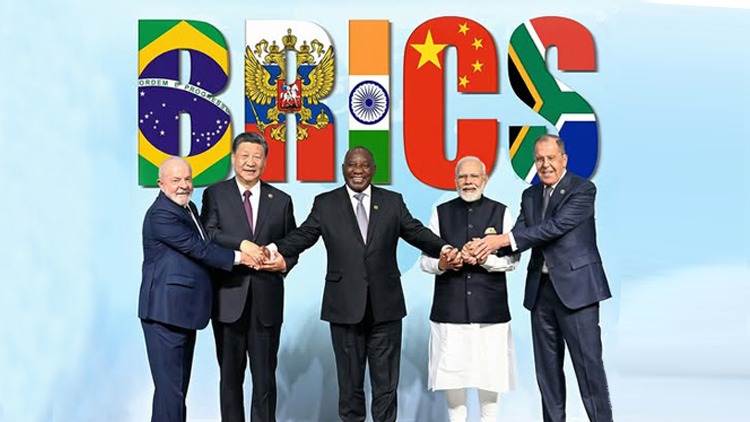
Left to right: Brazilian President Luiz Inacio Lula da Silva, Chinese President Xi Jinping, South African President Cyril Ramaphosa, Indian Prime Minister Narendra Modi and Russian Foreign Minister Sergey Lavrov
BRICS currently represents a significant share of the global population and economic output. As India is holding the BRICS rotational presidency for 2026, it is expected to advance a people-centred agenda that prioritises digital public infrastructure, climate and clean energy transitions, and reforms of multilateral institutions while carefully avoiding an overtly anti-Western posture.
India’s cautious and incremental approach to BRICS expansion contrasts with China’s and Russia’s instrumental use of the grouping to counter Western influence. These divergences highlight the heterogeneous strategic outlooks that shape BRICS decision-making. In South Asia, most non-BRICS states view India’s BRICS presidency as a conditional opportunity to diversify financing sources through the BRICS’s New Development Bank (NDB) and engage with the broader BRICS+ framework. At the same time, they remain alert to the possibility that India could use its leadership to consolidate regional influence, especially amid intensifying Sino-Indian rivalry. NDB, on the other hand, has the potential to support inclusive and sustainable development in South Asia, particularly through investments in infrastructure, climate-related projects, and local-currency financing. Realising this potential, however, will require strengthened project pipelines, more robust social and environmental safeguards, and improved coordination with other development partners.
India’s 2026 presidency is likely to position New Delhi as a “bridge” between BRICS and the West. This dual role is likely to deepen Europe–India cooperation in areas such as trade, technology, climate, and connectivity, even as divergences persist regarding Russia, China, and global financial governance. In conclusion, India’s presidency is poised to strengthen BRICS-driven regional and interregional integration, creating meaningful opportunities for South Asia and for Europe–India relations. Yet these benefits will depend on deliberate policy choices that preserve BRICS’ developmental orientation and prevent the further entrenchment of competing geopolitical blocs.