Hungary
Money for Reforms? Hungary’s Chance for a Reset with the EU

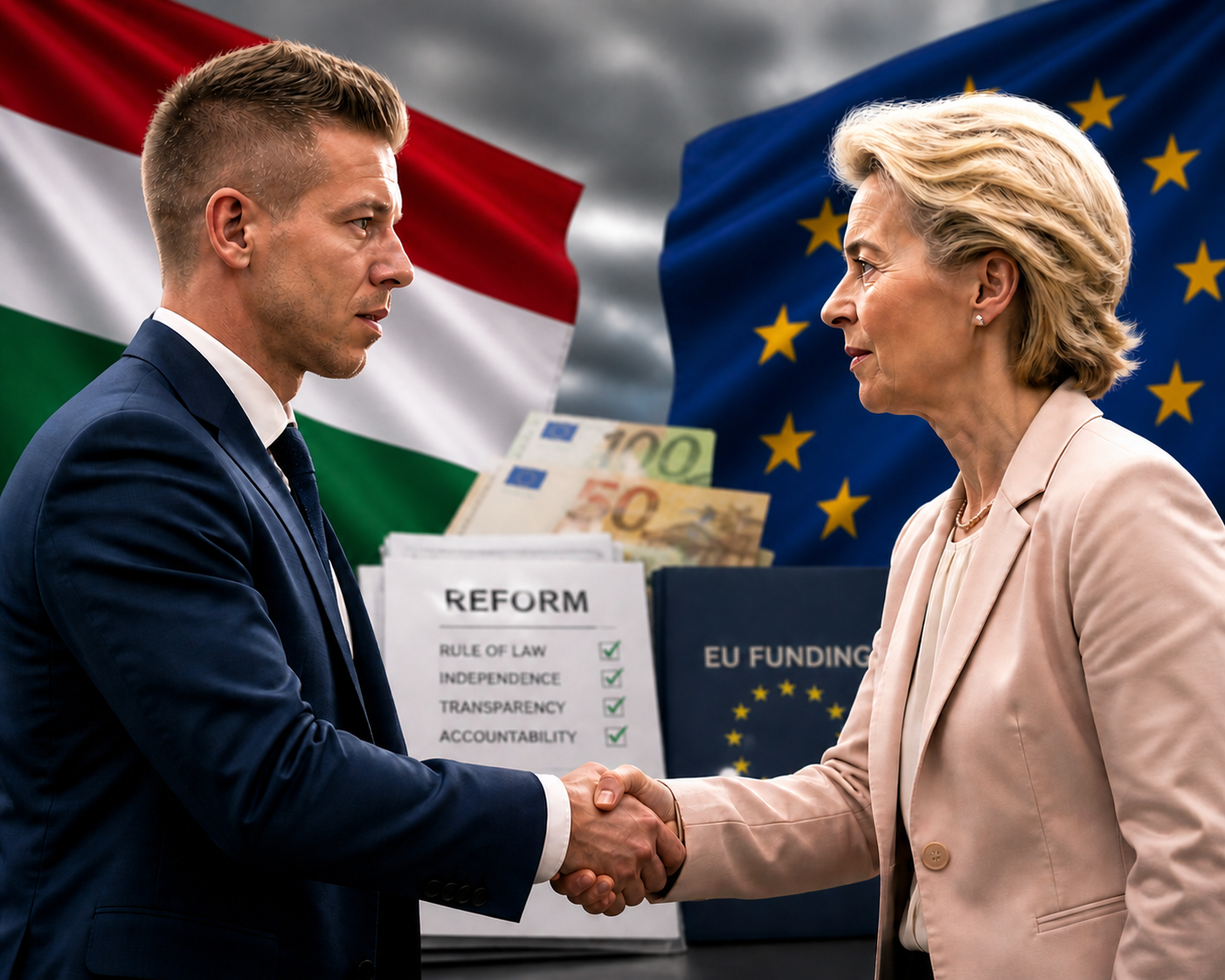
AI-generated illustration (not depicting real individuals) of EU–Hungary negotiations on reforms and funding
© AI generatedOn Sunday, 12 April, Hungary elected a new government, marking the end of years of increasingly autocratic governance and entrenched corruption. The result sent a clear signal: even entrenched political systems can be challenged by the electorate.
The conservative Tisza party, led by future Prime Minister Péter Magyar, secured a supermajority with 141 mandates. Magyar has announced plans to pursue a more pro-European approach, with a particular focus on strengthening cooperation with European partners.
A first concrete signal is Hungary’s decision to lift its veto on the €90 billion EU loan package for Ukraine, part of the EU’s broader financial support framework. This suggests a shift from confrontation towards greater cooperation. However, a full transformation remains uncertain. Key tensions persist, particularly regarding frozen EU funds linked to rule-of-law concerns, as well as ongoing economic and health system challenges.
This raises a central question: can these initial steps translate into lasting reforms and a genuine reset in Hungary’s relationship with the European Union?
The Roots of Hungary’s Conflict with the European Union
Over the past 16 years of Viktor Orbán’s rule, Hungary has gradually shifted towards a more centralised and increasingly illiberal political system, accompanied by a more confrontational stance towards the European Union (EU). During this period, Hungary frequently used its veto power to block or delay key EU decisions, particularly in areas such as financial support for Ukraine and sanctions against Russia.
This was made possible by the EU’s principle of unanimity, which requires all member states in the Council to agree on certain sensitive decisions, effectively granting each country a veto. This principle applies in areas such as foreign policy and parts of EU financial assistance, including support packages for Ukraine. While intended to ensure consensus, it also allows individual member states to stall or obstruct collective action.
Hungary made strategic use of this mechanism to exert disproportionate influence within the EU, at times delaying or blocking decisions in order to advance its own political and economic interests. This was particularly visible in areas where Hungarian policy diverged from the broader EU consensus.
At the same time, the government pursued closer economic ties with Russia, particularly in the energy sector, benefiting from comparatively cheap oil imports and increasing its political and economic dependence. This alignment further complicated EU efforts to adopt a unified stance on Russia-related policies.
In response to growing concerns over corruption, the weakening of judicial independence and broader rule-of-law deficiencies, the European Union decided to take action by freezing billions of euros in funding allocated to Hungary. This step was taken under the Rule of Law Conditionality Mechanism, an EU instrument designed to protect the Union’s budget in cases where breaches of the rule of law risk affecting the proper use of EU funds.
The suspended funds primarily include cohesion funds, which are intended to support regional development and infrastructure projects across EU member states, as well as resources from the Recovery and Resilience Facility (RRF). The RRF is a central component of the EU’s NextGenerationEU programme and was established as a temporary instrument to help member states recover economically from the COVID-19 pandemic.
The decision to freeze these funds was not solely a reaction to political disagreements between Hungary and the EU. Rather, it was driven by increasing concerns about the potential misuse of EU money, linked to systemic corruption, limited transparency and insufficient oversight mechanisms.

Crowds gather in Budapest during Péter Magyar’s 2026 victory speech, reflecting strong public support for political change.
© Vaiua Rex / CC0 (Public Domain)A Dilemma Between Reform and Funding
Hungary now faces a significant political and economic challenge. The country urgently needs EU funds to stabilise its economy and address weaknesses in sectors such as healthcare, both central campaign issues for the Tisza party.
At the same time, the EU requires concrete rule-of-law reforms before releasing any funding. This creates a fundamental dilemma: reforms require financial resources, yet access to these resources depends on their implementation.
As a result, both sides depend on each other to act first, creating a political deadlock. This is further complicated by a deep trust deficit after years of conflict between Budapest and Brussels, making the process of rebuilding cooperation particularly challenging.
This situation is further intensified by significant time pressure. Under the rules of the EU’s Recovery and Resilience Facility, Hungary must meet the required reform milestones by the end of August 2026 in order to access a substantial share of the allocated funds. Otherwise, up to €10 billion could be lost permanently.
Recent developments in Budapest suggest a possible shift in approach that now warrants closer examination.
Signs of a policy shift in Budapest
Recent developments suggest that Hungary may be moving towards cautious re-engagement with the European Union. One of the most visible signals of this shift was the government’s decision to lift its veto on the EU’s financial support package for Ukraine. After years in which Hungary frequently acted as a blocking force within the Union, this move indicates a willingness to cooperate on key foreign policy issues.
This shift is reinforced by early high-level diplomatic engagement. Even before formally taking office, Péter Magyar has initiated direct talks with European Commission President Ursula von der Leyen. Such outreach is unusual and signals urgency and a clear intention to rebuild strained relations with Brussels. It suggests that the incoming government is prioritising constructive engagement over confrontation.
At the centre of this renewed cooperation lies a highly pragmatic objective: unlocking billions of euros in frozen EU funds. A significant portion of these funds – including around €10 billion from the EU’s Recovery and Resilience Facility – risks being lost permanently if the required reforms are not implemented within the set deadlines. This creates a strong incentive for the new government to act quickly.
Magyar’s approach appears to reflect this urgency. Rather than pursuing broad and potentially time-consuming systemic reforms from the outset, his team is focusing on measures that can be implemented in the short term. In particular, attention is directed towards meeting the EU’s so-called “super milestones”, a set of legally binding reform requirements set by the European Commission, which cover key areas such as public procurement transparency, judicial independence and academic freedom. More complex structural reforms, including constitutional changes, are expected to follow at a later stage.
This suggests a shift away from ideological confrontation towards a more technocratic and results-oriented form of governance. However, whether these developments represent a genuine transformation or a strategic adaptation remains an open question. Past experiences within the EU, including recent reform efforts in other member states, have shown that initial commitments do not always translate into sustained implementation. As a result, cautious optimism prevails in Brussels, where political support for Hungary’s new course is accompanied by continued scrutiny.

Ursula von der Leyen meets Péter Magyar in Brussels, signalling a potential reset in Hungary’s relationship with the European Union.
© Dati Bendo / European Commission, licensed under CC BY 4.0What Needs to Happen for Funds to Be Released
To unlock the frozen EU funds, Hungary must fulfil a series of clearly defined conditions set by the European Commission. These include implementing effective anti-corruption measures, ensuring transparent public procurement procedures and strengthening judicial independence. Central to this process are the EU’s “super milestones”, which function as concrete benchmarks to assess whether reforms are not only announced but fully implemented.
Despite recent positive signals from Budapest, the EU remains cautious. Past experience has shown that reform commitments do not always lead to lasting structural change. For this reason, any potential release of funds is likely to follow a gradual and conditional approach, closely tied to measurable progress.

The European Parliament building in Brussels, representing the institutional centre of EU decision-making.
© Guillaume Périgois / UnsplashFuture Scenarios and a Liberal Perspective
Looking ahead, several scenarios can be envisaged. In an optimistic scenario, Hungary implements key reforms in a timely manner, enabling a phased release of funds and a gradual rebuilding of trust between Budapest and Brussels. A more realistic scenario may involve partial progress, with funds being released step by step while negotiations continue. In this context, alternative arrangements are also being discussed, such as temporarily transferring funds to national institutions to prevent them from expiring while reforms are still underway.
However, if reforms stall or remain superficial, the current deadlock could persist, potentially leading to the permanent loss of a significant share of EU funding. Such an outcome would not only weaken Hungary’s economic prospects but also further strain its relationship with the European Union.
From a liberal perspective, this process requires a careful balance between engagement and accountability. Initial steps towards cooperation matter, but they should not be rewarded unconditionally. Instead, the EU should maintain a rule-based approach, linking financial support to clear and verifiable reform outcomes. Strengthening independent institutions, ensuring transparency and involving civil society in monitoring processes are key to achieving sustainable change. Ultimately, EU funds should support genuine reform efforts rather than political promises.
Conclusion
Recent political developments in Hungary open a window of opportunity for a reset in its relationship with the European Union. However, the release of frozen EU funds will depend on the government’s ability to deliver credible and measurable reforms. A sustainable improvement in relations will require not only political will, but also a consistent commitment to rule-of-law principles and institutional accountability. In this sense, Hungary’s trajectory may become a test case for how the European Union manages political change within its own ranks.