CZECH REPUBLIC
100 Days of Babiš: Pressure, Conflict, and Czech Democratic Institutions

When Andrej Babiš returned to power at the head of a right-wing populist coalition in December 2025, many observers expected turbulence. Few, however, would have predicted how quickly his government’s opening months would become defined by clashes with democratic institutions, increasing tensions with independent actors, and efforts to recast criticism as political sabotage. One hundred days in, the picture is increasingly clear: this is not simply a controversial government. Its actions have raised questions about the balance between executive power and institutional restraint. Its first months in office suggest a governing approach marked less by consensus-building and more by confrontation with the media, the president, civil society, and established democratic norms.
Conflict as a Governing Style
Institutional conflict has marked the first 100 days of the Babiš government. Rather than presenting itself as a stabilising force, the coalition has repeatedly deepened tensions with actors that serve as checks on executive authority.
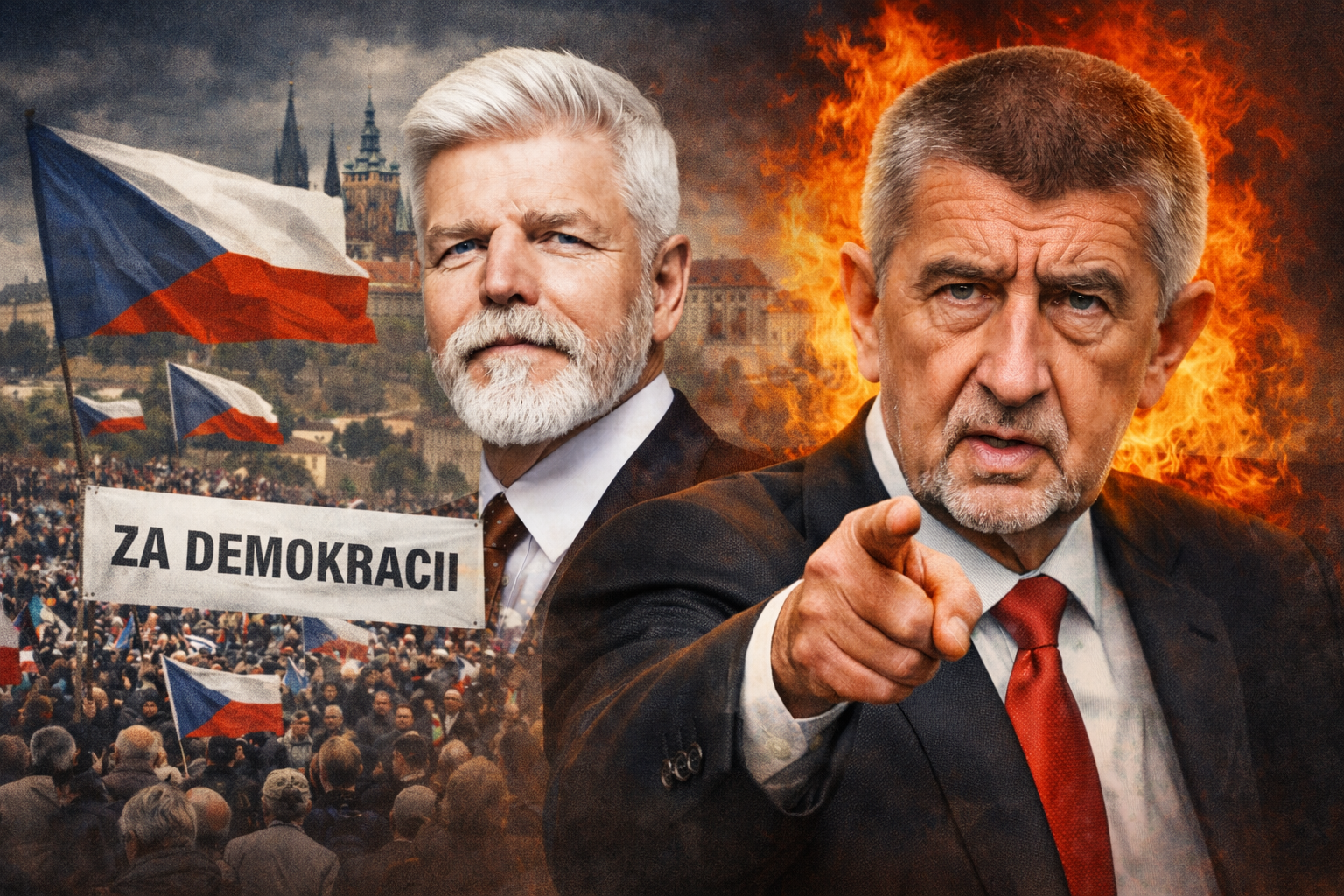
The most visible of these conflicts has been the dispute with President Petr Pavel. What might in another political context have remained a constitutional disagreement over ministerial appointments escalated into a public and highly damaging confrontation. President Pavel accused Foreign Minister Petr Macinka of attempting to blackmail him over the appointment of far-right politician Filip Turek as environment minister. This dispute triggered tens of thousands of people protesting on Prague’s main squares to support the President. The episode highlighted not only tensions within the governing camp but also raised concerns among critics about respect for democratic political norms.
Similar dynamics can be observed elsewhere. Parliament’s decision to shield Babiš from trial in the Stork Nest case reinforced criticisms that political power is being used to shield allies and weaken accountability mechanisms. Even if such moves can be defended procedurally, their broader political implications are difficult to ignore. The message of the first 100 days is therefore not only that the government is controversial. It also reflects a pattern of sustained confrontation with institutions traditionally expected to remain independent of the executive.
The Media as the Next Target
Nowhere is this dynamic clearer than in the government’s escalating hostility toward independent media. Recent attacks by Babiš on outlets such as Seznam Zprávy, Novinky.cz, and the daily Právo go beyond the familiar complaints of politicians unhappy with coverage. By branding these platforms “activist media,” accusing them of manipulation and dishonesty, and targeting their owner personally, Babiš has been described by critics as undermining the legitimacy of critical journalism.
This is part of a pattern observed elsewhere in the region. Across Central Europe, attacks on independent media have often preceded more systemic efforts to reshape the public sphere. Typically, this begins with rhetorical delegitimisation: journalists are portrayed not as watchdogs, but as political actors. Then comes pressure on ownership, financing, or public service broadcasting. Over time, it can contribute to an environment where critical reporting can be dismissed as partisan sabotage rather than recognised as a core democratic function.
It is therefore significant that press freedom watchdogs have already drawn parallels with Slovakia and Hungary. Such comparisons should be used carefully. Czechia is not yet in the same category as either country, and its democratic institutions remain significantly stronger. But this makes current developments particularly sensitive. Democratic backsliding rarely begins with a single dramatic break. More often, it starts with the normalisation of language and tactics that make future interference easier. The unusually broad response from the Czech media landscape - including a joint statement by 21 editors-in-chief condemning political attacks on journalism - reflects an awareness that this is not a routine dispute. It signals growing concern within the media sector.
The ‘Foreign Agent’ Draft
If the attacks on media represent a rhetorical threat to democratic pluralism, the draft of “foreign agent” law raises more structural concerns. The draft legislation would require organisations and individuals with foreign funding, partnerships, or links to register with the state. Supporters insist the proposal is about transparency and compare it to the US Foreign Agents Registration Act (FARA). But critics have rightly pointed out that the comparison is misleading. Unlike FARA, which focuses on acting on behalf of a foreign principal, the Czech draft appears to cast a far wider net, potentially stigmatising actors whose only “foreign tie” is a grant, scholarship, research partnership, or international cooperation project.
This has led critics to warn about potential risks. Critics argue, and the reality of some countries proves it, that such laws may go beyond transparency and risk creating a climate of suspicion around internationally connected civil society and NGOs. This can frame foreign cooperation as politically sensitive or problematic. The backlash from universities, legal experts, and scientific institutions has therefore been important. It demonstrates that concern is not limited to the political opposition but extends across sectors that understand how such legislation can damage both democratic life and international openness.
For a country like Czechia, whose post-1989 success has depended heavily on openness, European integration, and cross-border exchange, this matters enormously. Critics argue that stigmatising foreign ties could undermine a key strength of Czech democracy: its openness and international cooperation.
Foreign policy: Reassurance Abroad, Nationalist Signalling at Home
The Babiš government’s foreign policy during its first 100 days has been marked by a different kind of pattern: ambiguity. On the one hand, there have been repeated moments that raised concerns among allies about a possible drift toward the Orbán-Fico axis. The coalition’s political dependence on far-right SPD (Freedom and Direct Democracy), rhetoric around Ukraine, and the government’s broader nationalist posture all contributed to fears that Prague might move away from its previously strong support for Kyiv.
On the other hand, the government has also taken steps clearly aimed at reassuring international partners. Foreign Minister Macinka’s trip to Kyiv and Babiš’s decision to maintain the Czech ammunition initiative for Ukraine were both signals that the government does not intend to be perceived as abandoning Ukraine or severing ties with the European mainstream.
This duality indicates that the government may not be pursuing a straightforward geopolitical realignment. Rather, it is attempting to combine nationalist domestic politics with selective foreign-policy pragmatism. In other words, it appears to seek the political benefits of anti-establishment rhetoric at home without paying the full diplomatic cost abroad.
That may work in the short term, but it also creates uncertainty. This creates uncertainty among partners, which version of the government is the real one: the one that reassures them in Kyiv and Brussels, or the one that cultivates ties with figures like Robert Fico and Viktor Orbán while feeding domestic narratives of grievance and confrontation. For Czech foreign policy, this ambiguity is itself a problem. Credibility is not built only on formal positions. It is built on consistency, trust, and predictability - all of which may have been affected in these first 100 days.
Democratic Resilience Remains Real
And yet, an important conclusion from this period is not that Czech democracy is collapsing. It is that it is being tested. The protests in support of President Pavel, the mobilisation of civil society, the unusually strong solidarity shown by media leaders, and the outspoken criticism from academia all point to an important fact: Czech democratic resilience remains evident. That distinguishes Czechia from more advanced cases of democratic erosion. The government is not operating in an empty space. It faces resistance from institutions, from public opinion, and from a political culture that still retains strong democratic reflexes.
This resilience should not be romanticised. It does not guarantee that democratic norms will hold. But it does mean that the current struggle is still open. Czechia has not “gone Slovak,” nor has it become Hungary. What we are witnessing instead is a battle over whether tactics associated with illiberal governance can be normalised in a country whose democratic institutions remain capable of pushing back. That debate is now well underway.
Pressure vs. Policy Vision
If one had to summarise the first 100 days of the Babiš government in a single sentence, it would be the following: the coalition has shown greater emphasis in pressuring democratic counterweights than in articulating a convincing governing project.
Its defining moves so far have not been ambitious reforms or credible solutions to Czechia’s long-term challenges. Instead, they have included institutional fights, attacks on critical media, proposals that risk stigmatising civil society, and efforts to test the boundaries of democratic political norms. This does not yet amount to a completed illiberal transformation. But it raises concerns.
The first 100 days suggest that Babiš is not only back in office. His approach raises questions about how far the Czech political system can be stretched and how far the language and methods of democratic erosion can be made to seem normal. The answer to that test will shape not only the rest of his term, but the future resilience of Czech democracy itself.