POLITICAL COMMUNICATION
From Good Cop to Bad Cop: What Political Communication Taught me

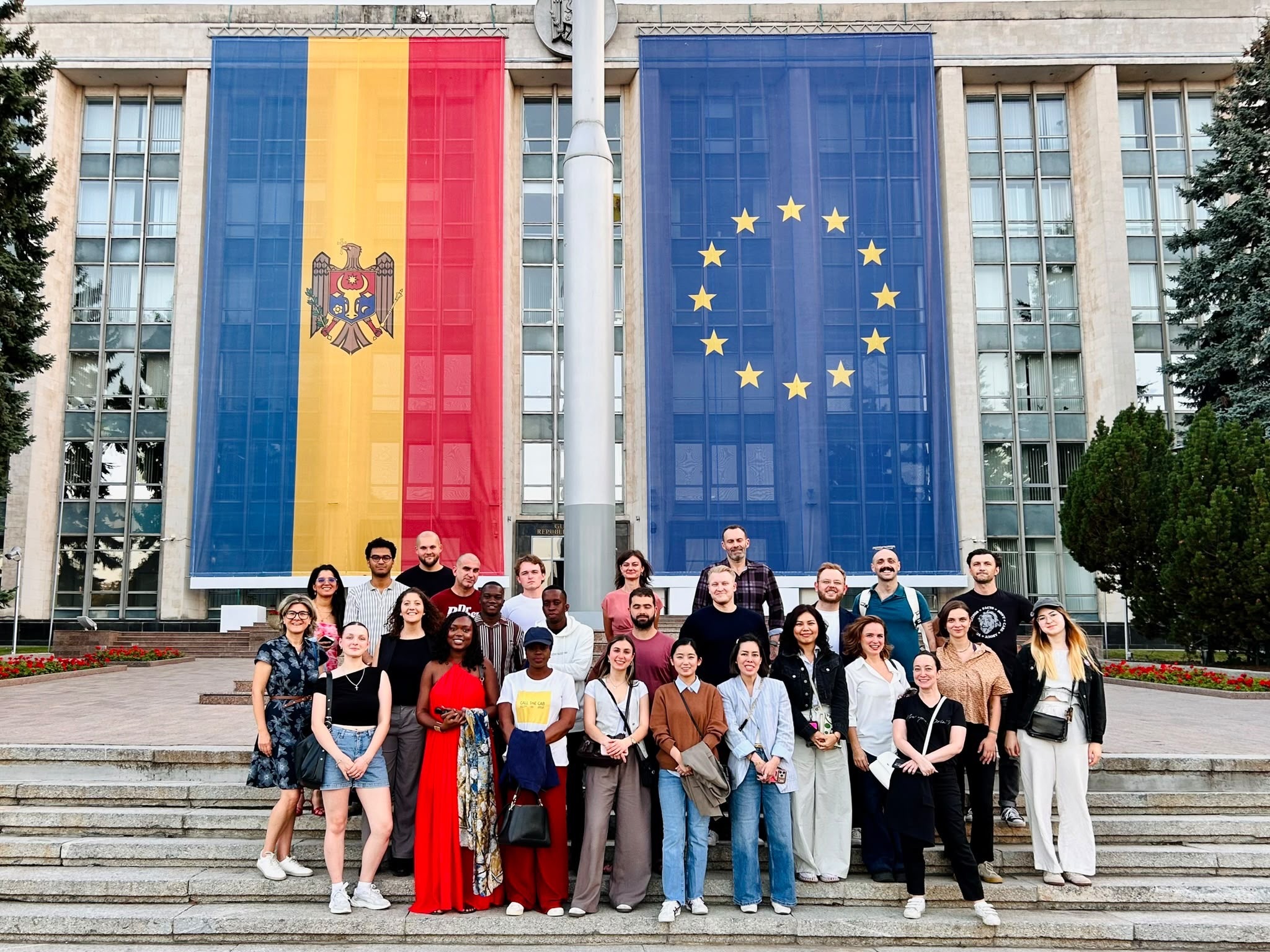
Political Communication Seminar at Chisinau, Moldova
© FNF MoldovaWhat thoughts cross your mind when someone mentions “political communication”?
Pye (1993) describes it as a flow of information and messages that gives structure and meaning to the political process, shaping public opinion, socializing citizens politically and mobilizing interests. Seen this way, political communication is not simply about sending messages. It is the careful and deliberate work of crafting a path for the public to follow, question, discuss and, ultimately, march upon when pursuing a better life.
At the Naumann Academy of Politics, organized by the Friedrich Naumann Foundation for Freedom, a radically different approach to political communication, at least for a Liberal like me, was discussed in Chisinau, Moldova, from August 30 to September 5, 2026. Nick Clelland and Clinton du Preez, two facilitators from Cape Town, challenged us to move beyond abstract ideas about communication and toward something more of a scientific and calculative approach that requires continuous monitoring, measurement and evaluation.
I took home five lessons which makes political communication truly effective.
1. Strategy gives you a direction
Imagine getting into a car and simply driving, without knowing where you are going. You can keep moving, but eventually you will run out of fuel. That, I realized, is what communication without strategy looks like.
Many of us communicate without a clear strategy. Instant messaging, especially in this era of rapid digital communication, can kill the very essence of communication. We send, post and respond constantly, but rarely stop to ask where all of it leads us to or even why we are doing the work in the first place. Eventually, we run out of money, energy and time.
The fundamental purpose of strategy is to help us calculate how we will get where we want to go. It is like knowing where to go before hopping onto the car and figure out if I have enough gas or my car is in good condition to arrive at my destination.
One concept from the seminar that stayed with me was the “White House and the Sun” strategy. The heart of strategic communication is not simply knowing where we want to arrive. It is also knowing how we are going to get there. And the answer to “how” is, in many ways, connection. What connects us to our destination our “White House”? What gives our communication the gravitational pull of the “Sun”? That connection is the driver of strategy, which would arrive at our goal.
So, know your White House. Know your Sun.
2. Feeling is a brand
The art of communication is the art of creating feelings. Communication is not merely the flow of information. We create feelings, build associations around them and, eventually, mobilize them around our interests. How? We build a brand attached to a feeling and communicate it consistently enough that people begin to associate that feeling with who we are, what we stand for and why we exist.
Maya Angelou famously said that people may forget what you said or did, but they will remember how you made them feel. That idea captures something fundamental about political communication: showing rather than telling, and doing so consistently over time as Nick Clelland has put it, “one message, in volume, over time”.
A political message does not become powerful simply because we repeat the facts. It becomes powerful when people attach a feeling to those facts and remember that feeling when they encounter us again.
Up to this point, I felt completely overwhelmed by the seminar and appreciated how useful it was to my current job as a communications officer at the Foundation. Then the next lessons shook my core principles and values.
3. Conflict makes news
The most mind-blowing lesson for me as a communicator was the idea of creating conflict.
I have always been told to be the good cop: show empathy, understand personalities, nurture mindsets and avoid unnecessarily confrontational propositions. I have believed that communication should serve as a platform for people to think, discuss and eventually make their own choices.
But Clelland challenged us to put those personalities aside and fulfill the core task of effective communication.
To differentiate ourselves, he argued, we need to make our position distinctive to find our niche. And doing that requires, first, a binary conflict: identifying a clear difference between us and something else. Then we find the opponent, engage with them and create a conversation that can generate public interest.
Conflict makes news. News gives us visibility. Visibility allows us to create feelings. Feelings can mobilize people. Without those things, Clelland argued, we are simply one fish among many in the ocean, with very few people noticing that we exist.
Initially, I disagreed. I believe in liberal values. I believe people should be able to discuss, engage and arrive at their own choices. In my liberal mind, the communicator's role is to provide people with the information and platforms they need to debate and then allow them to steer their own vehicles wherever they want to go. That belief is so deeply embedded in me that a few words from the facilitators were never going to make me abandon it.
But after the practical exercises, I could no longer completely dismiss the argument. Perhaps my reluctance to create conflict, while making me a good cop, can also make me ineffective. Perhaps, sometimes, I have to be a bad cop to get things done.
I would understand why only later in the seminar.
4. Reading the audience's mood as a fact
There was another part of the seminar that made me hesitate: Clinton's insistence that we should read the mood of the audience and use it. He introduced a basic mood map showing how communicators can understand where an audience stands emotionally and how communication can push an issue forward by eliciting particular feelings and reactions.
Again, my liberal instincts resisted. For me, politics should be about fairness. We should not force people to turn against one another. We should tone down our narratives, provide information and help people imagine a better society.
But political communication does not take place in that ideal world.
“Feeling is a fact.” That sentence stayed with me. Feelings can be measured. They can be observed. They can influence behavior. And whether we like it or not, they are therefore part of the political reality in which communication operates.
This is where liberal movements often struggle. While radical parties and political opponents may strategically recognize anger, fear, frustration or hope as political facts, liberals can sometimes treat emotions as something to be managed away rather than understood and incorporated into strategy. While we liberals live with the feelings of the public, our opponents study them.
After a long conversation with Clinton during a break, I came to a more complicated conclusion: perhaps the real question is not whether I should use people's feelings, but whether I should understand them well enough to decide when and whether to use them. Clinton can give me the tactics for a winning strategy. Whether I use them is ultimately my choice.
To be honest, I remain skeptical about the idea of using an angry crowd to my advantage. Understanding an audience's mood is one thing. Turning that mood into political mobilization is another. I am still deciding where I stand.
5. The struggle and reality of campaigning
The best part of the seminar was the simulation. Participants were divided into four political parties competing against one another in a fictional country called Freedonia. I became one of the campaign managers.
And that was when all my liberal values and all my personality came into play. I wanted my five team members to debate and discuss until we reached a political strategy that everyone could support. It took time. Too much time. Our party ran out of it.
I wanted everyone to have the freedom to contribute ideas. I wanted consensus before implementation. But that approach meant we could not finish six videos and one poster within four hours.
Our party was made up of young liberal minds. We avoided conflict. We focused on producing quality videos and attractive issues. We wanted to be the good cops. We did not attack our opponents. Eventually, we lost the election.
The experience was a painful demonstration of everything the facilitators had been trying to teach us. Under intense time pressure, we became too focused on completing tasks to step back and ask whether our strategy was actually working.
We followed the checklist. We produced the content. But we forgot the citizens. We did not have enough time to approach them, listen to them or create conversations with them. When other parties attacked us, we were too busy organizing ourselves and completing our own tasks to respond strategically. We were communicating. But we were not really campaigning. And perhaps that is the biggest difference.
Political communication is not about how much content we produce. It is not about how many messages we send, how many videos we make or how beautifully we package our ideas. It is about whether all those messages, across time and in sufficient volume, are taking us somewhere in consistency.
The simulation made me understand what the lectures alone could not. Being the good cop can feel morally comfortable. It can make us feel that we are respecting people's choices and protecting the values we believe in from organizing the party to communication in the end.
But politics is not conducted in a vacuum. There are opponents. There are competing narratives. There are feelings. There are limited resources. And, most importantly, there is a clock. We lost because we forgot those realities.
I entered the seminar thinking political communication was primarily about giving people the information and freedom to choose their own direction. I left understanding that communication is also about knowing where you want to go, building the connection that can take people there, understanding what they feel along the way and, sometimes, being willing to create enough tension for them to notice that you are asking them to move on your own agenda.
I am still a liberal. I am still not entirely comfortable with the idea of being the “bad cop.” But this seminar has taken me into a new dimension. It has made me question not only my own values and principles, but also whether I am simply holding on to them, riding with them, or actually communicating in ways that can help me achieve them.
Perhaps effective political communication requires something more complicated than choosing between being good or bad. Perhaps it requires having a strategy, what feeling gives sense of belonging and delivering it in consistency across time pressures. It requires knowing when to listen, when to persuade, when to provoke and, above all, when to act.
*Hnin Wint Naing is a regional communication officer of the Asia Office of the Friedrich Naumann Foundation for Freedom in Bangkok, Thailand.
Photo Gallery (More photos on your swipe)


Trainer Clinton at Political Communication Seminar held from Aug 30 - Sept 5 2026
© FNF Moldova
Campaign Simulation at Political Communication Seminar held from Aug 30 - Sept 5
© FNF Moldova
Group Work at Political Communication Seminar held from Aug 30 - Sept 5
© FNF Moldova
Group Work at Political Communication Seminar held from Aug 30 - Sept 5 2026
© FNF Moldova