Freedom Across Generations
A German-African story of liberal ideas and action

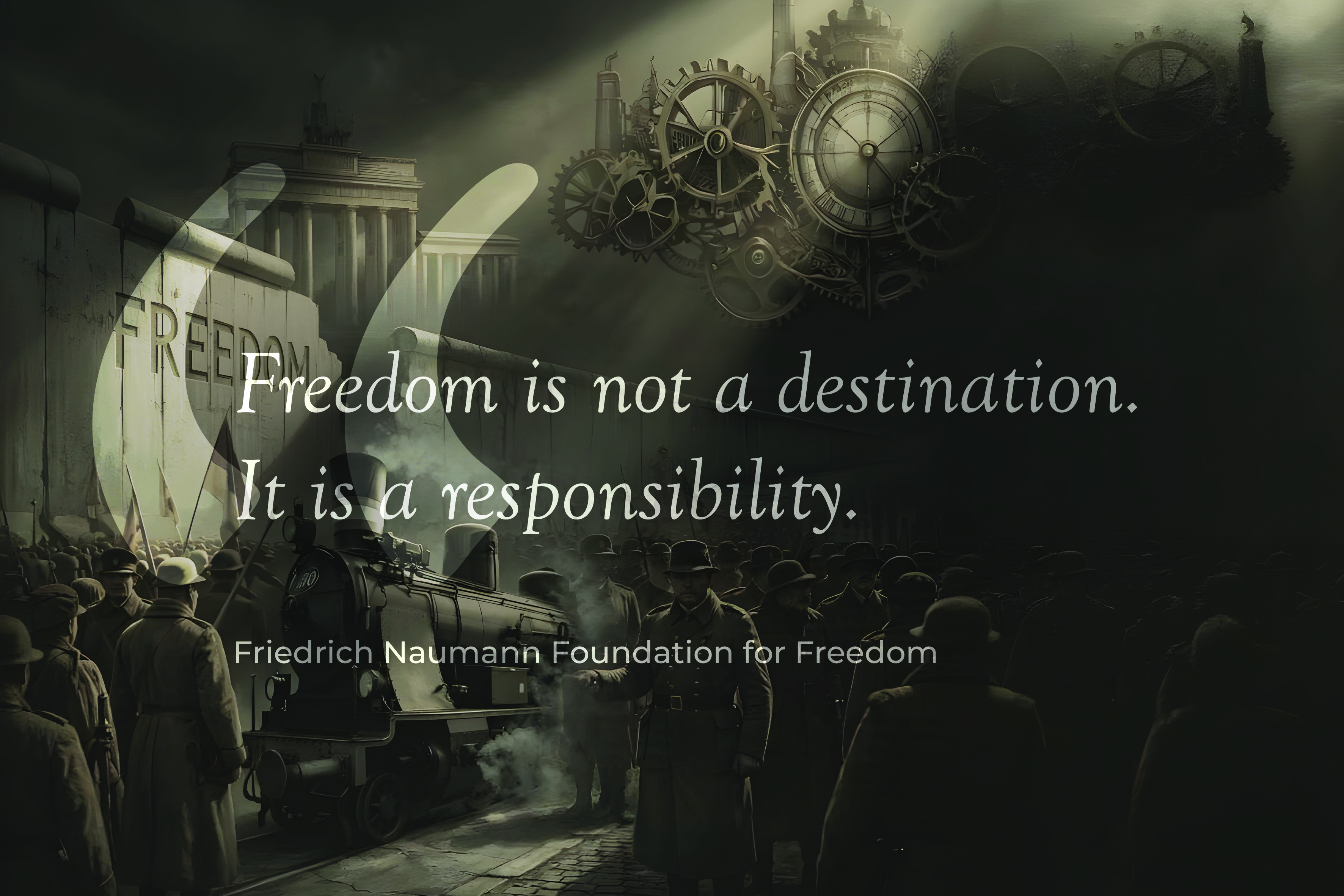
The work of freedom continues through dialogue, responsibility and democratic participation, carried forward by every generation. #FreedomInProgress
© Friedrich Naumann Foundation for Freedom“Freedom is not a destination. It is a responsibility.”
Step into the Engine Room at the Friedrich Naumann Foundation for Freedom’s Sub-Saharan Africa Regional Office in Johannesburg and this statement is the first thing that greets you. Wrapped around the space is a striking visual timeline, a vivid tapestry of the people, movements and partnerships that have driven the Foundation’s mission over decades.
This isn’t a story of European ideas being neatly exported to African soil. Democratic struggles, liberal philosophy and civic resistance in Africa have deep, independent roots. Instead, the exhibition captures what happens when ideas cross oceans, collide with real world politics and evolve through genuine dialogue, shared struggle and mutual accountability.
Where the journey began
The story opens in Germany at the turn of the 20th century. Between 1900 and 1919, amidst intense industrial transition and political friction, parliamentarian Friedrich Naumann emerged as a champion for civic education.
Friedrich Naumann knew that democracy couldn't survive on voting alone. It required an informed, critical public ready to take ownership of its political life. In 1918, he brought this vision to life with the establishment of his Staatsbürgerschule (Citizens’ School). Though Friedrich Naumann passed away the following year, his core principle, that genuine liberty relies on active, responsible citizenship, endured.

A German liberal thinker, political reformer and pioneer of civic education whose legacy inspired the Foundation’s name and purpose.
© Archive of Liberalism
Early liberal movements and civic-education initiatives in Germany helped shape the ideas of freedom, responsibility and democratic participation later carried forward by the Foundation.
© Archive of LiberalismA Foundation for Freedom
On May 19, 1958, Germany’s first Federal President, Theodor Heuss, gathered close allies at Villa Hammerschmidt in Bonn to officially launch the Friedrich Naumann Foundation.
Heuss purposefully anchored the new organisation in Friedrich Naumann’s educational legacy, building an intellectual sanctuary where people could gain the tools and confidence to defend democratic values. By the 1960s and 70s, as global politics shifted, the Foundation began taking those conversations far beyond Germany's borders.

The Friedrich Naumann Foundation was established in 1958 at Villa Hammerschmidt to promote liberal values, civic education and democratic participation in Germany and beyond.
© Archive of LiberalismConnecting leaders across borders
International growth came through handshakes, shared risks and trust built on the ground. Through tailored leadership initiatives and civic exchanges, the Foundation formed long term bonds across Africa, Asia and Latin America.
The archive photos in the Engine Room tell the story of those early years. Black and white snapshots of policy agreements being signed, public servants huddled in strategy sessions and grassroots activists debating economic reform and governance. The visual style reflects another era, but the underlying ethos hasn't aged a bit. Lasting democratic transformation cannot be imported or imposed from the outside. It must be cultivated and owned by the communities living it.

FNF expanded beyond Germany through political education, exchange and cooperation with partners working to strengthen democratic institutions and public leadership.
© Archive of Liberalism
Through exchanges, agreements and leadership networks, FNF connected liberal and democratic actors across borders and supported cooperation rooted in shared values.
© Archive of LiberalismPartnering with Africa
Early initiatives across Africa centered on civic education, public leadership and institutional resilience. Archives highlight pioneering joint efforts with government bodies and grassroots groups in countries like Benin and Tunisia, alongside workshops designed for young changemakers and public servants.
Over time, these initial programmes grew into enduring alliances with civil society groups, human rights defenders, independent researchers and political organisations.
Crucially, the exchange flowed both ways. African political philosophy, innovation and lived experiences actively reshaped global liberal thought, challenging European perspectives and expanding the definition of freedom on the international stage.

Early partnerships connected FNF with African institutions, civic educators and emerging leaders, laying the groundwork for long term cooperation on democratic participation.
© Archive of LiberalismDialogue during apartheid
The South African exhibit reveals how open dialogue carved out vital space for political transition during one of the country's darkest eras.
In July 1987, the landmark Dakar Conference brought a delegation of predominantly Afrikaans speaking South African intellectuals into direct, groundbreaking talks with exiled members of the African National Congress (ANC). The Friedrich Naumann Foundation backed this historic meeting alongside the Institute for a Democratic Alternative for South Africa (IDASA).
This momentum carried into the 1988 Leverkusen Conference in Germany, where exiled activists, white South Africans and international observers met face to face to challenge long held assumptions and chart a path toward a negotiated settlement.
These meetings didn't dismantle apartheid overnight, but they opened doors that had been locked for generations, proving that constructive dialogue across fierce political divides was possible. Later partnerships with organisations like the Helen Suzman Foundation reinforced this deep commitment to constitutional democracy, accountability and the rule of law.

FNF supported dialogue across political divides and partnered with leaders and institutions advancing constitutional democracy, policy debate and liberal values in South Africa.
© Archive of LiberalismContinent wide networks
Today, the African story is driven by regional leadership and interconnected networks.
The Engine Room brings this modern energy to life. Workshops led by the Africa Liberal Network (ALN), collaborative initiatives with Tanzanian political leaders, vibrant youth organisations, and active programmes operating across Zambia and Zimbabwe.
Working out of regional hubs in Johannesburg, Cape Town, Nairobi, Abidjan and Dakar, the Foundation collaborates with local partners to push for democratic governance, economic innovation, open markets and human rights. The old black and white photos have given way to vibrant snapshots of youth forums, digital advocacy and cross border organising, but the underlying question remains unchanged: How do we empower people with the freedom to shape their own destiny?

From regional liberal networks to leadership training and policy dialogue, FNF supports African partners working for open societies, accountable government and individual freedom.
© Archive of LiberalismA living history
This exhibit isn't built to showcase artifacts frozen in time behind glass. It's a direct invitation to everyone who enters to see themselves as part of an ongoing, unfinished movement.
Freedom has always relied on citizens willing to defend it, institutions resilient enough to protect it and individuals ready to carry its weight. That responsibility doesn't belong to one nation, one continent, or one generation. It belongs to all of us.
Freedom is not a destination. It is a responsibility.

A German liberal thinker, political reformer and pioneer of civic education whose legacy inspired the Foundation’s name and purpose.
© Archive of Liberalism
Across dozens of countries, FNF and its partners connect local experience with international exchange in support of freedom, human rights and democratic societies.
© Friedrich Naumann Foundation for Freedom