ECONOMIC FREEDOM
250 Years of Adam Smith: Lessons for the Philippines

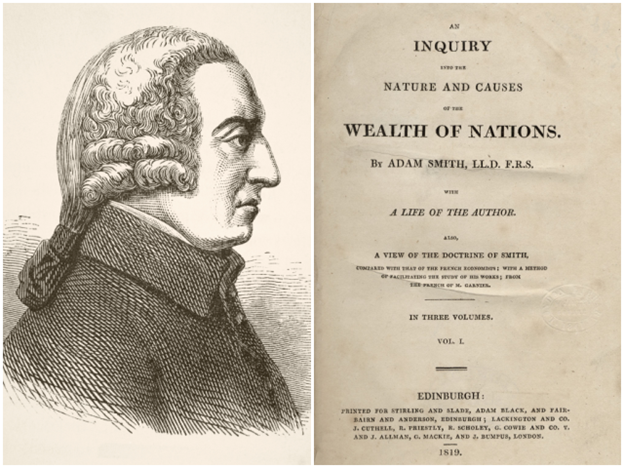
Getty Images, used in “Breitbart Business Digest: Trump Is the President Adam Smith Has Been Waiting For,” by John Carney, Breitbart, published March 10, 2026.
2026 marks the 250th anniversary of Adam Smith’s The Wealth of Nations. But what does a Scottish economist and philosopher from the 1700s have to do with our situation in the Philippines?
A lot, dare I say. The full title of his magnum opus is indicative in itself, which is An Inquiry into the Nature and Causes of the Wealth of Nations. Smith, acknowledged widely by scholars, is the father of modern economics. His project was a bold attempt to investigate the causes of prosperity vis-à-vis poverty. In fact, many of Adam Smith’s insights on markets, specialization, and international trade have since been absorbed into the study of economics and its application in policymaking. By this very virtue, he is less explicitly discussed in contemporary economics than in the history of economic thought. Despite Smith’s enduring intellectual presence, it isn’t far-fetched to claim that unlocking the secrets of wealth generation remains an arcane field in the Philippines, which has continuously suffered from policies that extract rather than enrich wealth.
Wealth Comes from Productivity, Not Redistribution
One of the many deceptively simple yet profoundly important ideas of Smith is that wealth does not exist as a fixed stock. For today’s developed countries, this may sound commonsensical, but during Smith’s time, the dominant mercantilist view treated wealth as something finite to be accumulated, plundered, and redistributed by political authority.
Smith’s great intellectual contribution was to overturn such a zero-sum understanding of wealth.
In fact, for the majority of human existence, wealth was effectively non-existent. In other words, all humans were dirt poor. Global GDP per capita is estimated to have remained largely stagnant at around $600-$1,000 (adjusted for purchasing power parity) for most of human history up to around 1800. This effectively consigned the entire global population to the Malthusian trap. It was only during and after the Industrial Revolution that sustained per capita growth began to emerge. Smith, witnessing the revolution unfold firsthand, pointed to technological innovation, mechanized production, institutional changes in property rights, free trade, and capital accumulation as the hammer that finally broke the Malthusian link between population growth and diminishing returns to labor.
Despite this strong explanandum, Smith’s voice remains unheeded by many Filipinos. Contemporary economic debates remain filled with pre-Smithian assumptions. In the same mercantilist fashion, numerous lawmakers continue to believe that wealth is primarily something to be redistributed rather than created by anyone other than themselves. On paper, they talk about the need to “raise productivity,” but their policies remain geared towards redistribution in the form of ayudas, subsidies, and discretionary entitlements that keep citizens dependent on their supposed benevolence. Meanwhile, academics outside of economics articulate a different version of the redistributive ethos. They frame wealth as something “stolen” from the people by so-called greedy businesses and that must be “taken back” by the oppressed. Both perspectives underemphasize the fact that wealth expands through innovation and competition.
In fact this mentality has shaped entire areas of policy. The Philippine constitutional commitment to agrarian reform evolved into strongly redistributive policy instruments, most notably the Comprehensive Agrarian Reform Program (CARP). According to a National Bureau of Economic Research (NBER) study by Adamopoulos and Restuccia, CARP reduced average farm size by 34% and agricultural productivity by 17%. The result has been fragmented and unproductive farmlands alongside expensive agricultural products, costs that disproportionately burden poor households for whom food constitutes a large share of consumption.
This is not to say that all forms of redistribution are inherently wrong. Redistribution can serve legitimate welfare functions and, when properly designed, may even increase productivity by addressing market failures and improving access to opportunity. Smith himself was not indifferent to social welfare. In The Wealth of Nations, he wrote: “No society can surely be flourishing and happy, of which the far greater part of the members are poor and miserable.” The problem is that redistribution is often treated less as a targeted policy tool to address market gaps and more as an altruistic or discretionary function of government, one that easily becomes a vehicle for populism. The crucial point in Smith is not whether redistribution should exist at all, but the ends to which the government pursues it, and the extent to which it does so.
Capitalism Needs Rules to Function
Critics of capitalism in the Philippines argue that the problem is capitalism itself—that is, that we must pursue an alternative model of the economy. But even the most ardent defenders of capitalism, from Adam Smith to F.A. Hayek would likely be aghast at the version of capitalism we have: one that is extractive, protectionist, and lacking the basic rule of law required for markets to function.
And unlike the tired “no true Scotsman” claim that “real socialism” has never been tried (because in all the other instances in which it has been tried, it has failed), the more accurate argument is that dynamic capitalism, the kind rightly described by Smith, has been tried elsewhere, with significantly better outcomes (see Fraser Institute’s Economic Freedom of the World: 2024 Annual Report). For Smith, effective capitalism rests on a set of preconditions, which we call “economic freedom”: open and competitive markets, secure property rights, an impartial and predictable rule of law, and low barriers to entry that allow specialization and exchange to flourish.

Back then, Britain’s economy was shaped by a dense web of state-sanctioned monopolies and trade privileges that reflected the colonial mercantilist system he criticized. One of the most prominent was the British East India Company, which held exclusive trading privileges granted by the Crown across vast parts of Asia, including India’s Bengal, Madras, and Bombay, alongside China’s Canton system, inter alia. Because firms were regulated by the monarchy, economic outcomes were determined by political currying, not economic performance.
Without being subjected to the pressures of competition, the Company lacked the incentive to innovate or lower the prices of its goods, as its market dominance was guaranteed by political favor (or protection) from the Monarchy. Take tea, for example. Recent empirical evidence vindicates Smith’s insights and shows that monopoly trading under the East India Company made tea more expensive, as goods were purchased cheaply in Asia but sold at significantly higher prices due to restricted entry and lack of competition. This made tea a luxury. But once the market was opened to competition in the 19th century, tea prices in Britain fell sharply, and tea became far more accessible to ordinary consumers.
In many ways, the Philippines’ stubborn commitment to protectionism is not too different from the time of Smith. This has manifested in its economic nationalism, with “Filipino First” and “Filipino Only” provisions in the Constitution (the fundamental law of the land) abounding and resulting in the Philippines being one of the most concentrated economies in Asia, that is, our markets being dominated by monopolies and duopolies. The fundamental flaw in this economic thinking is two-fold: the obvious one is that it limits competition, but another is that, because the economy is “protected” from external competition, local players face stronger incentives to capture regulators and maximize rent extraction. This, in turn, makes the “rules of the game” less predictable for new market entrants.
It isn’t unreasonable, then, to claim that this economic structure, similar to that of the Crown and the East India Company, incentivizes collusion between local politicians and oligarchs: in this system, both sides benefit from a captured regulator that enables maximum rent extraction. This is why the answer of “good governance” through electing “good leaders” is not sufficient (after all, those currently in office likely see themselves as such), but rather requires an overhaul of the underlying incentive structure grounded in a more open and competitive economy.
Enlightenment scholar Nicholas Phillipson has dedicated much of his scholarly life to chronicling the works and ideas of Adam Smith, which he published in his book Adam Smith: An Enlightened Life. It is beyond the ambition of this article to do the same, but the lessons discussed here show that despite the centuries separating Smith from the present day—and despite the immense progress the Philippines have made—many of the fundamental problems we face can still be traced back to Smith’s time. In confronting questions of wealth creation and redistribution, economic freedom and unfreedom, the question remains: are we ready to heed him?
*Jam Magdaleno is Head of Information & Communications at the Foundation for Economic Freedom (FEF) and an Asia Freedom Fellow at the London School of Economics and Political Science (LSE) and King’s College London.