China's AI
China's AI sweeps into Europe


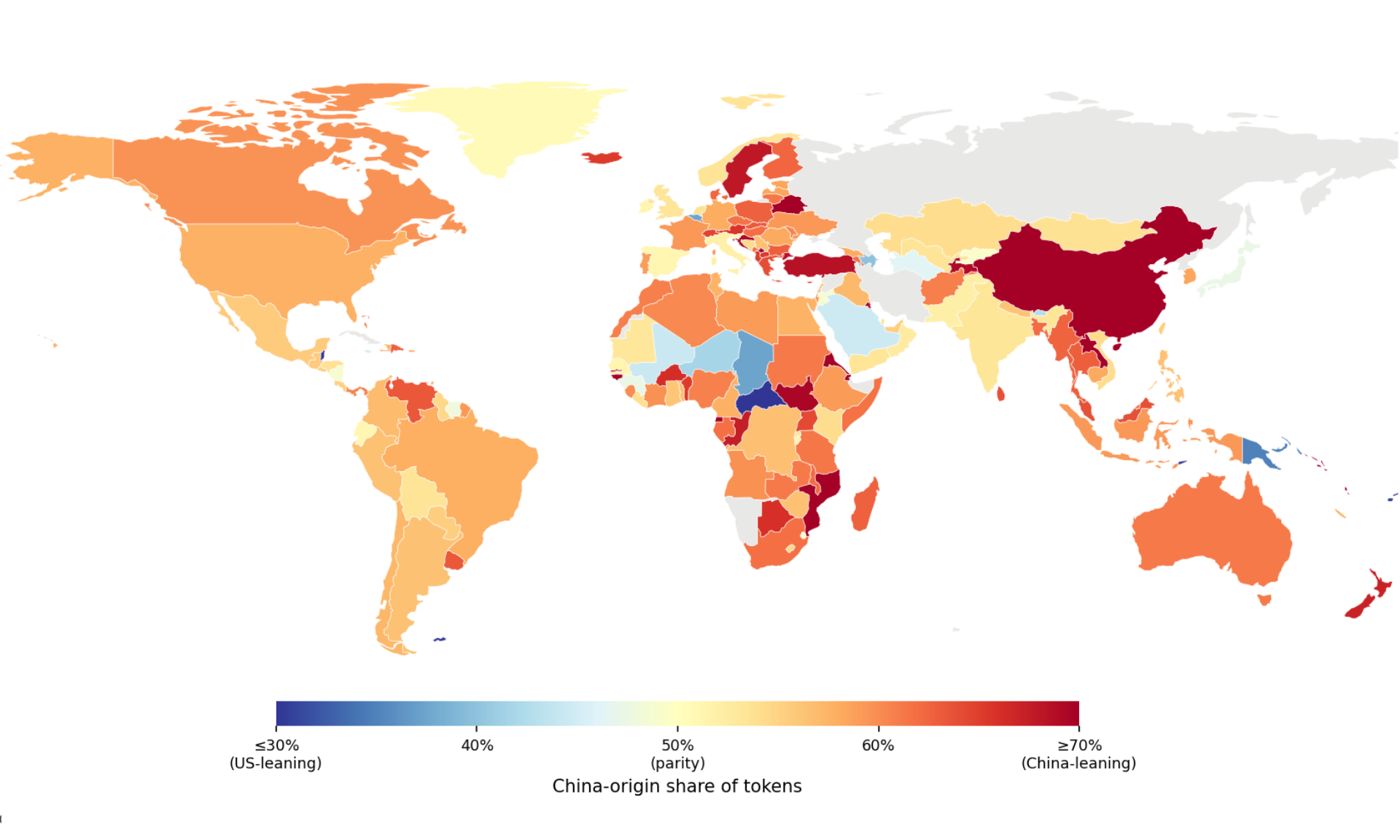
Chinese AI models have overtaken US models in Europe on one of the leading AI platforms for developers. In July and August 2026, Chinese models accounted for 58 percent of token consumption in the European Union on OpenRouter, one of the world’s largest AI gateways. Their share reached 61 percent in Germany and 58 percent in France. In the United Kingdom, Chinese models accounted for 53 percent of token consumption.
These are the findings of a new study by the Global Innovation Hub of the Friedrich Naumann Foundation for Freedom in Taipei, “China’s AI Sweeps Into Europe”. It provides the first country-level analysis of how widely Chinese AI language models are used. The study analyses token consumption data from the major AI platform OpenRouter and download figures from Hugging Face. Tokens are a unit of measurement in AI. They indicate how much text a model processes and generates.
OpenRouter is primarily aimed at developers and companies integrating AI models into their applications. The data therefore provides insights into the adoption of AI models in application development. The direct use of services like the ChatGPT app is not captured. Consequently, the results do not reflect the entire AI market."
The study shows how rapidly Chinese AI models are gaining ground. Just a year ago, they accounted for only around 15 percent of token consumption on OpenRouter across EU countries. In Germany, too, they played only a marginal role on the platform at the time.
While acknowledging that their low cost and increasingly competitive performance can accelerate the diffusion and adoption of AI, the authors, Valentin Weber and Céline Nauer, warn that many users might underestimate the risks associated with Chinese models. “Europe needs competitive alternatives and a Plan B,” says Valentin Weber, Senior Research Fellow at the German Council on Foreign Relations.
Chinese models accounted for the highest shares in Luxembourg, where they represented 71 percent of token consumption, followed by Croatia at 67 percent, Cyprus at 65 percent, Austria and Greece at 64 percent, Poland and Slovakia at 63 percent, and Germany at 61 percent.
A one-sided dependence
Models from companies such as DeepSeek and Alibaba are often available at a fraction of the cost of leading US alternatives. At the same time, the performance gap between leading Chinese and US models has narrowed considerably, making Chinese models attractive for a growing number of business applications.
Open licensing is another factor behind their popularity. Furthermore, several Chinese models are released as open-weight models, allowing companies to download, modify and host them on their own infrastructure. “Chinese models are affordable and good enough, which is why companies are adopting them. But anyone building on them today is making themselves dependent on decisions taken in Beijing”, says Weber.
While Europe and the US are using Chinese models on a large scale, China’s AI market remains largely self-contained. In China and Hong Kong, approximately 95 percent of observed token consumption is accounted for by Chinese models, while US models accounted for only around 5 percent. ChatGPT and Claude are also not available in China.
“This asymmetry is significant: If China restricted model exports or overseas access, European and US users would be affected immediately. A comparable US restriction on China would have a much smaller impact, since Chinese users already rely predominantly on domestic models,” says Céline Nauer, Deputy Head at the Global Innovation Hub of the Foundation in Taipei and co-author of the study
Three risks for Europe
If China restricts access to its models, this will lead to high costs for European companies. Once a company has tailored its prompts, software and evaluation processes to a particular model, switching providers can also be costly. Open-weight models reduce dependence on a platform, but not necessarily on future updates or technical support.
Another concern is the relationship between opaque technology and suppliers operating under Chinese law. Advanced models remain difficult to assess, while Chinese providers operate under Chinese law and may be required to cooperate with state authorities. For European users, this raises questions about data governance, censorship, model behaviour and the reliability of AI-generated code.
Cybersecurity risks add another layer of uncertainty. Frequent model updates could make it harder to detect vulnerabilities or unwanted changes. Code generated by an AI system may contain security flaws or hidden backdoors, while increasingly capable models could gain access to sensitive corporate systems. Small and medium-sized businesses may struggle to assess these risks adequately.
Europe needs alternatives and a backup plan
The rapid spread of Chinese models shows that technological dependence can emerge within a very short period of time. European companies should therefore establish backup plans for possible restrictions on Chinese or US models, assess how quickly they could switch providers and identify which products and services depend on foreign foundation models.
European policymakers should communicate more clearly about the risks associated with Chinese AI models and consider requiring software providers to disclose which large language models power their products. While low-cost Chinese models can accelerate AI adoption and reduce dependence on a small number of US providers, the benefits need to be weighed against the risks of lock-in, data governance concerns, cybersecurity vulnerabilities and geopolitical dependence. Europe needs competitive alternatives and the ability to make a genuine strategic choice.
Frederic Spohr heads the Taiwan and Korea offices of the Friedrich Naumann Foundation for Freedom (FNF) and leads its Global Innovation Hub in Taipei
Celine Nauer serves as a project advisor and the deputy head at the Global Innovation Hub in Taipei
Valentin Weber is a Senior Research Fellow at the German Council on Foreign Relations (DGAP)