Nordkorea
The Risk of a Nuclear Arms Race in East Asia

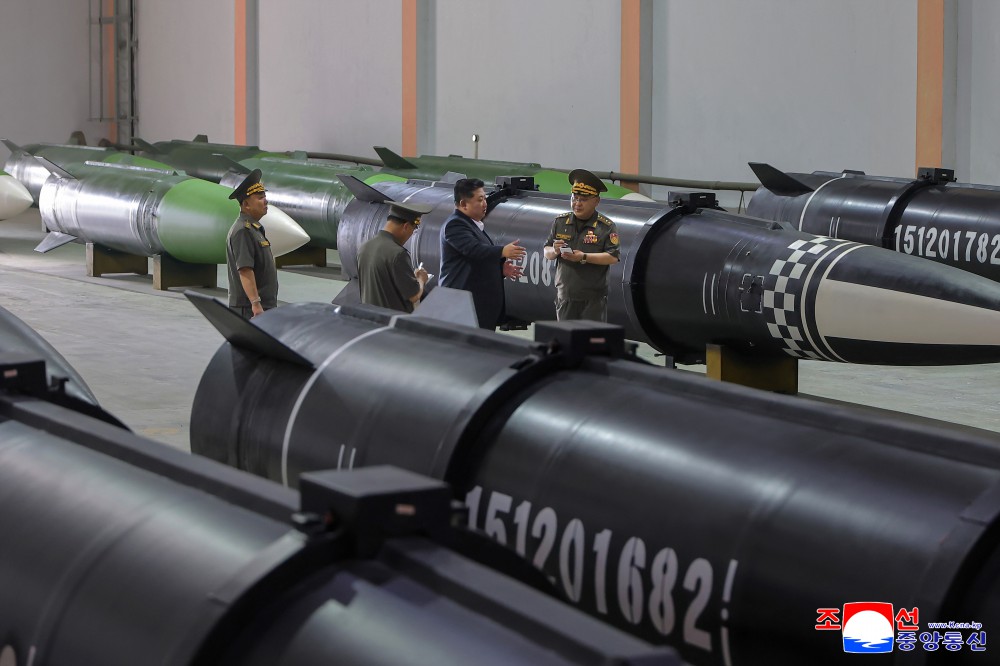
The security order in East Asia is coming under increasing pressure. North North Korea and China are expanding their military and nuclear capabilities, while Russia is arming North Korea in return for its assistance in the war of aggression. At the same time, doubts are growing in Japan and South Korea about the long-term reliability of American security guarantees. As a result, the risk of a nuclear arms race in the region is increasing. In Seoul and Tokyo, voices are growing louder in favor of considering new security policy measures - up to and including the development of their own nuclear arsenals as a strategic “last-resort” option.
How far are Japan and South Korea actually from developing their own nuclear weapons, both technically and politically? A new study by the Friedrich Naumann Foundation for Freedom examines this question. The political scientist Mason RIches of Hanguk University of Foreign Studies analyzes 13 factors for this purpose, including civilian nuclear infrastructure, the availability of fissile material, delivery systems, technical know-how, political support, and international risks.
Japan is already classified as a “nuclear threshold state” in the analysis. The country has uranium enrichment capabilities, facilities for reprocessing of spent nuclear fuel, and around 44 tons of separated plutonium. According to the study, Japan could develop a nuclear weapon within six to 36 months. However,political and societal opposition remains considerable: around 60 percent of the population continue to oppose nuclear armament.
South Korea is described by Richey by contrast as an “advanced latent nuclear state” potentially on its way to becoming a “nuclear threshold state.” The country operates 26 nuclear reactors and has highly advanced missiles as well as military infrastructure. Unlike Japan, however, South Korea does not yet possess its own uranium enrichment and reprocessing capabilities. If the ongoing negotiations with the United States result in South Korea being permitted to enrich uranium and reprocess spent nuclear fuel itself in the future, the country could significantly reduce its technological gap with Japan. The study estimates that a potential nuclear breakthrough could take two to five years. Politically, the debate in South Korea has already progressed considerably further. Around 70 to 75 percent of the population support an independent nuclear arsenal.
Nevertheless, the costs for both countries would be high: withdrawing from the nuclear non-proliferation order could trigger sanctions, diplomatic isolation, regional countermeasures, and a serious strain on alliances with the United States. The greatest obstacle is therefore not technical capability, but the political decision. As long as Seoul and Tokyo trust in American protection, independent nuclear armament remains unlikely. A sustained loss of confidence in Washington or a severe regional security crisis could, however, fundamentally change this calculation.
The European Union also has an interest in preventing such an arms race. It should work to ensure that Japan and South Korea comply with the internationally applicable provisions on nuclear non-proliferation. At the same time, it should expand the security policy cooperation with both countries. Furthermore, a Europe with greater security capabilities can relieve the burden on the United States, enabling the United States to continue credibly protecting its allies in East Asia. This could reduce the incentive for Japan and South Korea to develop their own nuclear weapons.
You can find the full study at the bottom of the page. Simply click “Download” to download it for free.
Pascal Pewesdorf is currently undertaking an internship at FNF office Seoul. He is pursuing a masters in International Relations at Monash University in Melbourne, Australia, and completed an exchange semester at Yonsei University in Seoul.