Brazil
Why Brazil's Presidential Election Is Geopolitically Crucial for Europe
It is more than just a symbolic image. Senator Flávio Bolsonaro stands in the Oval Office of the White House. The 45-year-old wears a yellow-and-green-striped tie—the colors of Brazil—and stares intently into the camera. Seated at the desk in front of him, United States of America, President Donald Trump smiles broadly. The photo was taken on May 26 of this year. Although it was already clear by then that the eldest son of imprisoned former Brazilian President Jair Bolsonaro intended to run in the presidential election, he had not yet officially announced his candidacy. Nevertheless, he was certain of Trump’s support.
Just a few weeks earlier, the left-leaning incumbent Luiz Inácio Lula da Silva had met with the USA president at the White House. The photos from that visit tell a different story. The two heads of state are seated across from each other in armchairs, Trump leaning forward and Lula gesturing wildly with his legs crossed. Lula, who is now campaigning for a fourth term, wanted to demonstrate strength on equal footing and project Brazil’s newfound foreign policy confidence to the world.
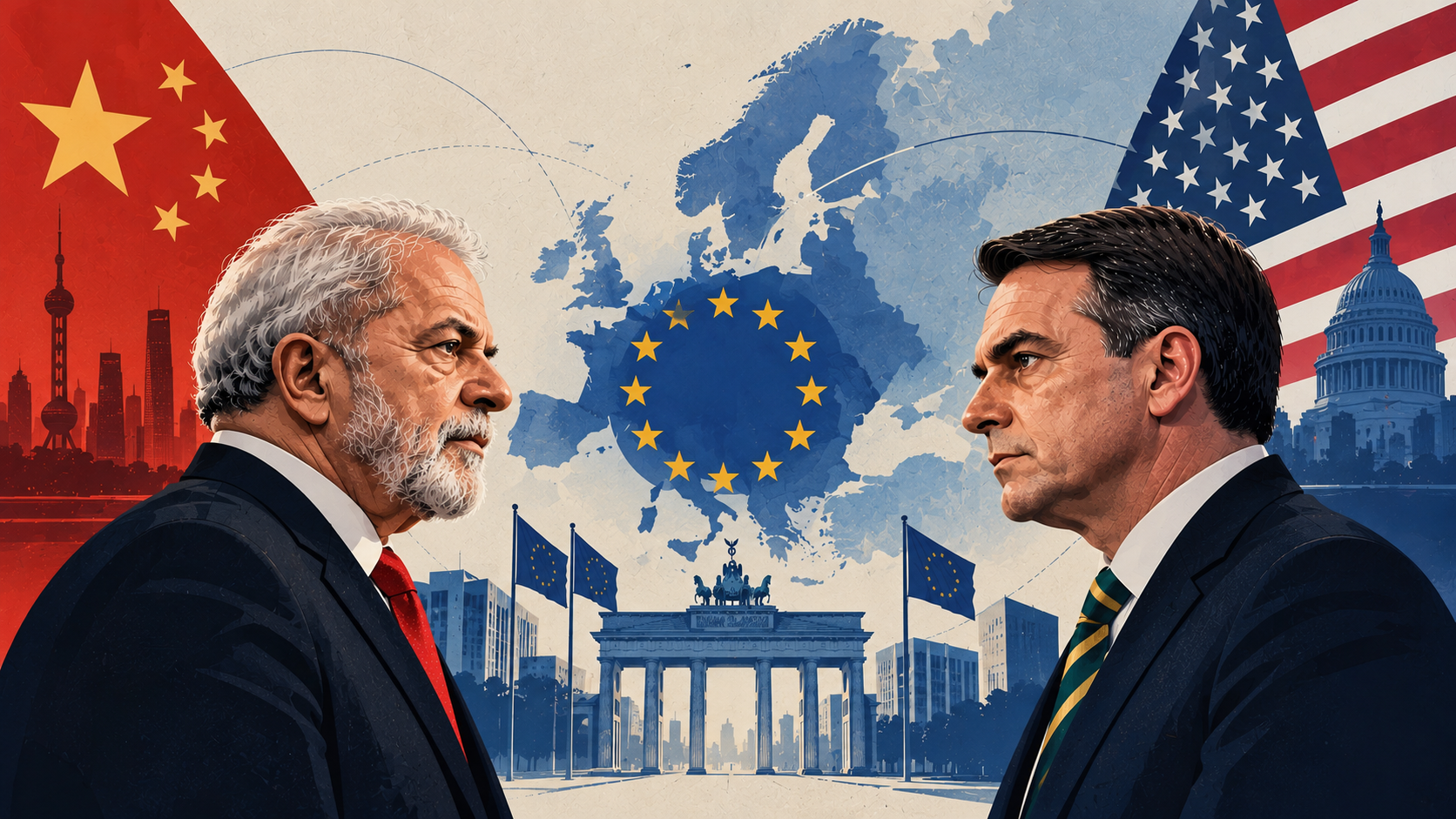
When Bolsonaro Jr. and Lula face off in the presidential runoff on October 25, it will not merely be a clash between two camps that have been at odds for nearly a decade. The USA is acting as a powerful player behind the scenes. Trump sees an opportunity to expand his strategic influence in Latin America.
In recent months, conservative politicians who favor closer ties with the major partner to the north have won every election in Latin America. So far, Brazil—the region’s most important economy—has been the exception. A victory for Bolsonaro Jr. in the runoff would therefore also be a victory for Trump. In the first round of the presidential election on October 4, the right-wing conservative politician led Lula by about three percentage points.
As expected, foreign policy issues are not at the center of the election campaign. Nevertheless, this election also involves a fundamental decision: How should Brazil position itself vis-à-vis the USA in the future?
A one-sided alignment with Washington would be a risk for Bolsonaro
The trade conflict that Trump instigated last year was sparked by Jair Bolsonaro’s sentencing to 27 years in prison for an attempted coup. Trump wielded the tariff stick and imposed additional duties on Brazilian exports. Behind this was an overt threat to Lula’s left-leaning government.
Most recently, in July, Trump imposed tariffs on Brazilian goods. Products such as beef and coffee were exempt. In doing so, the USA president spared powerful agricultural producers, who are key supporters of Bolsonaro Jr. Although Trump is not openly interfering in the Brazilian election campaign, he is nonetheless exerting influence through statements supporting Bolsonaro and his tariff policy.
While the USA. is aggressively pursuing its power politics, Europe remains in a wait-and-see mode. It is too uncertain how Bolsonaro Jr. will position himself on foreign policy as a potential new president. The only certainty is that ties with the USA are likely to grow closer. That would mark a break from the course of “active non-alignment” pursued by Lula.
In his campaign platform, Bolsonaro Jr. presents himself as moderate and avoids radical rhetoric. On foreign policy issues, however, he remains vague, and his statements are at times contradictory. This is evident in the EU-Mercosur agreement, the free trade initiative between Brazil, Argentina, Paraguay, and Uruguay and the European Union.
Bolsonaro Jr. speaks of freeing Brazil “from the shackles” of the Mercosur agreement and relying more on bilateral treaties. He said he would “aggressively” seek new agreements. It remains unclear whether he is aiming for a complete withdrawal from the Mercosur agreement, a suspension, or renegotiations in certain areas, such as environmental protection requirements.
Bolsonaro Questions the EU-Mercosur Agreement
According to his own statements, one of his first actions will be to conclude a bilateral free trade agreement with the USA modeled after Argentina’s. This would grant the United States privileged market access. European suppliers would be left behind.
The stakes are high for the EU. After more than 25 rounds of negotiations, the agreement with the Mercosur countries was finally brought across the finish line this year—at least in terms of provisional implementation. Lula played a decisive role in this. It is his greatest foreign policy triumph.
However, even a slight weakening of the free trade agreement would be disastrous for Europe. This is because many EU countries, led by Germany, are struggling with sluggish growth and are counting on new markets in Brazil. At the same time, they are seeking to reduce their economic dependencies. Brazil possesses the world’s second-largest reserves of rare earth elements, has numerous offshore oil reserves that have not yet been developed, and intends to expand the mining of iron ore and critical raw materials.
Bolsonaro has also made an announcement regarding security policy that is likely to be noted with interest in Europe. He intends to join the “Shield of the Americas” security initiative, which was founded by Trump about eight months ago. The pact, which currently includes 19 Latin American countries, aims to combat cross-border drug trafficking and organized crime.
Lula Defends Multilateralism and Neutrality
As the USA assumes a leading role in the alliance, Trump’s influence in the region is growing. The two largest countries in Latin America, Brazil and Mexico, are currently led by center-left governments and have not yet joined the alliance. They fear that Washington could expand its claim to power in the region.
Bolsonaro Jr. also supports Trump’s decision to designate Brazil’s two largest criminal organizations, the PCC (Primeiro Comando da Capital) and Comando Vermelho, as terrorist organizations. This marks another break with Lula’s foreign policy, as his administration had unsuccessfully argued against the move, citing Brazil’s sovereignty. Such a designation of criminal organizations gives the USA a stronger legal basis to crack down on the cartels—including through operations on Brazilian soil.
These examples show that the Brazilian presidential election has significance far beyond the country’s borders. A government under Lula would adhere to the traditional principles of Brazilian foreign policy: autonomy, multilateralism, and cooperation with various partners.
Bolsonaro, on the other hand, has announced a geopolitical reorientation. He would shift the focus toward the USA, while Europe would become less important. Efforts to strengthen partnerships and economic ties could thus suffer significant setbacks.
However, a foreign policy orientation that is one-sidedly aligned with the USA would also be risky for Bolsonaro Jr. Should he align himself closely with the White House, he could face resistance from within his own ranks. Political scientist Octavio Amorim Neto of the Getúlio Vargas Foundation in São Paulo anticipates conflicts with segments of the economic elite, nationalist forces within the armed forces, and major media conglomerates. He attributes this to economic interests and concerns that Brazil might sacrifice some of its autonomy if it were to form ties with Washington that are too close.
Uncertain Future for Brazil’s BRICS Membership
Bolsonaro Jr. has explicitly called into question not only the future of the Mercosur agreement but also Brazil’s BRICS membership. On his first day as president, he said in a podcast that he would examine whether Brazil should remain in an alliance that is ideologically driven and provokes the USA
Under the Lula administration, Brazil has advocated for a pragmatic and open approach to the alliance, which is anything but homogeneous. The BRICS should explicitly not be viewed as an anti-Western alliance, but rather as a means of pooling the political and economic interests of its member states. In 2025, Brazil hosted the BRICS summit. China, Russia, India, and Brazil are founding members of the alliance, which has since expanded.
In an increasingly multipolar world marked by growing tensions and conflicts, the BRICS group could continue to gain in importance. Brazil’s withdrawal would not only weaken the alliance; the South American country would also lose international influence and jeopardize its self-proclaimed role as a mediator between different centers of power.
Under Lula, Brazil has increasingly sought closer ties with Europe. Its support for the Mercosur agreement is one example of this. Further evidence is the decision not to join China’s “Belt and Road” initiative. In doing so, Brazil is attempting to limit its dependence on China and preserve its autonomy.
Brazil Remains a Key Geopolitical Player
With its renewed engagement in Latin America, the United States aims above all to curb China’s influence in the region—both economically and politically. But the groundwork has already been laid. China is by far Brazil’s largest trading partner, ahead of the USA Brazil is the world’s leading supplier of agricultural products to China, such as soybeans, beef, sugar, and corn. Brazilian farmers are thus in direct competition with American farmers and have a significant interest in securing their market access.
Should Bolsonaro Jr. win the election, he will have to face this economic reality. Unlike his father, he is promising a pragmatic approach to China in his campaign. Jair Bolsonaro once warned against a “sellout” of Brazil, but during his time in office, he expanded ties with China.
At the same time, Bolsonaro Jr. says he intends to be more considerate of USA sensitivities in economic relations. This also applies to the financial sector. He criticizes the Lula administration’s efforts to reduce dependence on the dollar in international trade. Underlying this is a fundamental dispute over Brazil’s foreign policy options.
Lula wants to expand opportunities to trade with countries that are also affected by USA tariffs or sanctions. Bolsonaro, on the other hand, fears that moving away from the dollar could strain relations with Washington.
Regardless of who wins the runoff election, Brazil will continue to have to align its foreign policy with economic interests. The interdependence with China is too great, and relations with the USA are too important. Neither Bolsonaro Jr. nor Lula can ignore these factors.
However, Bolsonaro Jr. would in all likelihood challenge the model of multilateralism and pursue a closer partnership with Washington. For Europe, this would be more than just a diplomatic shift: it could complicate access to an important future market, jeopardize the implementation of the Mercosur agreement, and set back efforts to pursue a more independent raw materials and trade policy.