Restorative Justice
Restorative Justice Sandbox: Bringing Justice to Schools and Beyond

Restorative Justice in school
© TIJMore than 54 percent of Thai children have experienced violent discipline or physical punishment, according to UNICEF Thailand’s Multiple Indicator Cluster Survey (MICS) 2022. Such incidents can occur in everyday settings, including homes, schools, and communities. The World Health Organization (WHO) also reports that around 25 percent of young people in Thailand have been involved in a physical conflict at least once a year.
Without appropriate ways to address these situations, everyday conflicts can escalate into more serious violence and create lasting harm for individuals and communities. Restorative Justice (RJ) offers an alternative approach. Rather than focusing solely on who is at fault or what punishment should be imposed, restorative justice seeks to understand the harm caused, rebuild relationships, and bring together those affected by a conflict to find a fair and constructive way forward.
At its core, restorative justice encourages those responsible for causing harm to acknowledge its impact, take responsibility, make amends, and work towards changing their behavior. At the same time, those who have been harmed are given an opportunity to have their experiences heard and to participate in finding a meaningful resolution.
Gamifying Restorative Justice
The Thailand Institute of Justice (TIJ) has been working to promote the principles of restorative justice in Thai society as part of its efforts to strengthen justice and the rule of law. In March 2026, TIJ launched the “Restorative Justice in School Sandbox” in cooperation with the Bangkok Metropolitan Administration (BMA). The initiative aims to create safer spaces for children while equipping schools with practical tools to address conflicts responsibly through a restorative justice approach.
As part of efforts to strengthen the rule of law and access to justice in Thailand, Freidrich Naumann Foundation Thailand supported the gamification of restorative justice principles. Working with designer Sukumal Surichamorn of Found by Design, two games: RJ Journey and RJ Express were developed to turn the principles of restorative justice into an engaging and practical learning experience.

RJ Journey and RJ Express
© FNF ThailandThe two games serve different purposes. RJ Express introduces players to the basic principles and processes of restorative justice through three key steps: understanding the thoughts and feelings of those involved in a conflict; choosing appropriate approaches to address the situation; and understanding the goals of using restorative justice to resolve conflicts.
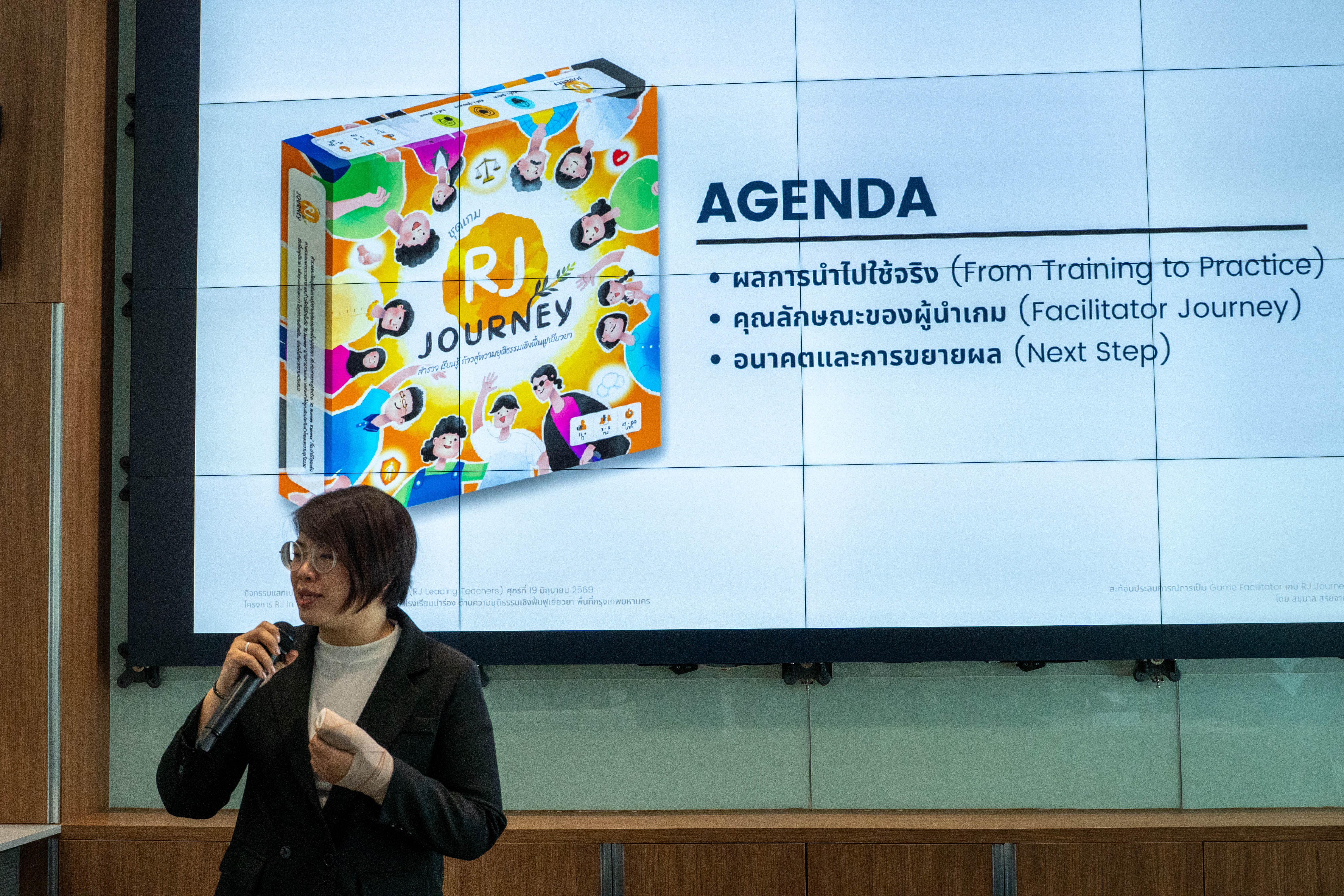
RJ Journey, meanwhile, puts players in the role of facilitators. Through simulations and roleplay, participants navigate different conflict scenarios while other players take on the roles of people involved in the conflict. This allows participants to experience first-hand how a restorative process can unfold.
“We chose games as a learning tool because they can transform Restorative Justice (RJ), which may seem like an abstract concept, into a tangible experience that players can engage with,” says Auraprang Pornpermpoon, Policy and Project Coordinator at TIJ. “Through games, players can practice active listening, asking questions, and staying with conflict without rushing to judgment.”
Creating Safe Spaces, One School at a Time
Under the “Restorative Justice in Schools Sandbox” initiative, TIJ, BMA, and FNF Thailand organized a series of training sessions for teachers and educators in Lak Si district of Bangkok. The project aims to strengthen teachers’ capacity to address conflicts in schools using restorative justice principle and to integrate the approach into their everyday work.
Around 30 teachers from 6 schools were selected as pioneers for the initiative. The training began with an introduction to the theory and principles of restorative justice, combining lectures with opportunities for participants to exchange experiences and reflect on conflicts they encounter in their schools.

teacher exchange at RJ workshop
© TIJThe training then moved from theory to practice. Using RJ journey and RJ express games, teachers were able to practice applying restorative justice principles and take on the role of facilitators in different conflict situations simulations, and roleplay based on the mechanism of the games. This hands-on approach allowed participants to explore how restorative practices could be applied to real-life situations in their schools.
“This game allows us to use restorative justice theory effectively. It is not [just] fun, but you can learn the basic process.” One teacher reflected.

RJ Journey gameplay
© TIJFor TIJ, the ultimate goal is not to create schools where conflicts never happen, but schools that have the capacity to deal with conflict constructively. “Our goal is not to create schools that are without conflicts, but schools that can tackle conflicts effectively,” says Anuwan Vongpichet, TIJ’s Deputy Executive Director. “Without focusing on who is at fault or who should be punished, everyone should still remain a part of the school community.”
The organisers plan to expand the initiative to schools across all districts of Bangkok in its next phase, with the aim of making restorative justice approach more accessible to educators and ensuring that schools can become safer and more inclusive spaces for children.
One conflict, one conversation, one school at a time.

RJ in school sandbox pioneer teachers
© TIJ