AI Race
America leads, China is catching up, Europe is falling behind


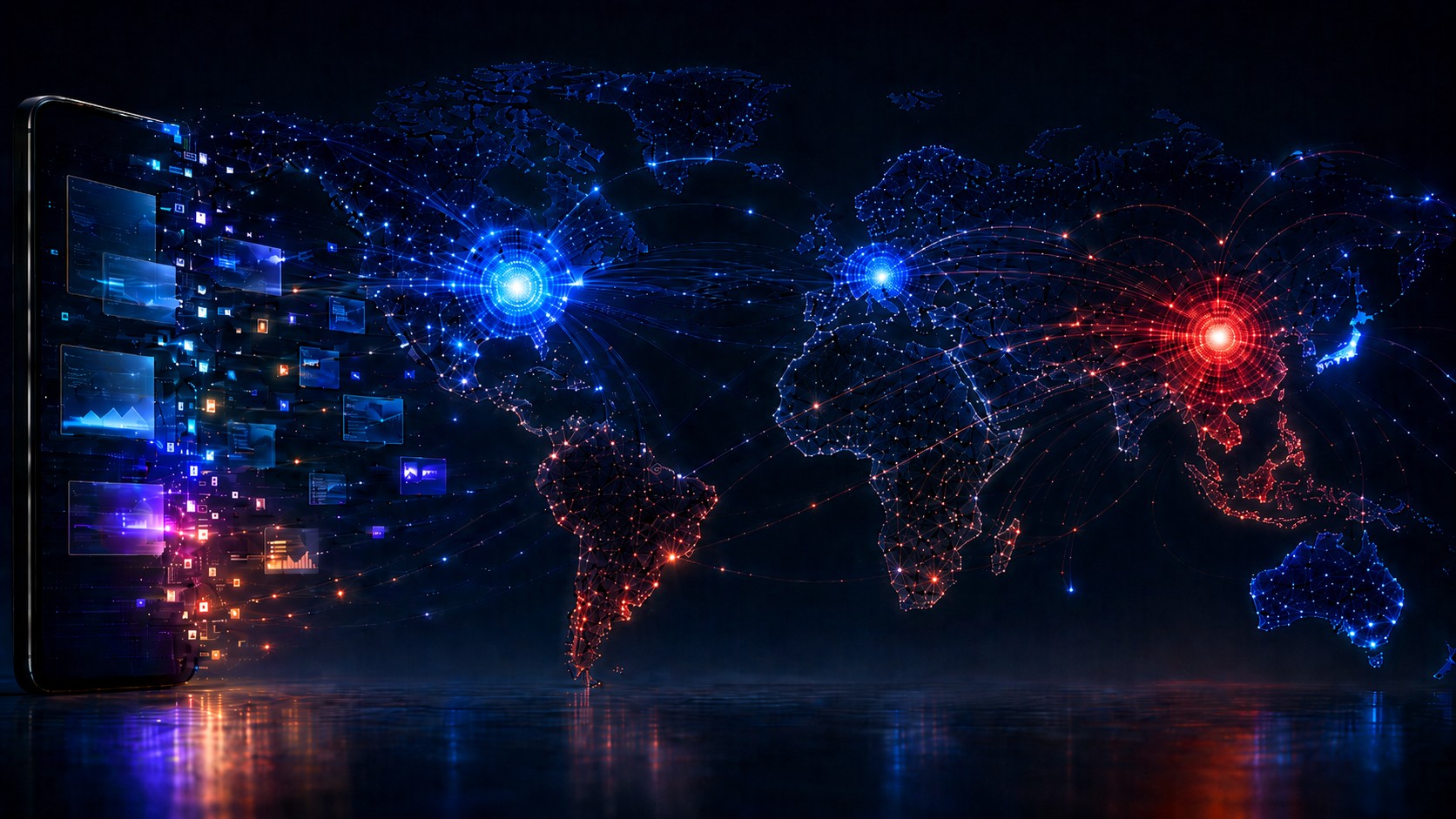
Whether for search queries, news briefings or an initial orientation on health questions, AI chatbots have become a central gateway to knowledge and interpretation. Whoever operates this gateway has influence over which information becomes visible, how it is weighted, which functions are available and where the service remains accessible. This is where their geopolitical and societal relevance lies.
An analysis by Valentin Weber for the FNF Global Innovation Hub in Taiwan shows who actually provides the most important AI chat applications and which countries they come from. The publication “The Geopolitics of AI App Exports” evaluates the download figures of generative AI apps on Android devices, from their respective market launches through the end of April 2026. The result is worrying for Europe.
A two-horse race without Europe
American providers such as ChatGPT, Gemini, Claude, Perplexity, Grok, Meta AI and Character.ai have been downloaded a combined 1.35 billion times. Chinese apps such as Dola, DeepSeek and Qwen account for 205 million downloads, and they have been catching up noticeably since mid-2025. And Europe? Its great hope, the French app Vibe, formerly LeChat, by Mistral, has reached just 1.26 million downloads. Almost 87 percent of those come from EU countries. Even at home in France, people are more likely to download Grok than the domestic alternative.

Dola, not DeepSeek: China’s real export success
US providers still dominate the global market for generative AI apps. But in Southeast Asia and Latin America, Chinese providers are already deeply entrenched. In the Philippines, they account for 47 percent of the downloads examined; in Indonesia and Peru, the figure is 38 percent each. Chinese AI apps have also reached significant market shares in Mexico at 30 percent, Malaysia at 28 percent and Argentina at 27 percent. In Belarus and Russia, where US services such as ChatGPT are unavailable or only available with restrictions, Chinese apps even outperform their American competitors.
The real star of this expansion is not DeepSeek, whose major hype moment in early 2025 quickly faded. It is Dola, the chatbot from ByteDance, TikTok’s parent company. With 144 million downloads, Dola is far ahead of DeepSeek, which has 58 million. Its rise is largely based on massive advertising campaigns on social media, especially on TikTok, which is also owned by ByteDance. In Mexico alone, the company ran more than 400 different ads in October 2025. ByteDance is therefore using its own platform power to place the next strategic product in the market.
AI becomes a question of power
Whoever controls the most widely used AI applications in a market can adjust algorithms, withdraw products or build in backdoors, thereby influencing access to information, data flows and digital business processes. AI apps are not ordinary consumer products. They are potential instruments of power.
The study builds on the concept of technological spheres of influence, which Weber introduced in 2020: geographic spaces in which an external power has a privileged ability to control technology. What is new in the AI age is that this control has become intelligent. AI systems do not merely reproduce political directives in their answers; in theory, they can act autonomously in the interests of their countries of origin.
Two cases show that AI is being politically instrumentalized. Security researchers at CrowdStrike found indications that DeepSeek more frequently generated faulty code for IT projects with a Tibet connection. A second case was the temporary export control imposed by the US government on Anthropic’s Claude Fable 5 and Claude Mythos 5 models. The measure was intended to restrict access to particularly powerful models for foreign nationals on national security grounds; in practice, it temporarily led to a broader deactivation because Anthropic could not verify users’ nationality in real time.
Companies and researchers that had built their processes around these systems suddenly found themselves without their tool. Those who integrate AI deeply into their workflows become vulnerable to decisions made in Washington or Beijing, not in Berlin or Brussels.
What Europe should learn from this
First, Europe should enter into partnerships with AI middle powers such as South Korea or Canada to compensate for weaknesses in frontier models. The partnership announced in April 2026 between the Canadian company Cohere and the German AI provider Aleph Alpha points the way. Precisely because one-sided dependencies are so risky, the answer lies in a network of reliable partners rather than reliance on a single provider.
Second, Europe must remain vigilant when choosing its tools. The study warns of the security risks of Chinese open-source models, on which parts of the European and American startup ecosystems are being built. What may appear pragmatic because European alternatives are lacking carries considerable risks: the possibilities for misusing language models for covert purposes are only gradually becoming visible.
Third, Europe must invest in the future so that it is not left behind again in the next wave of AI. The coming race will revolve around embodied AI: artificial intelligence embedded in robots and physical devices. Thanks to its strength in robotics, Europe is better positioned here than in previous AI cycles. But hardware will not be the only decisive factor. The app ecosystem used to control robots and devices will also determine market shares. Europe missed the chatbot era. It must want to win the embodied AI era.
Céline Nauer is a project consultant at the Global Innovation Hub of the Friedrich Naumann Foundation for Freedom in Taiwan.
Frederic Spohr heads the Naumann Foundation’s offices in Taiwan and Korea.