Driving AfCFTA Forward
What will it take to build Africa’s digital trade routes?

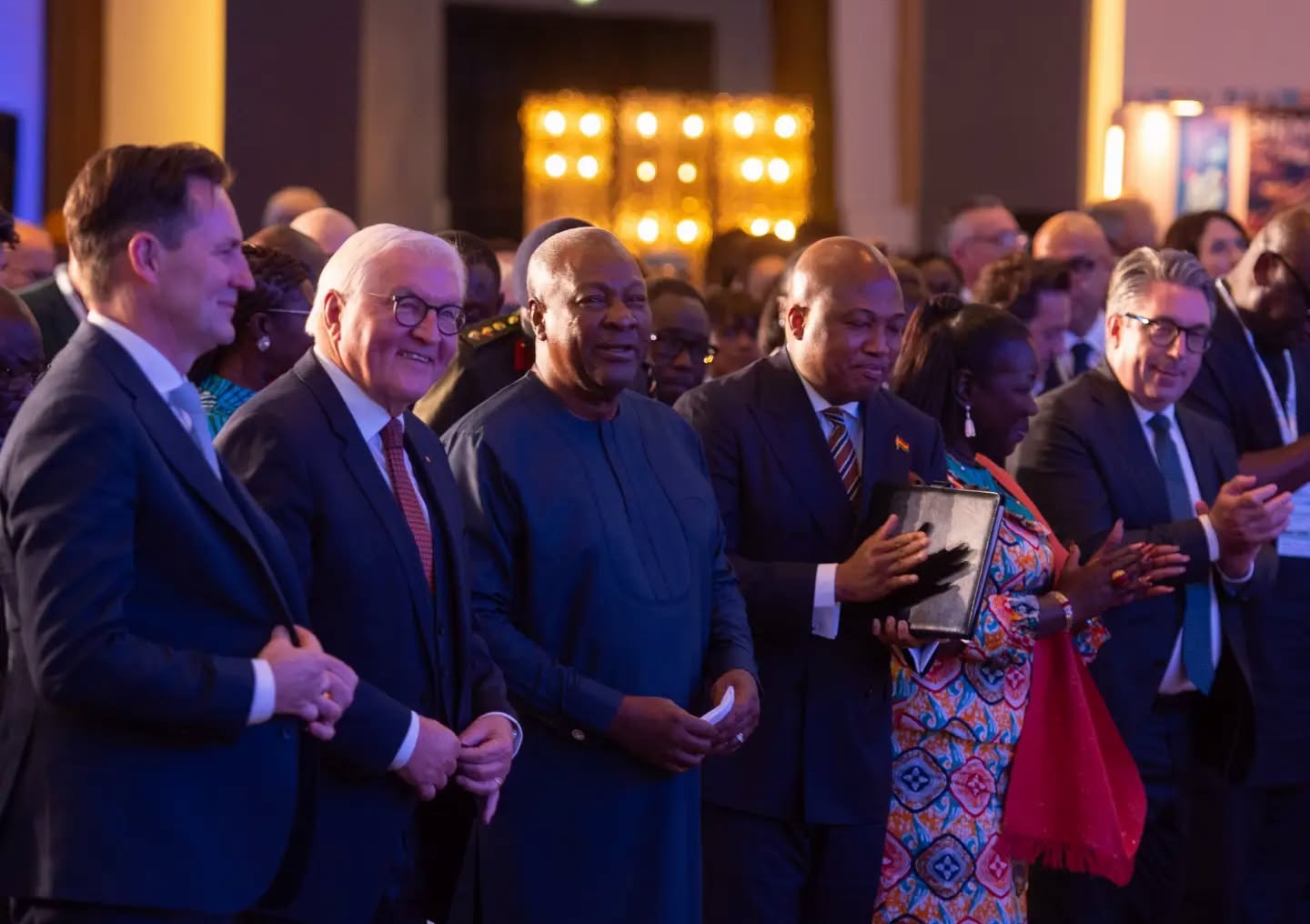
President Frank-Walter Steinmeier with President John Mahama of Ghana at the opening night of the German Africa Business Summit in Accra on 24 November 2026.
© German Embassy GhanaAt a side event during the German-African Business Summit in Accra, speakers discussed the barriers that make it difficult for businesses to trade across African borders and how the AfCFTA could help remove them.
“The average waiting time of a truck here is a week to get a container out of the port,” said Tobais Maier, CEO of DHL Global Forwarding for the Middle East and Africa. “In Dubai, it takes me 20 minutes.” The comparison drew a quiet but telling picture of the challenge facing African trade, the reality that goods can cross oceans more easily than they cross some land borders. Maier was speaking at “Driving AfCFTA Forward: Establishing the Digital Autobahn for African Free Trade”, a side event discussion hosted by the Friedrich Naumann Foundation for Freedom (FNF) and the Federation of German Industries (BDI) in Accra on 25 November, during the German-African Business Summit.
For Maier, the delays are not an abstract policy concern. They keep trucks and other assets idle, add to logistics costs and they can raise the price of goods. “The truck in Dubai can make 30 deliveries, and the truck here makes one delivery,” he said. He also described how difficult it can be for companies to move goods between African countries. “It’s easier to bring a shipment from China or Germany to Ghana than it is to move it to the neighbouring country,” he said, pointing to complicated border and customs procedures.
The figures he shared offered a measure of the gap. Maier put trade within Europe at around 66% of the region’s total trade, and trade within Asia at 59%. Intra-African trade, he said, is about 16 or 17%. The AfCFTA is intended to create a single market for 1.5 billion people. But the discussion made clear that an agreement alone cannot make trade seamless. Businesses need borders that function, payment systems that connect, documents that are recognised and practical cooperation between the countries and institutions involved.
Freda Yawson-Aminu, Senior Manager at the African Centre for Economic Transformation (ACET), urged the audience to recognise the progress already made. “Sometimes we don’t give ourselves enough credit,” she said. “I want to give ourselves a little bit of credit for at least getting the policies together.” She pointed to the African Union’s digital framework, the AfCFTA digital trade protocol and improvements in connectivity. But she said the scale of investment remains a major barrier. According to the figures she cited, around US$10 billion is being invested annually in digital connectivity, while an estimated US$36 billion a year is needed. “There is still a gap in terms of financing all the things that make it work,” Yawson-Aminu said.
She noted that governments are under pressure and that private investment is already providing a substantial share of funding. The challenge is to develop projects that can attract investment and to bring public institutions, development finance institutions and private investors together. Digital networks also need reliable electricity and other supporting infrastructure. The obstacles are not only financial or technical. Yawson-Aminu described a case in which traders from Benin tried to export pineapples to Ghana but were told their certificates were not recognised. The countries may intend to recognise each other’s documents, she said, but the systems needed to make that happen are not in place. “Legally, at the continental level, they share that interest, but legally they can’t do that yet,” she said.
Digital signatures, data rules and national laws must work across borders if trade documents are to be accepted. She also pointed to less visible barriers: language, political incentives and a reluctance to coordinate. “There are softer issues,” she said, including entrenched attitudes between countries. For integration to work, she added, governments need to see how cooperation can benefit all sides.
Prof. Brando Okolo, Head of Science, Technology and Innovation at AUDA-NEPAD, said that countries need to build systems that can work together and share data. Trust, he argued, is central to that effort. “Trust is very important,” Okolo said. He also cautioned against overlooking what has already been achieved. “There is progress taking place,” he said. “We shouldn’t underplay the rate of progress that has taken place so far across the continent.” For small businesses, the barriers can be painfully concrete.
Samuel Opoku, COO and Co-Founder of Kutana Pay, said that when an entrepreneur crosses a border, financial services do not always cross with them. “The thing that is really difficult for them is, if I’m crossing the border, my financial services provider that is sitting in my country then just stops to work,” he said. Insurance, payments and sometimes access to credit may all be affected.
Opoku described a journey by bus between Accra, Abidjan and Lomé. “I made the mistake of travelling by bus between Accra, Abidjan and Lomé. Don’t do it,” he said. At one border, he recalled, passengers and their goods had to be unloaded and checked before being loaded again. The process could take close to five hours. Kutana Pay brings financial services together for small and medium sized businesses trading across markets. Opoku said the platform helps customers manage currencies such as the Ghanaian cedi and Nigerian naira without carrying cash. But it cannot remove every obstacle.
To make payments in multiple markets, his company needs access to local funds in each one. “We need to be able to actually have cash and keep it in many markets to make this happen,” he said. “There’s a lot of liquidity that is needed.” That reality gave the discussion’s “digital autobahn” a more grounded meaning. Digital payments can help traders move money, but they cannot by themselves make a border process faster or ensure that one country accepts another’s documents. The conversation also turned to how AfCFTA initiatives are communicated and implemented.
Gregor Schneider, Trade Counsellor at the European Union Delegation to Ghana, raised concerns about transparency around some projects. “It’s not very transparent what they’re doing,” he said, calling for information to be shared with member states and partners. A representative of the AfCFTA private-sector platform argued that the focus now must be on implementation and on hearing directly from businesses. “The focus has to be on implementation,” he said. He also stressed the need to connect the AfCFTA more effectively with Africa’s regional economic communities, where much trade takes place.
The discussion closed with a reminder that integration depends on relationships as much as systems. Yawson-Aminu said trust requires people to understand how one another work and to be willing to meet halfway. “It comes down to trust, it comes down to negotiation, and it comes down to patience to make it work,” she said. That may be the most human measure of the digital autobahn. Not just how quickly data or payments travel, but whether traders, institutions and governments can work together to help goods cross borders with less delay.