German-Philippine
The SONA 2026 in light of German-Philippine relations

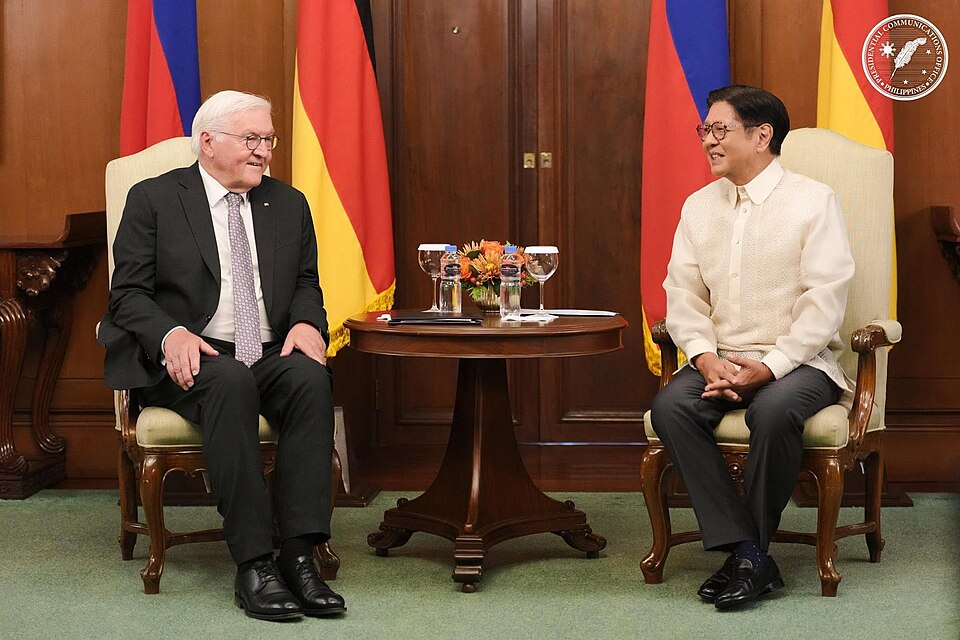
President Ferdinand R. Marcos Jr. on Tuesday welcomed German Federal President Frank-Walter Steinmeier to Malacañang, as the latter commenced his State Visit to the Philippines from June 15 to 17 2026, marking a significant milestone in the longstanding diplomatic relations between the two countries.
© Presidential Communications Office website – https://pco.gov.ph/photos/?post_id=246598President Ferdinand Marcos Jr. delivered his 5th State of the Nation Address (SONA) on July 27, 2026, at the House of Representatives of the Philippines in Quezon City. Lasting 1 hour and 26 minutes, the speech focused not only on completing ongoing economic and anti-corruption reforms but the president also reaffirmed the defense of Philippine sovereignty in the West Philippine Sea, and a broader multi-alignment foreign policy approach.
Can a friend of my enemy be my friend? The dilemma of wanting to befriend nations regardless of their practices in terms of the international humanitarian law is shown particularly strongly in Pres. Ferdinand Marcos Jr’s foreign policy of „friends to all, enemy to none“. This has once again shown in the latest State of the Nation Address (SONA) held on July 27. After several diplomatic visits of the highest level in 2025 and early 2026, the statements of Pres. Marcos are also of particular interest for the growing cooperation and partnership between Germany and the Philippines. The latest defense agreement signed last year symbolizes an elevated security partnership.
Human relationships and therefore, diplomatic relations as well, are and in their very essence must be, based on trust. The term of trust in that regard can be found rooted in a multitude of factors. Ideally, diplomatic trust is based on a mutual and shared value system. This poses the strongest foundation. If that is not given, mutual interest can be another cornerstone that enables trust, striving towards a joint objective. If neither values nor interests are aligned, an alienated version of trust can be found once the actions of one another show a certain degree of predictability. That to the very least allows for a diplomatic early warning system.
The State of the Nation Address of 2026 has shown that Germany and the Philippines partly share values or at least mutual interests, which creates a solid base for an enhanced cooperation in terms of economic enablers as well as in the areas of security and defense. As one of the countries strongest affected by climate change, Pres. Marcos Jr. made a firm statement, towards reduction of carbon emissions in the Philippine’s vehicle fleet. A commitment to prioritize electric vehicles and the removal of tariffs on EV’s until 2028 is not only a welcome development towards Free Trade in times of growing protectionism, but at the same time an important step and a commitment to address the climate crisis. This field in particular poses potential for deepening cooperation in terms of supply, production and knowledge transfer. Potential new markets might be an opportunity for the struggling automotive industry in Germany.
In terms of conflict prevention and security politics, the Philippines and Germany seem to share deeply rooted mutual values. With both countries having made strikingly opposite experiences in their history, the Philippines having been colonized twice and Germany being the aggressor in two world wars, it is an encouraging sign that the value systems have come to align over the last decades, agreeing to upkeeping international humanitarian law and the firm rejection of moving borders through violent acts of aggression through blunt military force. In the SONA this aspect was given particular relevance through the firm commitment to upholding the 2016 UNCLOS Arbitral Award, granting the Philippines sole sovereignty over their territories in the West Philippine Sea against Chinese claims. A strong partner in efforts to maintain international humanitarian law cannot be taken for granted in times of democratic decline and the return of the „law of the jungle“ and great power politics.
This image however, was slightly clouded by the remarks of Pres. Marcos Jr. regarding energy cooperation with Russia. In order to compensate oil shortages caused by the closure of the Strait of Hormuz, the Philippines found itself forced to resort to other players in the oil export market, among them Russian president Putin. The aggressor and cause of the biggest and most extensive war on European territory since the end of World War II offered his support in alleviating the Philippine national energy crisis. This in turn poses a threat to the German-Philippine relations for two particular reasons. For once, the import of Russian oil and gas is boosting the war funds that Russia can use against Ukraine. Paired with the reports of several intelligence services, that Russia might be preparing and ready for an attack on European territory by 2029, every import of these goods might pose a threat to European sovereignty by filling the war treasury of the Russian Federation. And second, importing from a dictatorship always poses the risk of blackmail. A dependence on certain goods out of these countries can and will never be truly advantageous. It can only be a short-sighted advantage, but eventually the bill will be presented at a later stage. A mistake Germany has made itself in the recent decades, might pose a potential challenge to German-Philippine relations. Particularly, if security cooperation is intended to be tightened. For the German security interests to be upkept, a closer cooperation between Russia and the Philippines is particularly disadvantageous.
This is the dilemma of Pres. Marcos Jr.’s foreign policy of „friends to all, enemy to none“. In certain situations it will not be possible to be friends to all, because a close friend can hardly be friends with one’s archenemy. Under enormous pressure and tension, which the current situation of international law is definitely confronted with, the unwavering commitment to the moral values and standards set in the post-war system is coming to show. This applies equally to all powers, since also Germany is rightfully facing the allegations of double-standards. For a deepening partnership however, this commitment is necessary to strengthen mutual trust as an even stronger building block to German-Philippine relations.
One of the main factors of trustbuilding however, is reliability on the partnering government. The recent corruption scandals however have posed a relevant threat to the tightening relations in terms of both economic and security relations. Reliability is a cornerstone of foreign investment. As long as the effective use of funds from both private and public players cannot be guaranteed, a consistent hesitation will diminish the potential of the cooperation. In terms of security cooperation, the stability of the government is key. The current controversies around high ranking personalities such as Vice President Sara Duterte or Martin Romualdez have been shaking the foundations of the government itself. If security equipment and training shall be provided, solving these stability issues is essential. The statements of President Marcos Jr. regarding the persecution of corruption cases have to be embedded into a systematic anti-corruption agenda.
The cooperation potential between Germany and the Philippines in the current stage does grow on fruitful foundations. The mentioned limitations however, have to be addressed from both sides. The remaining double-standards in terms of international law have to be firmly removed from the german side in order to be fully trustworthy in building closer relations outside the European context. On the Philippine side, the foreign policy of „friends to all » is one of the key limitations for the aforementioned reasons. Once these factors are taken into account, the partnership between Germany and the Philippines could become even closer and be of even greater benefit to both sides.
*Alexander Berghaus is member of the German Armed Forces and Master’s graduate in social sciences. His previous works have been focused on Philippine electoral and party politics. He is a former intern at FNF`s office in the Philippines.