Midterm Elections
From Washington to Michigan: Power, Polarization, and the Limits of Midterm Change

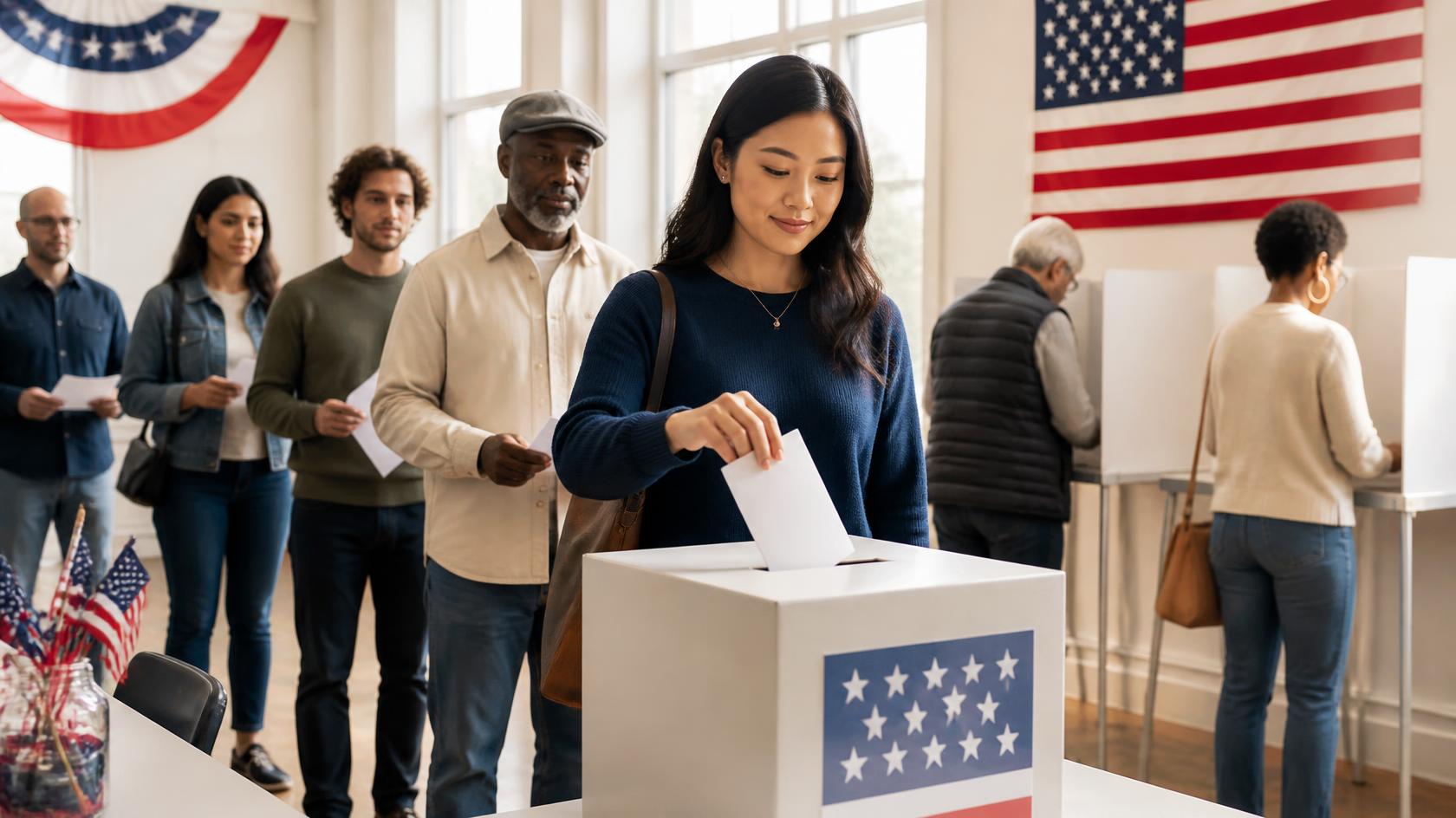
With only 40 days remaining until the midterm elections, tensions across the United States are running high. While some hope the elections will set the country on a different course, others fear that the results may not deliver the change many are seeking. How could the outcome alter the current political situation in the United States? Can the two-party system continue to function in its current form? And how will growing polarization and deepening divisions within both parties affect the country’s ability to govern?
To explore these questions, we invited a delegation of eight participants from Canada, Germany, Kenya, Romania, Singapore, Taiwan, Uruguay, and Venezuela. Together, we met with experts in Washington, D.C., as well as in Detroit and Lansing, Michigan.
Midterm elections typically attract less attention and lower voter turnout than presidential elections, and their outcomes are often considered more predictable.(i) This time, however, more appears to be at stake. In the middle of Donald Trump’s second term, the United States is confronting a war abroad and a cost-of-living crisis at home. Although the opposition party traditionally performs well in midterm elections (ii), and Republicans fear losing at least the House of Representatives, the outcome remains uncertain. Even if the Democrats regain control of the House, the consequences may not be as significant as many expect.
Election integrity has been the subject of intense debate, including disputes over gerrymandering, mail-in voting, and voter-identification requirements. Just weeks before the midterm elections, the Supreme Court ruled against restrictions on mail-in voting proposed by the Trump administration (iii). The Republicans we spoke to described the restrictions as necessary to uphold election integrity and prevent alleged voter fraud, while Democrats viewed them as part of a broader effort to restrict access to the ballot. The issue forms part of a wider debate about election integrity, including discussions surrounding the SAVE America Act.
The administration has also vowed to increase election surveillance. In the absence of a clear definition of what this would entail, Democrats fear that the administration could invoke the Insurrection Act of 1807 and deploy the National Guard and Immigration and Customs Enforcement (ICE) to polling stations in a way that could intimidate voters (iv).
Trump has struck a mixed tone regarding the midterm elections and their likely outcome. Speaking at the United Nations General Assembly, he said the elections were not influencing his decisions about the war with Iran and emphasized that he himself was not running for office (v). However, at the GOP’s midterm convention, he promised $5,000 to every adult U.S. citizen if Republicans win control of both the House and the Senate (vi). On another occasion, he urged voters to pretend that he was on the ballot (vii), suggesting that he may be more concerned about the election’s outcome than he claims.
Most of the experts we spoke with predicted that the Democrats would regain control of the House and might even have a chance of taking the Senate. Their assessments of what would happen afterward, however, differed considerably. Some argued that even a Democratic victory in the House would lead to far less change in U.S. policy than many might expect. In their view, the Democratic Party is too divided. Although Democrats agree on opposing Trump, they have yet to reach consensus on what they would do if given the opportunity to govern.
The tensions are not limited to the relationship between the two parties; divisions within each party are also deepening. This was particularly evident in Michigan, where the Democratic primary was decided by an almost 50–50 split between incumbent Haley Stevens and progressive candidate Abdul El Sayed (viii). Some Democrats we spoke to admitted that they are hesitant to endorse the winning candidate, fearing that El Sayed’s political vision was too progressive and did not align with the Democratic Party’s core values.
This kind of internal division is not unique to the Democrats. The Republican Party is also divided between more moderate Republicans and supporters of the MAGA movement. According to one of the experts we met, the growing fragmentation within both parties, along with increasing support for right-wing and left-wing populism, will make it difficult not only for the parties to reach agreements with one another, but also to reach agreements internally.
Some experts even questioned whether it still makes sense to speak of a strictly two-party system. As internal divisions continue to grow, alternative political movements or parties could gain greater relevance in the future.
The Democrats also face a deeper structural problem. Because of the way the U.S. political system is designed, even a Democratic victory in the Senate would not necessarily guarantee significant policy change. The Senate does not operate solely on the basis of majority rule; in practice, many legislative measures require 60 votes to advance. Since the Democrats are unlikely to secure such a majority, Republicans could block many of their proposals.
Furthermore, the Republicans who retain their seats are likely to be strong Trump supporters and may continue to side with him, making it even more difficult for Democrats to pursue new policy initiatives.
Trump also governs differently from many of his predecessors. He does not wait for Congress to pass legislation, but instead relies on executive orders to implement his policies, making the outcome of the midterm elections less consequential. Congress can challenge or limit the president’s executive powers, but any legislation passed for this purpose could be vetoed by the president. As a result, Democrats would face significant obstacles in trying to alter the direction of policymaking.
At the same time, Democrats would almost certainly launch investigations into the current administration and potentially pursue impeachment proceedings against the president. Such efforts could divert attention from their own policy agenda, ultimately disappointing voters who supported the Democrats in the hope of seeing concrete change.
Other experts we spoke with, however, believe that even some Republicans might support impeaching the president if Democrats win the midterms, as a way of demonstrating the administration’s unpopularity and distancing themselves from it. Others predicted a less extreme scenario, arguing that Trump could remain in office as a “sitting duck.” Given his personality and governing style, however, some considered this unlikely.
Overall, these midterm elections have attracted far more attention than midterms usually do. The prevailing view among the experts we spoke with was that the Democrats are likely to regain control of the House and may even have a chance of taking the Senate. Yet such a victory may not be enough to change the course of U.S. politics as significantly as some voters hope.
Glossary:
(i) States United Democracy Center. (n.d.). Voter turnout in American elections since 2000. https://statesunited.org/resources/voter-turnout-since-2000/#section-2
(ii) Galston, W. A. (2025, August 28). What history tells us about the 2026 midterm elections. Brookings Institution. https://www.brookings.edu/articles/what-history-tells-us-about-the-2026…
(iii) Howe, A. (2026, September 14). Supreme Court denies Trump administration’s request to implement parts of rule on mail-in voting. SCOTUSblog. https://www.scotusblog.com/2026/09/supreme-court-denies-trump-administr…
(iv) Walker, C., & Nissenbaum, D. (2026, September 24). Across the country, election officials are preparing for the possibility of federal intervention. Votebeat. https://www.votebeat.org/national/2026/09/24/midterm-2026-election-prep…
(v) Farrow, F., Kerr, N., Murray, I., Stoddart, M., & Hensley, S. B. (2026, September 22). Trump in United Nations speech says “big decision” ahead: Make a deal or “annihilate” Iran. ABC News. https://abcnews.com/Politics/trump-addresses-global-leaders-united-nati…
(vi) Associated Press. (2026, September 9). Trump promises $5,000 to every US adult if Republicans win midterms. AP News. https://apnews.com/article/trump-dividend-5k-5000-check-republicans-cc8…
(vii) Desjardins, L., & Loffman, M. (2026, September 23). New poll reveals how Trump’s low approval might affect midterms[Video]. PBS NewsHour. https://www.pbs.org/newshour/show/new-poll-reveals-how-trumps-low-appro…
(viii) NPR. (n.d.). Michigan primary election results 2026. Retrieved September 24, 2026, from https://apps.npr.org/primary-election-results-2026/states/MI.html