Trade
The China Alternative Is Taking Shape—in Mexico
For German companies, the search for a more resilient relationship with China is no longer an abstract debate about “de-risking”. It is becoming a question of geography—and Mexico is moving to the centre of the answer.
As trade tensions between Washington and Beijing have intensified, China’s share of U.S. imports has fallen sharply. Between 2018 and 2024, Chinese goods imports declined by 18.5%, while total U.S. imports grew by 22.4%. Mexico, by contrast, has expanded its role: in November 2025, it accounted for 17% of U.S. imports, ahead of China and Canada.
The shift is visible across industry. Mexico gained market share in 22 of 32 major manufacturing sectors between 2018 and 2025, including computers and electronics, transportation equipment, industrial machinery, plastics and rubber, and metal products. These are not merely low-cost assembly operations. Mexico ranks among the world’s more complex export economies and combines an established industrial base with proximity to the United States and preferential access under the USMCA.
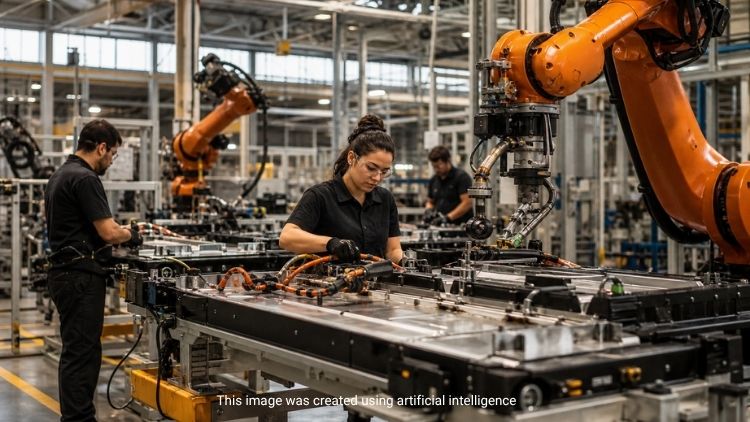
That combination creates a strategic opening for German industry. Mexican computer-equipment plants were operating at 97.4% of capacity in 2025, while semiconductor capacity stood at 94.9%. Automotive production and aerospace also ran close to capacity. The message is clear: demand is rising, but additional investment is needed in plants, automation, infrastructure and skilled labour.
German capabilities match many of these requirements. The paper identifies opportunities in semiconductors, sensors, industrial controls, precision machinery, mechatronics, energy efficiency and automotive technologies—including components for electromobility and advanced driver-assistance systems. German investment in Mexico’s automotive sector is already significant, but the electronics sector remains comparatively underdeveloped, suggesting room for expansion.
Mexico is not a frictionless substitute for China. Rules of origin, infrastructure constraints, energy supply and talent shortages will matter. Nor does every sector offer the same returns. But the evidence points to a country becoming an essential manufacturing platform for North America—and to a timely opportunity for European companies willing to move from supply-chain diversification to industrial investment.
The full paper maps these opportunities sector by sector, combining trade data with capacity-use indicators to show where German know-how could find its strongest foothold in Mexico.
*This text was generated with the help of Artificial Intelligence