Democracy
How autocracies attack democracy—and what can we do about it

Major powers are increasingly seeking to divide the rules-based international order into spheres of influence. Southeast Asia is at the center of the competition between the United States and China. Its strategic location, rapidly growing economies, key maritime trade routes, and abundant natural resources have made the region a focal point for external powers seeking to expand their influence.
Malaysia, one of Southeast Asia's democracies, has a strong interest in maintaining the rules-based order and advocating for regional integration. One reason is that Malaysia’s economy is highly dependent on trade and deeply integrated into global value chains. Like Germany, Malaysia is considered a so-called middle power and must skillfully manage its relations with major powers to preserve its strategic sovereignty.
Germany and Europe need international allies, in part to maintain international pressure on Russia. It therefore makes sense to collaborate with countries that share similar interests, such as Malaysia. Furthermore, Malaysia is a suitable partner for diversifying supply chains in order to reduce dependence on China.
The foundation therefore conducted research in Malaysia to examine how Russia and China disseminate their narratives among the population to influence politics in their favor. The study’s findings have now been presented in Germany.
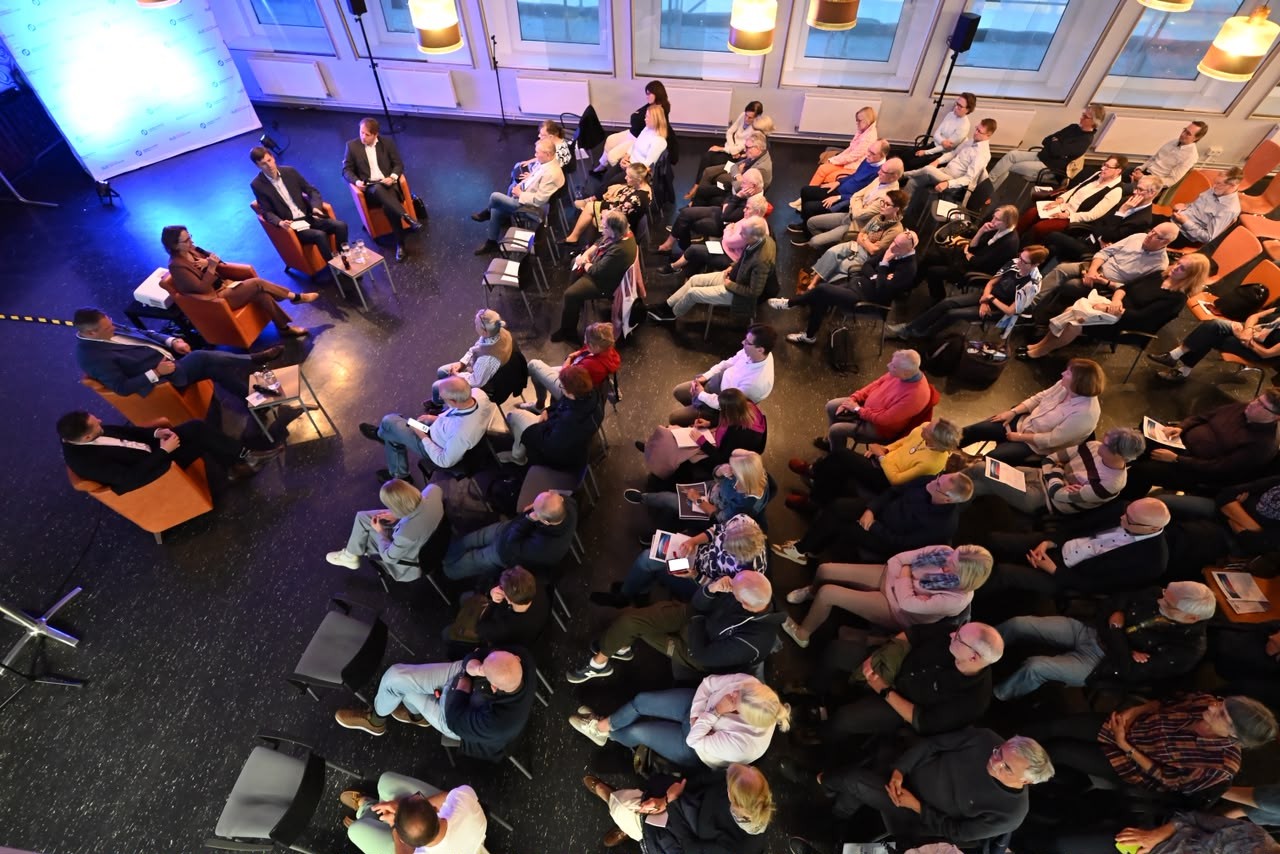
How do autocracies attack democratic societies—and what can we do about it? That was the question discussed during the panel discussions titled “Propaganda, Influence, Silent War” in Hanover and Stuttgart. The Malaysian studies show how Russia and China use state-run media, digital influence networks, and targeted disinformation to shape public opinion in Southeast Asia. There is much for Germany and Europe to learn from this.

From Malaysia to Germany: Lessons for Democracies
To discuss this, the panel in Hanover featured Reinhard Bingener, author of the SPIEGEL bestseller “The Silent War” and a journalist for the FAZ, and Patrick Döring, CEO of the WERTGARANTIE Group; while in Stuttgart, the panel included security policy expert Dr. Cornelius Adebahr.
Florian Frank, Director of the Cyfluence Research Center, explained how China conducts influence operations worldwide. In doing so, he noted, China has learned a great deal from Russia’s intelligence services in recent years. China also employs non-transparent elements to conceal the extent of its high level of coordination. In Malaysia, China operates on five levels: (a) social media accounts of its state-run media outlets Xinhua, CGTN, China Daily, and Global Times; (b) multilingual accounts run by government agencies, such as the embassy; (c) NGOs and think tanks; (d) influencer networks that package pro-China narratives as independent analysis; and (e) hyper-active inauthentic accounts that simulate local, organic engagement.
In Malaysia, the combination of relationship-building “soft power tools” and a digital image campaign has led to 75% of respondents not only trusting China as an economic partner but also 56% feeling inspired by its development model. This is one of the findings of the Merdeka Center study presented by Katrin Bannach, Head of FNF Indonesia and Malaysia. China’s state-directed market economy under autocratic leadership appears promising. In the long term, this alternative model poses a risk to democracy.
The panel discussion highlighted the dangers that information manipulation poses to democracy in Germany: it can poison the culture of debate to such an extent that dialogue is no longer possible. However, productive discussions of different solutions form the basis of a democratic culture.
All speakers agreed that stronger regulation of social media is necessary. However, the state should not be given too many tools to curtail freedom of expression. It should not be allowed to decide for itself which political narratives are to be banned within a democratic discourse. Otherwise, there is a risk that those in power will be able to restrict freedom of expression to their own narratives, thereby increasingly resembling autocrats.
Patrick Döring emphasized that our autocratic adversaries are also seeking to weaken our economy, for example through cyberattacks. This stirs up uncertainty among the population, which then tends to turn to parties on the political fringes.
This spanned the spectrum: from Malaysia to Germany, from analysis to the question of what concrete lessons we can learn from it.
What remains important is not only media literacy and the ability to recognize manipulation early on. Foreign policy communication should also be structured more strategically. Germany could position itself more clearly as a reliable partner, also towards countries in Southeast Asia.