Syria
Between Risk and Opportunity

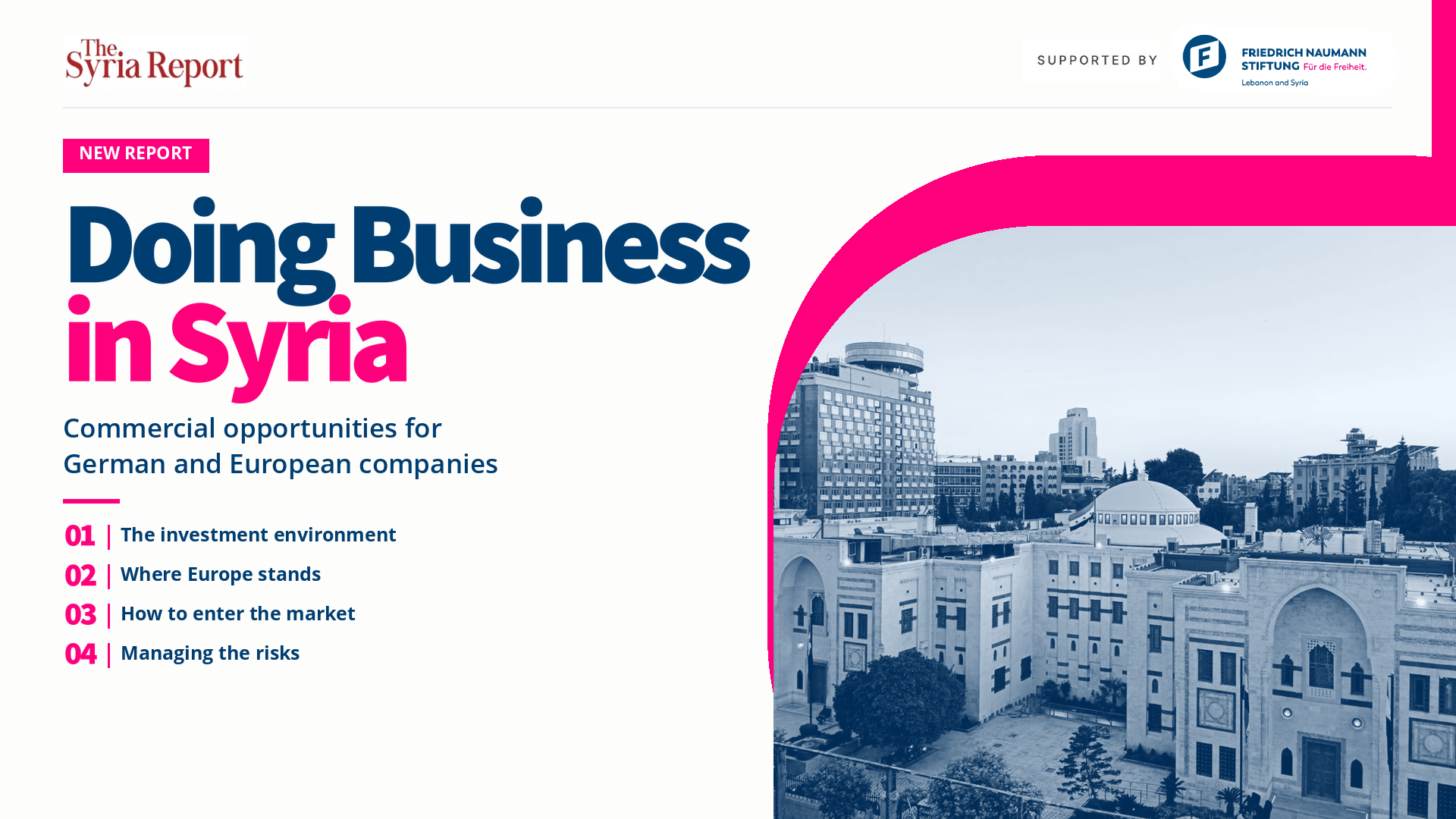
Syria's political transition after the fall of the Assad government in December 2024 has reopened a market that was closed to German and European companies for more than a decade. The need is enormous. The World Bank estimates the cost of physical reconstruction at around USD 216 billion, within a range of USD 140 to 345 billion. Syria's GDP in 2024 was around USD 21.4 billion, so the reconstruction bill is roughly ten times the country's annual economic output.
These numbers alone do not make a business case. What matters is whether the conditions for lawful, secure and sustainable commercial activity are emerging. The report Doing Business in Syria: Commercial Opportunities for German and European Companies by The Syria Report, supported by the Friedrich-Naumann-Stiftung für die Freiheit Lebanon and Syria, examines exactly this question.
Formal barriers are falling. The European Union lifted its remaining economic sanctions in May 2025. The United States ended its comprehensive sanctions program in June 2025, and the secondary sanctions under the Caesar Act were repealed in December 2025. Targeted restrictions remain in place, for example against individuals linked to the former regime and against certain Iranian, Russian and North Korean entities. European companies should therefore not assume that every counterparty is clear.
Practical barriers remain. The report's central finding is that the sanctions are lifted, but the financial infrastructure is not yet ready. Standard international transfers, letters of guarantee and foreign currency transactions through Syrian banks are still difficult. Correspondent banking relationships are not yet functioning at the level required for normal business. Data on markets, incomes and business activity is incomplete. Security conditions vary considerably between regions. For a company, this means that legal access does not automatically translate into commercial feasibility.
Germany has an edge. In 2025, Germany was Syria's largest trading partner within the EU, accounting for 23.3 percent of total Syria–EU trade. German strengths match Syria's needs: energy and electricity infrastructure, water and wastewater systems, industrial machinery, construction materials, medical technology, transport and logistics, and engineering services. Germany's existing relationships, its development cooperation and the large Syrian diaspora in Germany are further assets.
The recommendation is a phased approach. The report argues against both complete disengagement and rapid large-scale investment. Companies should start with market intelligence, carefully vetted local partners, donor-funded and internationally financed projects, equipment supply and technical services. These forms of engagement carry lower capital exposure and allow firms to build knowledge and networks. Larger commitments should follow observable progress: functioning banking connections, enforceable contracts and investment protection, greater regulatory predictability, and sustained improvements in security.
From a liberal perspective, the central questions are clear. Are property rights, contract enforcement and transparent rules being established? Can investment protection be relied upon? Will the reform process include all parts of Syrian society? Economic opening and the rule of law are closely connected. Business activity can support stability and reconstruction, but it cannot replace political reform, and a market that excludes parts of the population will not be durable.
German companies that engage now, carefully and with rigorous due diligence on sanctions, compliance, partners and security, can position themselves for a market that will develop over many years. Those that wait for complete certainty may find that the field has been taken by others. Those that rush in without safeguards may face losses and reputational damage. The middle path, as the report puts it, is to phase in.
Note: This article is based on the report by The Syria Report (2026). The analysis reflects information available up to August 2026. Companies planning transactions should conduct current legal, sanctions, tax, security and counterparty due diligence before making any commitment.
Download the Report