Global Security Hub
Benchmarking Defence: A Roadmap for Türkiye–EU Defence Industrial Synergy in the Age of Global Competition

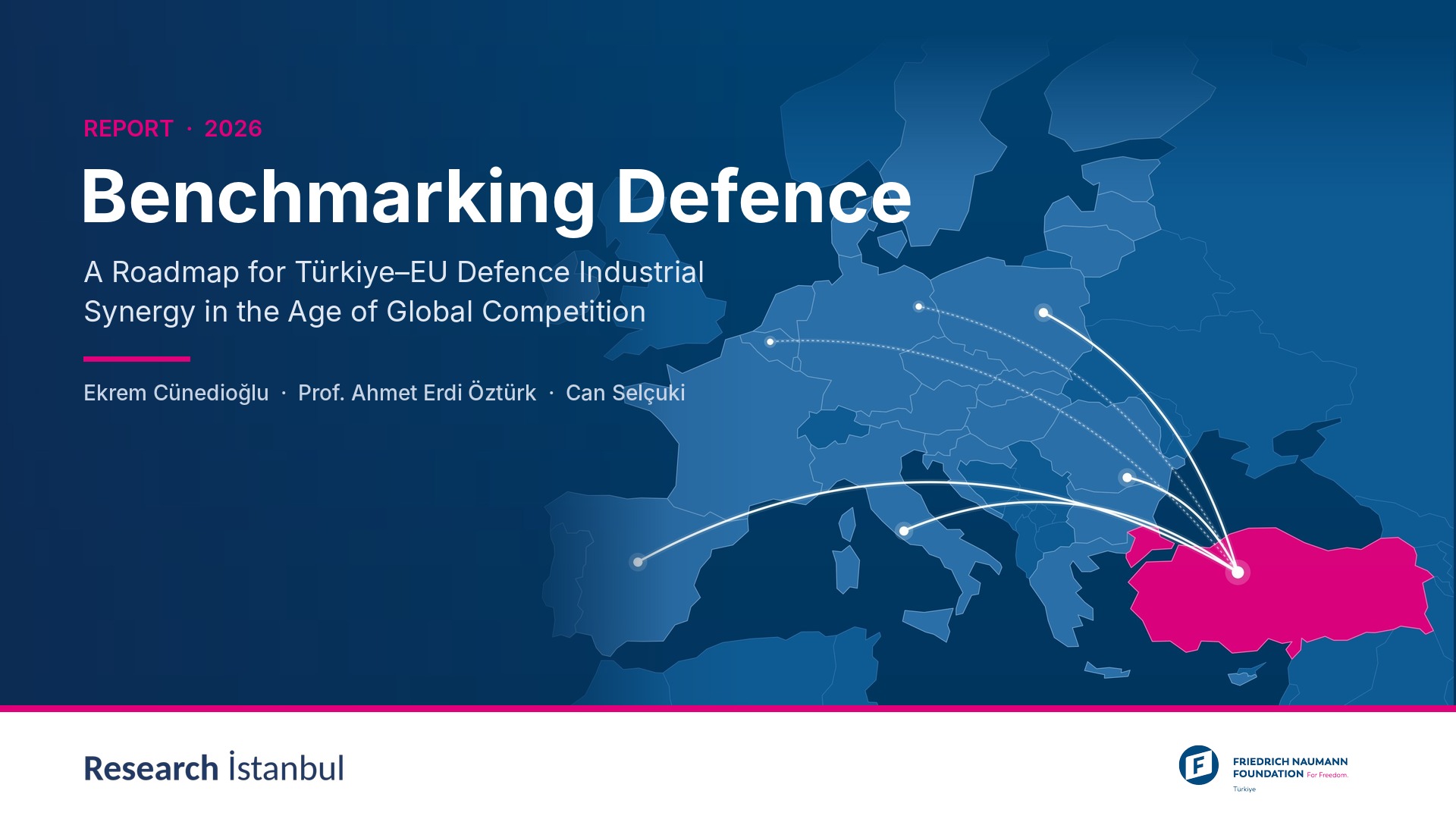
Read the Report (English):
-
Europe is rearming faster than its industry can produce, and Türkiye has built a fast-growing defence industry that already works with European firms. This report by Research İstanbul, supported by the Friedrich Naumann Foundation for Freedom Türkiye, examines how Türkiye-EU defence industrial cooperation can grow in four areas: trade, investment, research and human capital. It finds that the main barriers are legal and political rather than industrial, and it sets out 14 recommendations for companies, member states and EU institutions.
Read the Report (German):
-
Europa rüstet schneller auf, als seine Industrie produzieren kann, und die Türkei verfügt über eine stark wachsende Verteidigungsindustrie, die bereits eng mit europäischen Unternehmen zusammenarbeitet. Dieser Report von Research İstanbul, unterstützt von der Friedrich-Naumann-Stiftung für die Freiheit Türkei, untersucht, wie die verteidigungsindustrielle Zusammenarbeit zwischen der Türkei und der EU in vier Bereichen wachsen kann: Handel, Investitionen, Forschung und Humankapital. Er zeigt, dass die größten Hindernisse rechtlicher und politischer und nicht industrieller Natur sind, und formuliert 14 Empfehlungen für Unternehmen, Mitgliedstaaten und EU-Institutionen.
Europe is rearming faster than its industry can produce, and much of what it buys still comes from outside the Union. Türkiye, a NATO Ally and EU candidate, has built a fast-growing defence industry that already works closely with European firms. This new report by Research İstanbul, prepared with the support of the Friedrich Naumann Foundation for Freedom Türkiye, asks whether and how defence industrial cooperation between Türkiye and the EU can grow despite strained political relations.
Written by Ekrem Cünedioğlu, Prof. Ahmet Erdi Öztürk and Can Selçuki, the study looks at four areas: trade and industrial integration, investment and risk capital, research and innovation, and human capital. It also compares Türkiye with South Korea, another non-EU supplier that is expanding in the European market.
The report finds that the main obstacle is legal and political rather than industrial. Turkish capacity is strongest in ammunition, explosives, less complex platforms and components, and it matches some of the bottlenecks the European Commission itself has identified. What is missing are the agreements on which the EU’s deeper defence partnerships rest, above all a security of information agreement. Until these exist, joint ventures and production inside the EU remain the most workable route, and several Turkish firms have already started to take it.
The authors make 14 recommendations for companies, partner member states and EU institutions. The first steps they propose are a security of information agreement and an administrative arrangement with the European Defence Agency.
The Report Launch in Brussels
The report will be launched in Brussels on Thursday, 26 November 2026, from 09:30 to 12:00 at the FNF Brussels Office, in an event co-organised by Research İstanbul, the Friedrich Naumann Foundation for Freedom Türkiye and the FNF Global Security Hub. After opening remarks by Jules Maaten (FNF Europe), co-author Can Selçuki will present the report’s findings, followed by a panel discussion on moving from political gridlock to industrial cooperation, moderated by Jeroen Dobber (FNF Global Security Hub). The event will be held in English. To attend, please register by 24 November, 17:00 CET using the form below.
Registration: https://forms.gle/nTPuv2vF84VYHGSD7