Total Defence
Lithuanian Riflemen’s Union: Mobilising Lithuanian citizens for total defense - not only with rifles

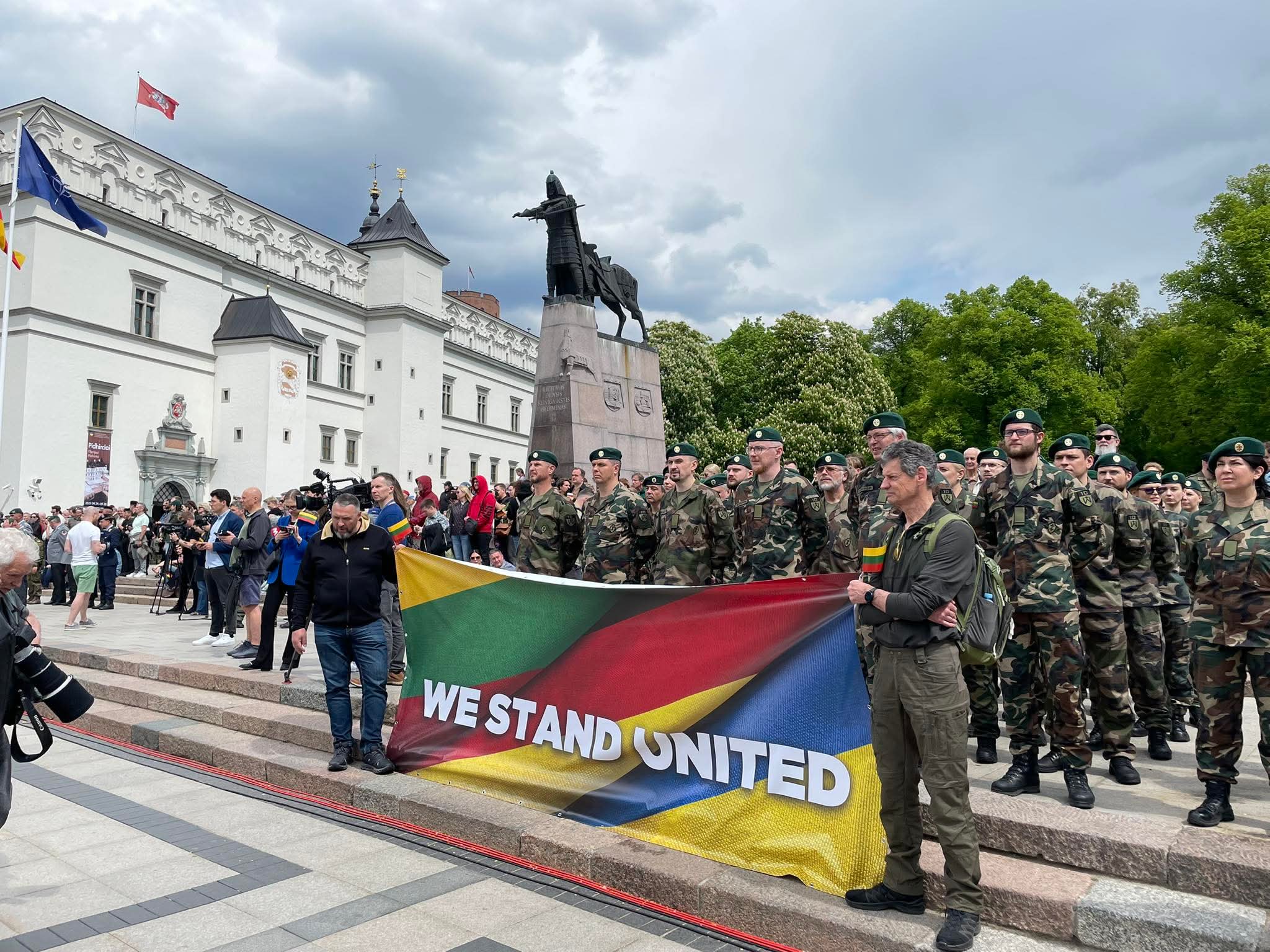
Mitglieder der Litauischen Schützenunion in Uniform beim Aufstellungsappell der Bundeswehr Panzerbrigade 45 Litauen am Kathedralenplatz in Vilnius am 22. Mai 2025. Zwei nicht uniformierte Mitglieder halten ein Transparent "We Stand United".
© FNF Baltische StaatenWhat does it take for an entire society to be ready to defend itself? In Lithuania, the answer lies in a concept that goes far beyond the military: comprehensive or total defence. It brings together the armed forces, public authorities, businesses and civil society in a shared effort to prepare the country for crises and, ultimately, to fight for the defence of the country.
At the heart of this approach is the Lithuanian Riflemen’s Union. Its members take on a wide range of military and civilian roles — from homeland security and crisis preparedness to drone operations and information security — illustrating what it means to make national defence a responsibility shared across society.
With hybrid threats also becoming an increasing concern in Germany and other European countries, Lithuania’s total defense approach might offer some interesting perspectives for the ongoing debate on strengthening civic resilience and preparing society for potential crises.
When Russia expanded its war of aggression against Ukraine to a full-scale invasion in February 2022, the defence policy debate in Lithuania also changed fundamentally.
Alongside increased defence spending, which has now reached 5.38% of GDP, the highest level in NATO, and the permanent deployment of the 45th German Armoured Brigade in Lithuania, the focus has also shifted towards a broader inclusion of society in national defence: How can society as a whole strengthen its preparedness for crises, hybrid threats and a potential war scenario? And what role can individual citizens and civil society organisations play in strengthening national defence and societal resilience?
This broader approach is reflected in Lithuania’s concept of “total defence”, embedded in the country’s defence policy strategies. It rests on the principle that national security is a shared responsibility, not one that falls solely on the armed forces. In a crisis, the armed forces, state authorities, municipalities, businesses, civil society organisations and citizens are expected to work together, each contributing their respective capabilities.
A key role within Lithuania’s comprehensive national defense system is played by the Lithuanian Riflemen’s Union (Lietuvos šaulių sąjunga, LRU), a voluntary, state-supported civic organization, uniting citizens of all ages who wish to contribute to national defense and community resilience within a democratic, transparent, and legal framework.
What is the Lithuanian Riflemen’s Union?
For German and other European audiences, the organisation is not easy to categorise at first glance. The name “Riflemen’s Union” may evoke associations with traditional shooting clubs, while its military training can make it appear similar to a reservist organisation. Neither comparison, however, fully captures what the LRU is: it is neither a traditional shooting association nor a military reserve.
Rather, it is a voluntary civic organisation with a state mandate to prepare people for armed and unarmed resistance, crisis preparedness and societal resilience, and to support the state institutions in times of crisis. It operates transparently under Lithuanian law and under the supervision of the Ministry of National Defense, thus combining tasks that in Germany are distributed among different institutions – such as the Bundeswehr reserve, homeland security, the Germany’s Federal Agency for Technical Relief (THW), associations, aid organisations and parts of the civil protection system.
“In the Service of the Homeland”: A Broad Network of Dedicated Professionals from Different Backgrounds
The LRU is one of Lithuania’s oldest and most dynamic civic organisations, founded in 1919, in the aftermath of Lithuania’s declaration of independence. During the interwar period, it became one of the largest and most influential public organizations in Lithuania, uniting tens of thousands of members. Riflemen played a vital role in strengthening the country’s security, civic education, and national identity.
The LRU was banned following the Soviet occupation in 1940, and many of its members faced persecution, imprisonment or deportation. Yet the the individual members of the LRU continued to resist both - Soviet and Nazi - forces, remaining committed to the restoration of Lithuania’s independence.
After Lithuania restored its independence in 1990, the organisation was re-established and became an integral part of the country’s total defence system. Its tasks, powers and position within the defence system are set out in the Law on the Lithuanian Riflemen’s Union.
Today, the LRU is a nationwide organisation with nearly 20,000 members in Lithuania and abroad, which continues its original mission: to provide citizens with a legal and transparent way to contribute to national defense, resilience, and community life - in close cooperation with the Lithuanian Armed Forces and state institutions.
“If an enemy attacks us in a time of disaster, the whole society must be ready to defend itself – not the army alone.”
The organisation brings together people of diverse ages and professional backgrounds, including teachers, students, entrepreneurs, communications and media professionals, lawyers, skilled workers, doctors, scientists, IT specialists and retirees.
Within the organisation, all members participate on an equal footing, regardless of their civilian profession or background. Age and physical fitness do not necessarily constitute barriers to participation. Depending on their individual capabilities or preferences, new members can choose between two forms of training: the regular basic course, which covers military fundamentals and practical field training, including weapons instruction, and a civilian resilience course, which places greater emphasis on societal preparedness, crisis management and resilience.
Defense Beyond the Military: A Society Prepared to Respond
Membership in the Riflemen’s Union is voluntary and unpaid. Members receive no remuneration; instead, they pay a symbolic membership fee and generally purchase their own uniforms and some equipment. Around 30% of members are women, while the organisation brings together people from a broad range of professional backgrounds and areas of expertise.
This breadth is central to the LRU’s organisational capacity. It allows the LRU to draw on skills that go well beyond the military domain, from communications and IT to catering, logistics and crisis response. “In the Service of the Homeland” is both the organisation’s motto and the oath taken by every member, reflecting its emphasis on civic responsibility and preparedness for national defence.
The path into the organisation begins with the swearing-in of new members. This is followed by an approximately eight-month basic course with theoretical content and practical exercises held in the evenings or at weekends.
Members then decide in which area they would like to contribute within the Riflemen’s Union. The organisation sees itself less as a training institution and more as a platform for active engagement: members receive continuous opportunities for further training, but above all put their knowledge into practice through voluntary activities.
The LRU also has a dedicated youth organisation for young people aged 11 and above. Its activities combine practical preparedness training, including first aid, navigation, civil protection and crisis response, with sports and outdoor activities. The programme is designed to familiarise young people with basic preparedness skills while fostering a sense of civic responsibility and resilience from an early age.
More Than Military Training: The Riflemen’s Union as a Partner in Everyday State Functions
With the strong growth in membership since 2022, the range of specialisations within the organisation has also expanded. Alongside traditional areas such as military exercises, there are now numerous non-kinetic activities, including culture and education, international relations, communications, documentation of war crimes, IT and cyber, medical support, psychological support, logistics, catering, canine units and civilian crisis preparedness, among others.
There are currently more than 20 different specialisations from which members can choose.
An important feature of the LRU is the combination of civilian expertise and security-related tasks. An IT specialist, for example, can work in a communications or cyber security group, medical professionals can contribute their expertise to medical structures, while engineers and technical specialists can support the development and maintenance of new systems.
The LRU’s role goes far beyond military preparation for a potential crisis. Even in peacetime, it supports state institutions and takes on tasks that contribute to societal resilience. This combination of voluntary engagement and state support is reflected in numerous official partnerships with state institutions – from blood-donation campaigns and educational work in schools to border protection.
For example, together with the police, the LRU members support the maintenance of public order at events and public gatherings. With the Lithuanian Red Cross, the LRU works in the field of civil protection, develops training programmes for citizens and strengthens coordinated assistance in emergencies. In cooperation with Lithuania’s border guard, the LRU assist with observation, patrols and temporary tasks in border areas.
Also, cultural, educational, and historical memory projects further connect the LRU to society, making it not only a defense organization but also a broader civic movement to protect freedom and promote democratic values.
And much much more. Taken together, these activities highlight the distinctive role of the LRU: combining defence preparedness with practical support to state institutions and a broader contribution to societal resilience in peacetime.
Defending the Country with More Than Weapons: Every Citizen Can Contribute leisten
Colonel Linas Idzelis, Commander of the Riflemen’s Union, emphasises in several interviews that modern defence requires much more than infantry skills.
“Civilian resistance can be compared to a castle and a spear. The castle represents the many vital functions of the state. Only some people take up the spear, while everyone else continues to perform their tasks as they would in peacetime, so that the state can continue to perform its essential functions in a crisis or war.”
As Idzelis explained, the organisation is therefore deliberately building capabilities in logistics, communications, medical care, cyber, information activities and drone technology alongside its armed units.
At the same time, the organisation aims to reach people who do not see themselves in a traditional military role but nevertheless want to contribute to security.
“Civilian resistance can be compared to a castle and a spear. The castle represents the many vital functions of the state. Only some people take up the spear, while everyone else continues to perform their tasks as they would in peacetime, so that the state can continue to perform its essential functions in a crisis or war.”
Drones as a New Key Area
The development of the LRU functions is particularly visible in the field of unmanned systems. The lessons of the war against Ukraine has demonstrated the importance of drones in a modern warfare for reconnaissance, situational awareness, tactical support, attack and defence. The LRU therefore began systematically developing its own capabilities in this field even before the Lithuanian armed forces did.
A key area of capability development is the training of FPV drone pilots. Dedicated training facilities have been established across several regions, providing members with opportunities to build practical flying experience under controlled conditions. The organisation has also equipped regional units with simulators to expand and standardise training capacity.
The training extends beyond piloting. Members are introduced to the technical fundamentals of drone systems, equipment handling and the integration of drones into broader operational processes. Dedicated programmes cover the use of FPV platforms as well as reconnaissance drones, reflecting the growing importance of unmanned systems in modern defence.
The longer term objective is to establish specialised drone capabilities across the LRU’s regional structures. Some units have already developed these capabilities and participate in exercises alongside the Lithuanian Armed Forces, while others remain in the process of building up their personnel, equipment and expertise.
From Vilnius to Magdeburg: Threats in the Information War Know No Borders
An example of the growing importance of non-kinetic capabilities is the development of the first specialised information operations company within the LRU. Its purpose is to strengthen the LRU capabilities in non-armed activities and increase resilience against information threats. Based on the experience of this unit, the LRU plans to expand similar capabilities throughout the organisation in the future.
“Modern wars rarely begin with artillery barrages. We live in an era of ‘war between people’, in which the battlefield has shifted to city streets, smartphone screens and people’s minds. The information space is now a front without a clear frontline – and we are all involved there,” representative of the Lithuanian armed forces said at the InfoOPS Day.
The LRU emphasises that resilience starts at the individual level: with responsible behaviour in the digital environment, critical thinking and the ability to engage constructively even with those who hold different or sceptical views. In this context, strengthening societal resilience has become an increasingly important component of national security, particularly in an environment shaped by disinformation, information warfare and other forms of hybrid pressure.
Societal Resilience Must Be Practised Before Crisis, Not During It
While Lithuania’s national approach is not a copy-and-paste model, the Lithuanian Riflemen’s Union demonstrates how civic engagement can be systematically integrated into a national security strategy.
What is particularly noteworthy is not so much its military component as the combination of a wide range of capabilities: medical care, logistics, communications, IT skills, psychology, language skills, youth engagement, drone technology and civilian crisis preparedness and many more are understood as components of the same overall strategy.
The basic idea is that citizens should be able to contribute according to their abilities. Not every member needs to take on a military role. Unlike, for example, a reservist organisation, the LRU pursues a broader approach: it sees itself as a link between the state, the armed forces and society. Military training is only one part of a broader concept of societal preparedness.
The Lithuanian model nevertheless demonstrates that societal resilience does not emerge only in a crisis. It must be built over the long term, practised regularly and institutionally embedded within the defence system.
It is precisely this approach that offers a particularly valuable perspective for the broader European debate on total defence, homeland security, and crisis preparedness.

Laura Tatarėlytė beim Fahnenmarsch zur Wiederlangung der Unabhängigkeit Litauens am 11. März 2025
© FNF Baltische StaatenFAQ Lithuanian Riflemen's Union
The Lithuanian Riflemen's Union (Lietuvos šaulių sąjunga) is a voluntary civic organization that unites citizens who wish to contribute to the defense and resilience of their country. It operates transparently under Lithuanian law and under the supervision of the Ministry of National Defense.
The Riflemen's Union plays a key role in Lithuania’s comprehensive national defense system, ensuring that citizens can participate in strengthening security not only through armed service, but also through civil, humanitarian, and educational activities. In wartime, Riflemen are integrated into the Lithuanian Armed Forces and contribute as specialists in fields such as drones, cyber defense, medical support, logistics, and engineering. In peacetime, they assist state institutions including the Armed Forces, Police, Fire & Rescue Service, and Border Guard in disaster relief, information security, community resilience, and other vital areas. Beyond defense, the Union is strongly committed to society and civic education.
Lithuania’s approach might offer relevant perspectives for the European debate on homeland security, crisis preparedness and the role of civil society in comprehensive defense. Its experience highlights how military and civilian capabilities can be integrated into a broader framework of societal resilience.