Interview
A Balcerowicz Plan for Germany


Germany has spent the past few years struggling to regain economic momentum. After two consecutive years of recession and growth of just 0.2% in 2025, Europe’s largest economy remains stuck in a period of weak performance. Poland, meanwhile, continues to significantly outperform its western neighbour: its economy expanded by 3.6% in 2025, making it one of the fastest-growing among the EU’s larger economies.
This growing contrast raises an obvious question: what lessons can Germany draw from Poland’s experience?
Much of Poland’s economic success can be traced back to the foundations laid during its post-communist transformation: the dismantling of inefficient structures inherited from the centrally planned economy, the embrace of free markets and entrepreneurship, openness to foreign investment and trade, and the development of stronger institutions. These reforms helped create the conditions for decades of economic growth and convergence with Western Europe.
To explore what Germany might learn from this experience, we spoke with Prof. Leszek Balcerowicz, the architect of Poland’s economic transformation after 1989. As Poland’s Finance Minister from 1989 to 1991, he led the far-reaching market reforms that became known as the “Balcerowicz Plan”.
He later returned as Finance Minister and Deputy Prime Minister from 1997 to 2000 and served as President of the National Bank of Poland from 2001 to 2007. Prof. Balcerowicz also founded the Civil Development Forum (Forum Obywatelskiego Rozwoju, FOR), a free-market think tank that promotes economic freedom, the rule of law and sound public policy in Poland.
We spoke with him about the roots of Poland’s economic success, the structural problems holding Germany back, and what policymakers in Berlin can learn from Poland’s transformation.
Q: Prof. Balcerowicz, if the German Chancellor asked you to design a “Balcerowicz Plan for Germany” today, what would be your first three priorities for getting the German economy growing again?
What I can say is based on what I have read about Germany and, more generally, on what the main engines of economic growth are.
The first would be financing for innovation. Innovation depends on technical competence and education, which Germany has, but also on the financing system. What distinguishes the United States, which is a leader in innovation, from Europe, including Germany, is the amount of venture capital available. There is much less venture capital in Poland, France and Germany, and the state cannot replace private venture capitalists. So I would look at the structure of the financial system.
The second would be removing artificial barriers to entering the market because such barriers limit competition.
The third, although this may not be a problem in Germany, would be openness to people from other countries and to innovative ideas.
Q: Having experienced socialism first-hand and later helped lead Poland’s transition to a market economy, how do you view the growing criticism of capitalism in Europe today, particularly among younger generations? Why do you think capitalism and the free market have lost some of their appeal?
First of all, the words you use are very important, because some words are burdened with negative emotions as a result of socialist propaganda. The word ‘capitalism’ is a leading example. “I have rarely used the word ‘capitalism’, when introducing free-market reforms. I spoke about the free market and economic freedom as a basis for political freedom, and so on.
Never ask people whether they like capitalism, because most of them would probably say no, given the emotional burden attached to the word. I do not see any persistent or strong negative tendency regarding markets or economic freedom. So, ask about economic freedom.
Q: There appears to be growing support, particularly among younger people, for greater state intervention and stronger welfare policies. Does this reflect greater scepticism towards economic freedom, and what would you say to those calling for a bigger role for the state?
I’m not quite sure that young people are particularly opposed to economic freedom. My impression is that it is not so different from older generations. Economic freedom has never been universally loved, even though it is absolutely fundamental to economic well-being and to other freedoms. There is no democracy without capitalism, if I have to use this “bad” word. But capitalism has given us some negative associations which are wrong, and one has to be active in defending the fundamentals of freedom in free societies. And there are a lot of civil society organisations, like my foundation, who play a key role in that.
And what I would say to people who are calling for more state intervention or state protection or even stronger social welfare? People usually dislike politicians. So, I would ask them: are you happy to give politicians more power over your life? Then they would probably hesitate, or say no.
We have to unmask this magic word, “the state”. What is the state? Politicians? Bureaucracy? Do you want to give them more power over your life? Proper questions are very important.
Q: Poland once looked to Germany as an economic model. Today, Poland’s economy is growing faster. What, if anything, can Germany learn from Poland’s experience?
In Poland, we have always looked at what constitutes best practice. After the Second World War, Germany was certainly an important model, but not the only one. I have also looked at countries that started from a relatively low level and then grew very quickly, such as South Korea.
Poland grew very fast because we started from a low level and because rapid stabilisation was necessary. We had high inflation, followed by massive deregulation and then privatisation, although privatisation took more time than deregulation.
What I would say is that Poland was relatively persistent in pursuing economic reforms.
In more recent years, Poland’s growth has also been supported by a large inflow of Ukrainians. But we cannot assume that this will continue indefinitely. If Ukraine wins the war against Russia, which I wish, I would expect at least some Ukrainians to return home.
So, in Poland, we need reforms too. The process is not finished, especially when it comes to the budget. We spend too much. And when public spending is excessive, it is not because of defence spending. It is usually because of untargeted social spending.
Q: Poland’s transformation showed that far-reaching reforms can deliver results, but they also create resistance. Are politicians today still capable of implementing difficult reforms?
In a democracy, reforms need the support of a sufficient proportion of voters — not everyone, but at least a majority.
A lot depends on the economic situation. When the situation is very bad, many people understand that something has to be done. That was the case in Poland in 1989.
When the situation is not dramatic but is slowly worsening, personalities and communication skills become more important, but also think tanks. Institutions such as the Friedrich Naumann Foundation, or in Poland the foundation I created, are very important in influencing public opinion.
Q: Looking beyond Germany, what do you see as the biggest mistakes politicians make today that prevent economies from reaching their full potential?
A major problem is statism — an excessive role for politicians in society and in the economy.
That can take several forms. One is excessive public spending, often designed more to gain political support than to improve economic outcomes. Populist politicians effectively bribe people with their own money.
Another problem is a large public sector and state-owned enterprises, which are often inefficient unless they operate in monopoly positions — and monopolies themselves are damaging to efficiency.
So, when populists propose economic policies, one has to look carefully at what they are actually offering and unmask the consequences. That is also an important role for free-market institutions and think tanks.
Q: Would you say that populism is slowing down economic growth? Or can there be such a thing as “good populism”?
The success of populism means a failure of the economy. Because, by definition – or in practice, as I said – economic populists propose medicines that are sometimes worse than the disease.
If we called those who promote good policies populists, then we would change the meaning of the word. And one should not do that. One should not confuse populism with being popular. Populists, if they are successful, are often popular in some circles, but you can also be popular while proposing an anti-populist agenda.
This requires, first, conviction, but also verbal skills and persistence, good advisers, and working with the media, which is very important.
Q: Is that also how you would advise policymakers who want to build support for necessary economic reforms?
If you have democracy – which is good, better than dictatorship – you have to convince a sufficient proportion of the people. And then communication skills and having a very good team matter - I mean, for politicians.
Secondly, working with free-minded thinkers is very important. So, when my public career ended in 2006, I immediately founded a free-market foundation for exactly these purposes.
*
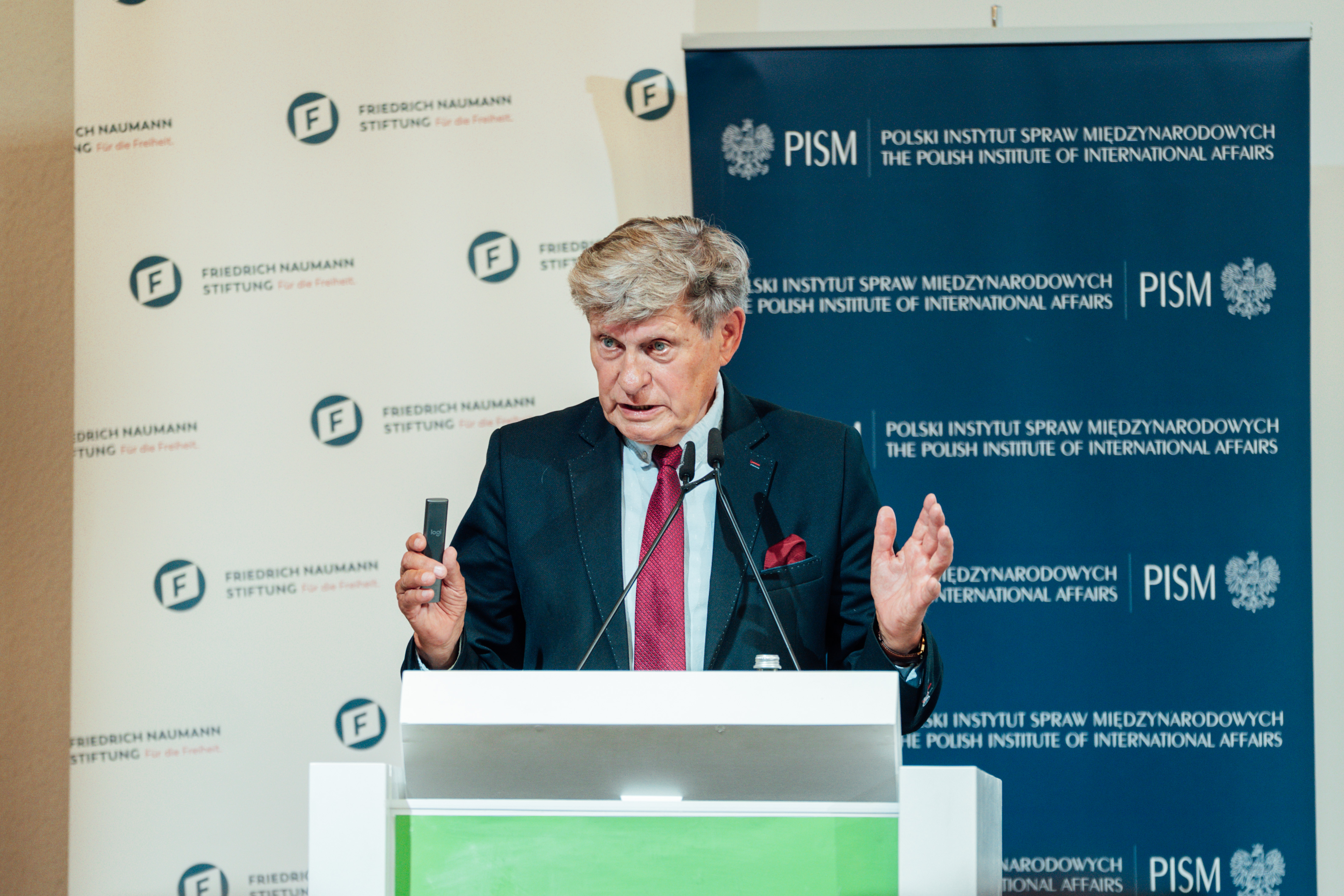
Prof. Leszek Balcerowicz also took part in the public discussion “The Polish Economic Miracle as an Example for Germany”, organised by the Friedrich Naumann Foundation for Freedom together with the Polish Institute of International Affairs (PISM) in Berlin on 7 September 2026. Following his keynote address, he discussed Poland’s reform experience and the lessons it may offer Germany with Svenja Hahn MEP, Vice-President of the FDP and President of the ALDE Party. The discussion, moderated by journalist and author Margaret Heckel, focused on market-oriented reforms, sound public finances, and the role of economic freedom, competition, deregulation and entrepreneurship in fostering growth and innovation. The event was held with the support of the BERPOL Polish-German Business Club, the Embassy of the Republic of Poland and the Polish Business Club at the Polish Embassy in Berlin.
Perhaps the most important lesson from Poland’s transformation is therefore a simple one: do not wait for a crisis to make reform unavoidable. Germany and Europe need the courage to reform while they still have the freedom to choose how.
