Trade
USMCA Review Tests German Industry’s Mexico Strategy
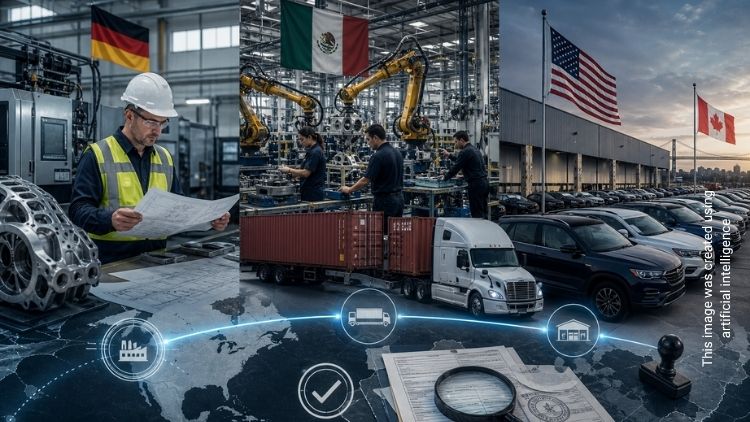
Mexico’s role as a manufacturing gateway to the United States is coming under closer examination as Washington, Mexico City and Ottawa review the United States-Mexico-Canada Agreement (USMCA).
For German industry, the stakes are significant. Companies including BMW, Volkswagen, Continental, Bosch, Schaeffler and ZF have built production and supplier networks in Mexico that connect European technology with North American value chains. The agreement’s future could determine whether those networks become a source of greater resilience—or face new compliance costs and regulatory uncertainty.
Mexico currently enjoys a major tariff advantage. In April 2026, it accounted for 16.9% of total U.S. imports and 17.9% of U.S. manufacturing imports, slightly ahead of the European Union. Its implicit tariff rate was 3.6%, compared with 8.6% for Germany and 7.4% for the EU. In transportation equipment, Mexico supplied 35.6% of U.S. imports, far exceeding Germany’s 7.2% share.
That advantage, however, is not guaranteed. The review is expected to focus on stricter rules of origin, higher regional-content requirements, labor provisions, energy policy, customs procedures, intellectual property and the role of Chinese investment in North America. For German manufacturers, tighter rules could mean replacing Asian inputs with suppliers from Mexico, the United States or Canada—and documenting that regional content in greater detail.
The report expects a prolonged review rather than an immediate rupture. The USMCA’s tariff preferences remain in force while negotiations continue, but the terms of its future renewal are uncertain. The agreement could be extended for 16 years, renegotiated, subjected to annual reviews or, in the most disruptive scenario, weakened through unilateral withdrawal.
For German companies, the message is both cautionary and strategic. Mexico remains an attractive platform for serving the U.S. market, but investment decisions will increasingly depend on local integration, traceability, labor compliance and supply-chain flexibility. The companies that adapt early may turn regulatory pressure into a competitive advantage—and secure a stronger position in North America’s next industrial realignment.