Economic and Social Benefits of German Value Chains in Mexico
This policy paper analyzes the economic and social benefits generated by German companies participating in value chains in Mexico. Covering the period from 2005 to 2025, it combines official foreign direct investment data with interviews involving German businesses and actors in the binational economic ecosystem.
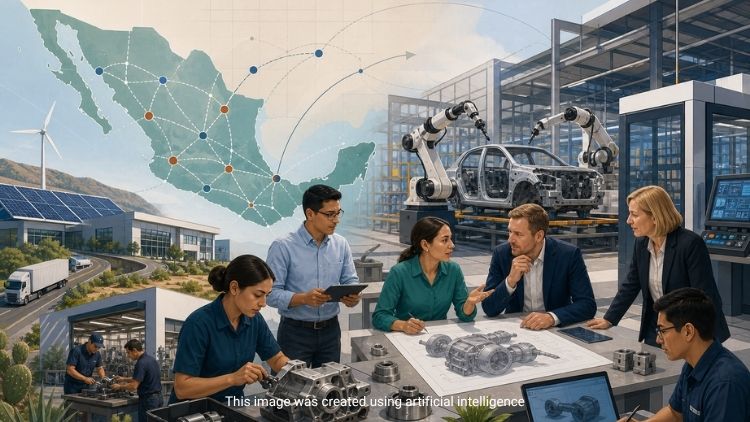
The study finds that German investment is characterized by a long-term orientation, substantial reinvestment, and close integration into global value chains. Its economic contributions include specialized formal employment, increased productivity, technology transfer, industrial sophistication, and the development of local suppliers. These effects are especially visible in the automotive, auto-parts, chemical, pharmaceutical, industrial automation, advanced manufacturing, and clean-energy sectors.
German companies also contribute to human-capital development through dual education, technical training, collaboration with academic institutions, and improved labor standards. Their environmental, social, and governance practices help disseminate higher sustainability, traceability, labor-rights, and supply-chain standards among Mexican suppliers.
However, these benefits are distributed unevenly. They remain concentrated in regions with strong industrial infrastructure, skilled workers, capable institutions, and effective public-private coordination, including Puebla, the Bajío region, and northeastern Mexico. Limited infrastructure, regulatory uncertainty, weak supplier capabilities, and insufficient institutional coordination constrain their broader impact.
The paper recommends stable public policies, stronger technical education, support for SMEs, strategic infrastructure investment, better foreign-investment monitoring, and closer cooperation among governments, companies, universities, and binational institutions. It concludes that German investment represents a strategic opportunity for more inclusive and sustainable development, provided its benefits can be expanded and distributed more equitably across Mexico.